
Need guidance on disposal of hot water heater? This concise guide covers safe removal, recycling options, and costs in NY & CT.
Disposal of hot water heater: Your 2026 Guide to Safe Removal
Getting rid of an old hot water heater isn't like tossing out a bag of trash. It’s a process that demands a bit of know-how to protect the environment, stay on the right side of local laws, and avoid some hefty fines. It all comes down to safely disconnecting and draining the tank, then picking a disposal method—like recycling or a professional pickup—that's both compliant and convenient. For most homeowners, calling in the pros is easily the safest and most efficient route.
Why You Can’t Just Dump Your Old Water Heater
That big, clunky water heater taking up space in your basement is more than just an eyesore once it's disconnected. It’s a real environmental headache, especially in areas like New York and Connecticut. Kicking it to the curb or trying to hide it in a commercial dumpster isn't just frowned upon; it's often illegal.
Taking a moment to understand the "why" behind proper disposal makes the whole process feel less like a chore and more like a responsible decision for your neighborhood.
Our Landfills Are Stuffed
Let's be blunt: our landfills are overflowing. A massive appliance like a water heater eats up a huge chunk of rapidly shrinking landfill space. This isn't some far-off problem; it puts a direct strain on local waste management and the environment right here at home.
The U.S. is facing a serious waste crisis, which makes how we dispose of old appliances more important than ever. With the country generating over 624,000 metric tons of waste every single day, experts predict we could run out of landfill space by 2036.
Now, consider this: in 2022 alone, about 4.1 million residential gas water heaters were sold in the U.S. That means millions of old units are being replaced each year, adding incredible pressure to a system that's already at its breaking point. You can learn more about the state of waste management from recent studies.
Think of your old water heater as a treasure chest of resources. It’s packed with steel, copper, and other valuable metals. When it gets buried in a landfill, all that material is gone for good. That forces manufacturers to mine for new ore—a process that scars the landscape and burns a ton of energy.
Staying Clear of Fines and Local Headaches
Beyond the environmental angle, there’s a much more immediate reason to handle disposal correctly: local regulations. Towns and cities across New York and Connecticut have very specific rules for getting rid of bulky appliances.
These ordinances are there for good reason:
- To stop illegal dumping. An abandoned water heater is an ugly blight on the neighborhood and can quickly become a safety risk.
- To keep sanitation workers safe. These things are incredibly heavy and awkward. Improperly placed tanks are a recipe for serious injuries.
- To manage potentially hazardous materials. While most modern tanks are straightforward, some older models might have components that need special handling.
Ignoring these rules can land you with citations and fines. By opting for a responsible disposal route, like bringing in a professional service such as D&B Complete Home Services INC., you're not just doing the right thing for your community—you're saving yourself a potential legal and financial headache.
How to Safely Get Your Old Water Heater Ready for Removal
Before you can haul that old tank away, you've got to disconnect it and get it ready to move. This is where you need to be extremely careful. An old water heater isn't just a heavy beast; it’s a tangle of power, water, and sometimes gas lines. One wrong move here can cause a ton of damage to your home or, even worse, get someone seriously hurt.
Trying to rush this job is the quickest way to end up with a huge, expensive mess. It’s all about taking a slow, methodical approach and ticking off every safety box.
Shut Down the Power and Water First
Your absolute first move is to cut off the heater's power source. How you do this depends on what kind of unit you have.
- Electric Heaters: Head to your home's electrical panel and find the circuit breaker for the water heater. It's almost always a double-pole breaker (the one with two switches tied together) and should be labeled. Flip it to the "OFF" position. Don't just trust the label, though. Get a voltage tester and double-check the wires connected to the heater to make sure there is no live current.
- Gas Heaters: Look for the gas shut-off valve on the pipe leading into the heater. When it's open, the handle runs parallel with the pipe. Give it a quarter-turn so it's perpendicular to the pipe to shut it off. It's also a good idea to turn the control knob on the heater unit itself to "OFF".
Once you've secured the power or gas, it's time to shut off the water. You should see a valve on the cold water inlet pipe, usually right on top of the tank. Turn the handle clockwise all the way until it stops.
Drain Every Last Drop From the Tank
Now for the step that keeps your basement from becoming a swimming pool: draining the tank. Your average 40- or 50-gallon water heater is holding over 400 pounds of water. Trust me, you're not moving it an inch until it's completely empty.
A Quick Tip from Experience: Never, ever try to drain a water heater when the water is still hot. That's a serious scalding hazard. Shut the heater down and give it several hours—or even let it sit overnight—so the water can cool to a safe temperature before you start.
Grab a standard garden hose and connect it to the drain valve near the bottom of the tank. Run the other end of the hose to a floor drain, a utility sink, or outside to a spot where all that water can drain away without causing problems.
With the hose connected, go open a hot water tap on a faucet somewhere else in the house. This lets air into the tank, breaking the vacuum seal and allowing the water to flow out nice and steady. Finally, open the drain valve on the heater. You'll hear the water start to move. This can take a while—anywhere from 20 minutes to over an hour, depending on how big your tank is.
The following flowchart shows what happens when old appliances aren't handled properly, putting a real strain on our local waste systems.
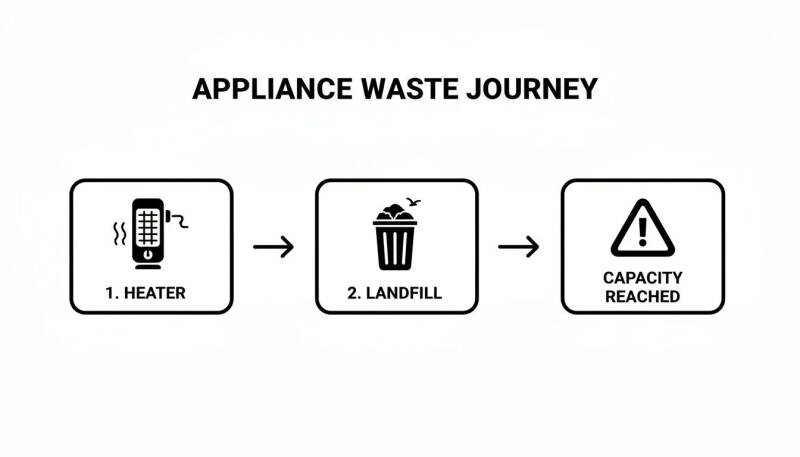
This really brings home how taking the easy way out directly contributes to our growing landfill crisis.
Look, this whole process can be a lot to handle. If you're feeling the least bit hesitant about dealing with gas lines or electrical circuits, that's your cue to stop and call in a professional. You can see how our teams at D&B Complete Home Services INC. manage these kinds of complex jobs by checking out our before-and-after project gallery.
Exploring Your Water Heater Disposal Options
So, you’ve successfully wrestled with the power, water, and gas lines. Your old water heater is finally disconnected and sits there, a hefty reminder of a job well done. The hard part is over, right? Well, almost. The final challenge is figuring out how to get this bulky appliance out of your house for good.
You've got a few different routes you can take, and each one comes with its own trade-offs in cost, convenience, and environmental impact.
Let's walk through the most common paths so you can decide what makes sense for your situation.
Do-It-Yourself Disposal Routes
If you're determined to see the job through yourself, you have a couple of solid options. The most direct method is hauling it to a local landfill or transfer station. This puts you in complete control, but it's not without its challenges. You'll need a truck or a large SUV, tie-down straps, and the muscle to safely load and unload it.
Be prepared for a "tipping fee" at the facility, which is usually based on weight. For a single large appliance, this can set you back anywhere from $25 to over $100.
A much more eco-friendly choice is taking it to a scrap metal recycler. The steel, copper, and other metals will be recovered and repurposed, which is a huge win for the environment. You might even walk away with a few dollars—maybe $10 to $20—but the real payoff is knowing the materials aren't going to waste.
Relying on Municipal or Retail Services
Your town or city might offer a curbside bulk pickup service. This can be incredibly convenient, but the rules and availability vary from one place to the next. You often have to schedule the pickup weeks in advance, and there might be a fee. Your best bet is to check your local sanitation department's website for the specifics.
Another route is to lean on the retailer where you bought your new unit. Many big-box stores offer a haul-away service when they deliver your new water heater. This service usually costs between $50 and $150, but it neatly bundles the problem into a single transaction.
The biggest catch with most of these options is the heavy lifting. You're still the one who has to get that awkward, 100-plus-pound tank from your basement to the curb or into a truck. This is where strained backs and damaged doorways often happen.
Comparing Hot Water Heater Disposal Methods
Deciding on the best path really comes down to your budget, how much time you have, and the amount of work you're willing to put in. To make it easier, I've put together a quick comparison of the most common methods for getting rid of an old water heater. This should help you weigh the pros and cons at a glance.
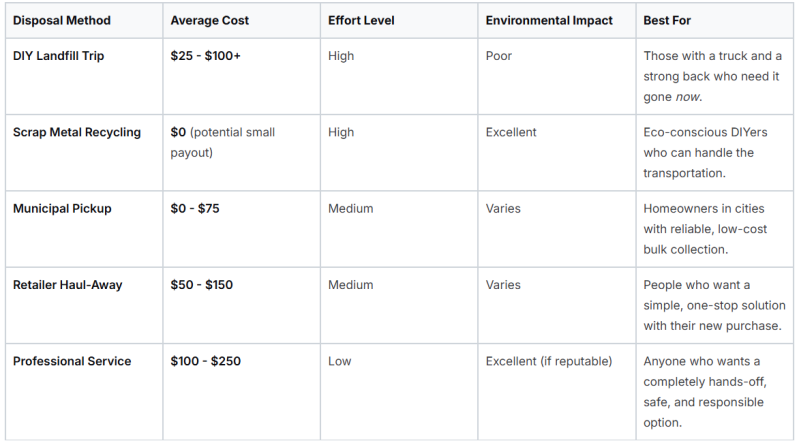
As you can see, a professional junk removal service like D&B Complete Home Services INC. often strikes the best balance. While it might seem like the most expensive choice initially, it completely eliminates the physical labor, transportation headaches, and guesswork. For more insights on dealing with big items, check out our guide on efficient junk removal strategies. It’s often the smartest move for a seamless and safe disposal experience.
The Eco-Friendly Choice: Recycling Your Water Heater
When your old water heater finally gives up the ghost, you're faced with a big decision: what to do with the old tank? By far, the most responsible choice is recycling. This isn't just about feeling good; it has a real, measurable impact on the environment and helps conserve our natural resources.
Choosing to recycle means all that valuable metal inside gets a new lease on life instead of just taking up space in a landfill for centuries.
Unlocking the Value Within
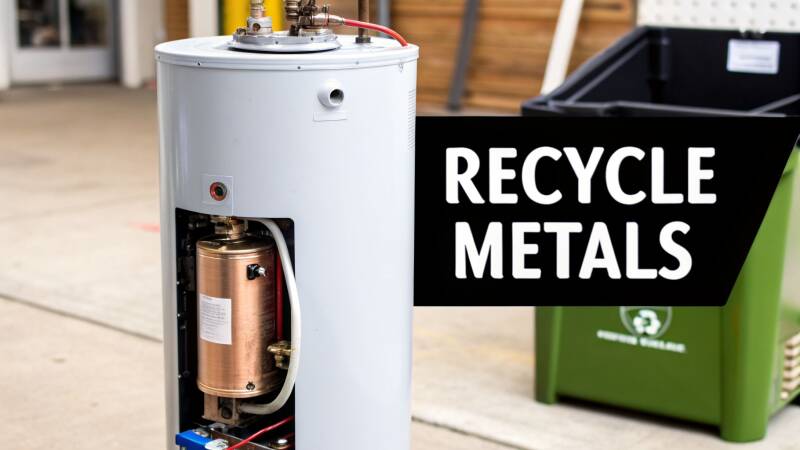
Think of an old water heater as a treasure chest of raw materials. It's essentially a large steel tank, but it also contains other valuable metals like copper and brass. These materials are always in demand for manufacturing, and recycling them is far more efficient than mining for new ore.
When you take your unit to a scrap yard or recycler, they're looking to recover:
- Steel: The main body of the tank is prime steel, which can be melted down and repurposed endlessly without losing strength.
- Copper: Highly prized for its conductivity, copper is found in the heating elements and internal wiring.
- Brass: Look at the valves and fittings—that’s usually brass, another non-ferrous metal that fetches a good price at the scrap yard.
By recycling, you’re directly reducing the need for destructive mining operations. That means less energy used, less pollution created, and more natural habitats preserved. The numbers don't lie. According to the EPA, in 2018 alone, roughly 3.1 million tons of ferrous metals were recovered just from shredded appliances. That’s a lot of material kept in circulation. You can learn more about the importance of appliance recycling on Junk-King.com.
The Rules for Modern Heaters
Now, if you're replacing a newer, high-efficiency model like a hybrid or heat pump water heater, the rules change a bit. These units are fantastic for saving energy, but they require special handling at the end of their life. They contain refrigerants and complex electronics that can't just be tossed in with regular scrap metal.
Critical Safety Warning: Refrigerants are powerful greenhouse gases. If they escape into the atmosphere during disposal, they cause serious environmental harm. Federal and state laws require these substances to be professionally recovered by a certified technician before the unit can be recycled.
This is not a DIY job. Trying to dismantle a heat pump water heater on your own is not only dangerous but also illegal. You need a licensed professional, like the team at D&B Complete Home Services INC., who has the proper certification and equipment to safely reclaim these hazardous materials and ensure your old unit is disposed of in full compliance with the law.
When to Hire a Professional Junk Removal Service
While the DIY spirit is something to be admired, getting rid of an old hot water heater is one of those jobs where calling in a pro is almost always the smartest move. This isn't just about saving yourself a hassle; it's about sidestepping property damage, personal injury, and the sheer logistical headache of wrestling a heavy, awkward hunk of metal out of your home.
Sometimes, the situation itself makes the decision for you. Is that old tank wedged into a cramped basement corner at the bottom of a narrow flight of stairs? Or maybe it's shoved into a tiny utility closet with absolutely no room to pivot. These are the classic scenarios where trying to muscle it out on your own is a surefire recipe for scraped walls, dented door frames, or worse, a trip to the chiropractor.
Weighing the True Costs of DIY vs Professional Help
When you really break down the numbers, you start to see why professional junk removal is the go-to choice. The average starting cost for a professional pickup is around $105, which is surprisingly reasonable once you factor in the alternatives. Even an empty residential water heater can weigh between 40 and 100 pounds. You'll need a heavy-duty dolly and a vehicle big enough to haul it away safely. You can learn more about the logistical costs of appliance removal on goloadup.com.
Thinking about doing it yourself? The hidden costs can sneak up on you fast.
- Truck Rental: Don't have a pickup? You’ll need to rent one, and that meter is running.
- Disposal Fees: Your local landfill or transfer station isn't free. Tipping fees can be unpredictable and add up.
- Your Time: This isn't a quick job. It can easily consume a whole afternoon that you could be spending on something else.
- Risk of Injury: A single medical bill from a strained back will cost far more than paying a professional service to handle it from the start.
For property managers and real estate agents, the math is even simpler. Time is money. A professional service ensures the job is done right, done quickly, and comes with proper documentation. That insured, reliable removal protects your investment and your clients.
Scenarios Demanding a Professional Touch
Beyond the pure hassle of it all, some situations practically scream for a professional. If you're up against a tight deadline for a property closing or a tenant move-in, you simply don't have time for delays or complications. A professional service operates on your schedule, guaranteeing that old unit is gone exactly when you need it to be.
This is especially critical for real estate agents who need a property to be spotless and show-ready. There's no room for clutter or lingering safety hazards. A pro junk removal company provides a clean, documented disposal, which is essential for maintaining the property's value and staying compliant with local rules.
When you just need a fast, reliable solution, looking into professional junk removal services is the most direct path to getting the job done right.
A Few Lingering Questions on Water Heater Disposal
Even after you've got a plan, a few questions always seem to come up when you're staring down that old water heater. Let's tackle some of the most common ones so you can wrap up this project with confidence.
What’s the Real Cost to Have Someone Haul It Away?
This is usually the first thing people ask, and for good reason. For a professional to come out and handle the entire disposal process, you can generally expect to pay somewhere between $100 and $250. That price typically covers the labor, the truck, and any fees at the recycling center or landfill.
Don't forget that "doing it yourself" isn't exactly free, either. You could be looking at landfill "tipping fees" that run anywhere from $25 to $100, plus the hassle and cost of renting a suitable truck. When you factor in your time and the risk of dinging up your walls trying to move it, that professional fee often looks like a pretty good deal.
Can I Just Drag My Old Water Heater to the Curb?
I wish it were that simple, but in almost every case, the answer is a hard no. Most city or county sanitation services have specific rules that prevent you from leaving large appliances like water heaters with your regular trash. You could easily end up with a fine for illegal dumping.
A few communities might have special bulk pickup days, but you'll have to check your local regulations to be sure. And even if they do, you're still the one who has to wrestle that heavy beast out of your basement and down to the street.
Is Getting Rid of a Tankless Water Heater Any Different?
It sure is. Tankless water heaters are a breeze to move around since they're so much smaller and lighter than the old tank-style units. But the disposal process is a bit more complicated. They're packed with electronics—circuit boards, sensors, and wiring—along with the usual copper and other metals.
Because of all that circuitry, many municipalities classify tankless units as e-waste. This is a critical distinction. It means they can't just go to a normal scrap yard; they need to be dropped off at a facility that specializes in recycling electronics. A pro will know exactly where to take it.
Is It Actually Worth Scrapping a Water Heater for Cash?
The short answer? Probably not. It's true that water heaters contain scrap metal, primarily steel with a bit of copper, but the actual payout is pretty minimal. After you've gone through the trouble of hauling a 100+ pound tank to a scrap yard, you'll likely only get about $10 to $20 for it.
For most people, that small amount of cash just isn't worth the time and back-breaking effort. While recycling is always the right move for the environment, letting a professional service manage the logistics is often the most practical choice.
When you just want the old tank gone without any of the hassle, turn to the experts at D&B Complete Home Services INC. We’ll handle the heavy lifting, transportation, and proper recycling, so you don’t have to think twice about it. Visit us online to schedule your pickup at https://www.dbcompletehomeservices.com.
Add comment
Comments