Discover how to pick eco friendly junk removal companies with confidence. Learn essential questions and how to verify green claims.
Guide to eco friendly junk removal companies: What to ask and verify
When you hear "eco-friendly junk removal," what does that actually mean? It’s more than just a buzzword. It's a commitment to keeping as much of your stuff out of the landfill as humanly possible.
These companies operate on a simple but powerful principle: responsible disposal. Instead of making a beeline for the dump, their crews meticulously sort through everything they haul away, looking for any item with a second life—whether that’s through donation, recycling, or repurposing.
What Makes a Junk Removal Company Truly Eco-Friendly?
Let's cut through the marketing fluff. A genuinely eco-friendly junk removal company isn't just about having a green logo on the side of a truck. Their entire business model is built around a "disposal hierarchy"—a specific, non-negotiable order of operations for every single item they collect.
First up is donation. This is always the top priority. Any furniture, appliance, or household good that's still in decent shape gets a new lease on life. It's dropped off at local charities and non-profits, helping support the community directly while keeping perfectly good items in circulation.
Next on the list is recycling. Once the donatable items are set aside, the real sorting begins. The crew separates everything by material—wood, metal, different types of plastic, paper, and especially e-waste—and sends each to the right processing facility. This step is crucial for conserving natural resources and cutting down on the energy needed to create new products from scratch.
Only after every opportunity for donation and recycling has been exhausted does the leftover, absolute-minimum amount of junk head to the landfill. This commitment is what separates the true green haulers from the standard outfits that take the easy (and cheap) route straight to the dump.
Before we dig deeper, let's quickly compare what to look for versus what to avoid.
Eco-Friendly Practices at a Glance
This table breaks down the core differences between a truly sustainable junk removal service and a standard hauler. It's a handy cheat sheet to keep in mind when you're vetting potential companies.
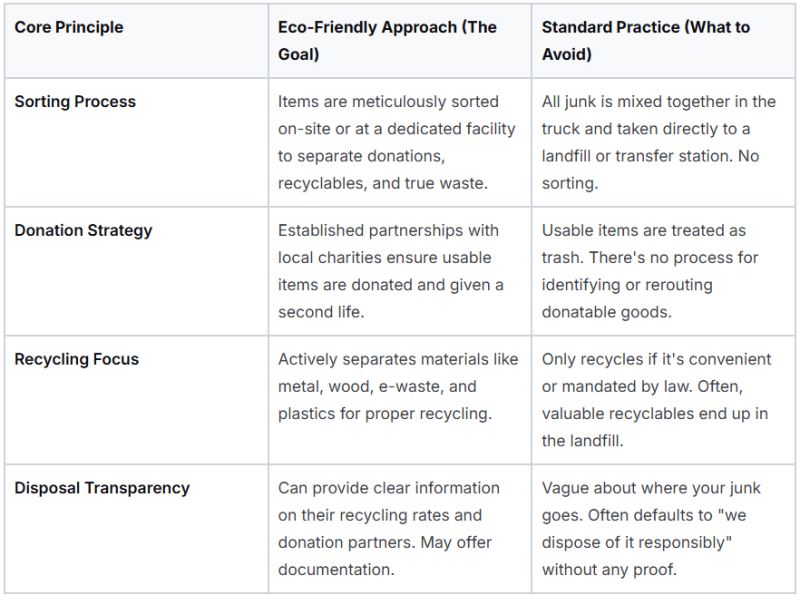
Understanding these distinctions is the key to making a choice that truly benefits the environment, not just one that sounds good on paper.
The Growing Demand for Sustainable Disposal
This shift toward responsible disposal isn't just some niche trend; it's a massive movement reshaping the industry. The global junk removal franchise market is projected to explode from USD 2.41 billion in 2025 to USD 6.12 billion by 2034.
What's driving this? You are. As of 2023, more than 58% of consumers in urban areas said they actively prefer eco-friendly recycling services. People are demanding more from the companies they hire, and for good reason. You can dive into more of these stats in this detailed junk removal franchise report.
Choosing a hauler with a strong disposal hierarchy has a real ripple effect.
- Reduced Landfill Strain: Our landfills are under immense pressure. Diverting even a single truckload of bulky items makes a tangible difference.
- Support for Local Communities: Your old sofa or desk can become a critical resource for a family in need through local donation centers.
- Conservation of Resources: When we recycle materials like metal, wood, and plastic, we reduce the need to mine, log, and drill for new ones—activities that often cause significant environmental harm.
The real measure of an eco-friendly service isn’t what they claim on their website, but what they do when the truck is full. Their commitment to sorting, donating, and recycling is the true indicator of their environmental impact.
The Right Questions to Ask Before You Hire
Once you’ve got a shortlist of companies, it’s time to do more than just compare prices. You need to dig a little deeper. Asking the right questions is the fastest way to tell which companies are genuinely committed to eco-friendly practices and which are just using "green" as a marketing gimmick.
Vague, slippery answers are a huge red flag. You're looking for concrete details and specific processes that show they have a real system in place for responsible disposal.
Don't just ask, "Are you eco-friendly?" Of course, they'll say yes. The trick is to ask questions that force them to prove it.
A truly green junk removal company operates on a clear disposal hierarchy, where the landfill is always the last possible option.
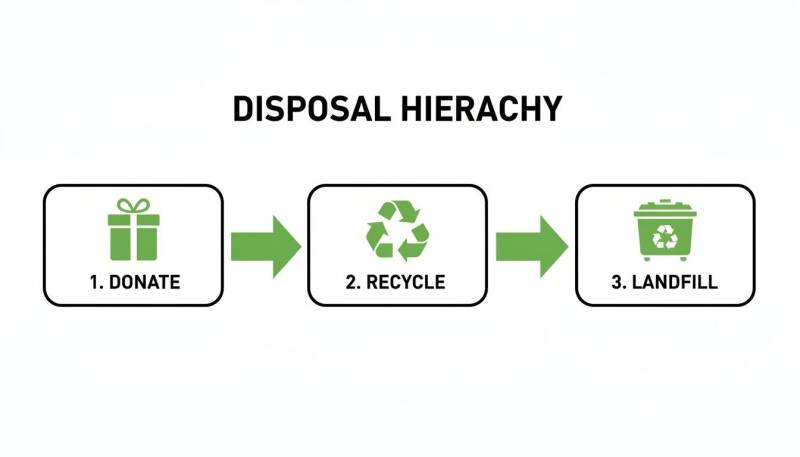
As you can see, the goal is to exhaust all donation and recycling avenues first. This is the model you want your chosen company to follow.
Questions About Donations and Recycling
Let's start at the top of that hierarchy. The strength of a company's community partnerships is one of the best indicators of its legitimacy.
Here's what to ask:
- "Which specific local charities do you partner with for donations?"
A reputable company won't miss a beat. They'll name local spots like Habitat for Humanity ReStore, Goodwill, or even smaller community shelters and thrift stores. If they get shifty and just say "various charities," ask for a couple of names. - "What is your landfill diversion rate?"
This is a key metric. It's the percentage of stuff they successfully keep out of the dump. While it can vary, a company that takes this seriously should be able to give you a confident estimate—often in the 60-70% range—and briefly explain how they track it. - "Can you walk me through your sorting process for a mixed load?"
Find out what happens after they drive away with your stuff. A solid answer will involve them taking the load back to their own facility or a transfer station to manually sort items—separating metals, wood, plastics, and electronics for different specialized recycling streams.
Verifying Their Process for Tricky Items
How a company deals with the difficult stuff really shows their expertise and commitment. Tossing items like electronics or appliances into a landfill can cause serious environmental damage.
Zero in on e-waste, for example.
A great response sounds like this: "We work directly with a certified e-waste recycler to make sure all electronics are properly dismantled and processed. We never landfill them because of the hazardous materials they contain."
A bad answer? Anything vague like, "Oh yeah, we take care of it." That's not good enough.
Push for details on other challenging items, too:
- Appliances: How do they handle refrigerators or AC units? Do they have a certified process for safely removing the Freon before scrapping the metal?
- Construction Debris: Ask where they take materials like concrete, wood, and drywall. The right answer involves facilities that specialize in recycling construction and demolition (C&D) waste.
- Mattresses: These are a real headache to recycle. Do they actually have a partnership with a mattress recycling facility, or are they just trucking it to the dump?
By arming yourself with these specific questions, you shift from being a passive customer to an informed one. You'll be able to quickly spot the company whose actions actually match their promises, ensuring your cleanout project does some good for your community and the planet.
How to Spot Real Commitment vs. Greenwashing
So you've asked the right questions, and a company has given you all the right answers. That's a great start, but talk is cheap. Now it's time to verify those claims and see if their actions actually match their marketing.
This is where you'll learn to separate the truly eco friendly junk removal companies from the ones just "greenwashing"—slapping on a leafy logo and using buzzwords without any real substance behind them.
You can actually start this detective work without even making a call. If a company boasts about its partnerships with local charities, do a little digging yourself. Pop over to the websites of well-known local spots like a Habitat for Humanity ReStore or Goodwill. Look for a "community partners" or "corporate donors" page.
If the junk removal service is a legitimate, regular contributor, you'll often see their name listed right there. Finding it is a fantastic piece of third-party validation. If you don't see it, it's not an automatic deal-breaker, but its presence is a huge green flag.
Digging Deeper for Proof
Beyond a quick online search, don't be shy about asking the company for direct proof of their disposal methods. They obviously can't give you a receipt for every single item they haul, but they should have some documentation to back up their claims.
Here are a few things that are perfectly reasonable to ask for:
- Redacted Disposal Receipts: Can they show you a redacted weigh ticket or receipt from a certified recycling facility? Or from a specialized C&D (construction and demolition) waste processor? This proves materials are actually going where they're supposed to.
- Donation Acknowledgements: Ask if they have any thank-you letters or formal acknowledgements from the charities they work with. Any established partner would have this kind of paperwork.
- Customer Testimonials: Spend a few minutes scrolling through their reviews on Google or Yelp. Look for specific feedback. Do past customers mention how the crew carefully sorted items for donation, or express relief that their old furniture went to a good cause?
A company that's genuinely proud of its eco-friendly process will be transparent and happy to share this kind of information. If you get hesitation, vague answers, or a run-around, that’s a serious red flag.
The Power of Consumer Demand
Your diligence is more powerful than you might think. You're part of a massive shift in consumer awareness that's forcing service industries to adapt. A Nielsen survey, for example, found that a staggering 73% of global consumers would change their habits to reduce their environmental impact. This is exactly what’s pushing for better practices. You can see just how much this is changing the game by looking at the latest consumer junk removal trends.
By asking for proof, you’re doing more than just your own homework. You're sending a clear message to the entire industry that transparency and legitimate eco-friendly practices are what customers demand. It holds companies accountable and raises the bar for everyone.
Ultimately, this is all about building confidence. You want to be certain that the company you hire is a true partner in responsible disposal, not just someone who painted their truck green. Taking these extra steps ensures your unwanted stuff does some good in the community and for the planet, instead of just ending up in another landfill.
Making Sense of Pricing and Service Logistics
So, how do a company's green promises translate into what you actually pay and how smoothly the job gets done? It’s a common myth that going with an eco-friendly junk removal company will automatically cost you more. In my experience, it's often the opposite—their smarter approach can mean better value than you'd get from a crew that just makes a beeline for the landfill.
Think about it this way: companies that take the time to donate and recycle can actually lower their own costs. Scrap metal can be sold, and taking smaller, pre-sorted loads to the dump is far cheaper than offloading a massive, mixed truck. Those savings can get passed right on to you, making them surprisingly competitive.
How Junk Removal Companies Charge
When you start getting quotes, you'll see a few common ways companies break down their pricing. Knowing what to expect helps you avoid any last-minute surprises on the invoice.
- By Volume: This is the industry standard. Your price is based on how much of the truck your stuff fills up—think a quarter load, half load, or a full truck.
- By Item: Got just one or two big things, like an old fridge or a worn-out mattress? Many companies offer a simple flat fee for single-item pickups. It’s perfect for small, quick jobs.
- Hourly Labor: For bigger projects that need a lot of on-site work—like dismantling a swing set or clearing out a hoarder situation—some services might charge by the hour on top of their disposal fees.
My biggest piece of advice: Always, always ask for an all-inclusive quote. A reputable company will spell out all the costs for labor, transport, and disposal fees from the get-go. A fuzzy estimate is a major red flag.
Logistics Are Just as Important as Price
Beyond the quote, the practical side of the service is what really makes for a stress-free experience. A company that really knows your local area is worth its weight in gold. They'll know exactly which recycling center is best for electronics and which local charities are desperately in need of furniture donations. That local expertise makes the whole process faster and way more efficient.
You also need to think about scheduling. Do they give you a clear two-hour arrival window, or are you stuck waiting at home all day? A lot of the best services now offer same-day or next-day appointments, which is a lifesaver when you need something gone now.
When you're comparing your options for junk removal services, make sure to ask how they can fit into your timeline. The sweet spot is finding a company that offers fair pricing, deep local knowledge, and scheduling that actually works for you. That's the sign of a true professional.
Responsibly Handling Specialized Junk Items
Let's be honest, not all junk is created equal. An old armchair or a stack of cardboard boxes? That's the easy stuff. But what about the items that require more than just a strong back to haul away?
These are the things that really test a company's commitment to being eco-friendly. It's one thing to say you recycle; it's another to have the right processes for items that can do real harm if handled improperly. This is where you separate the pros from the "chuck-it-in-a-truck" outfits.
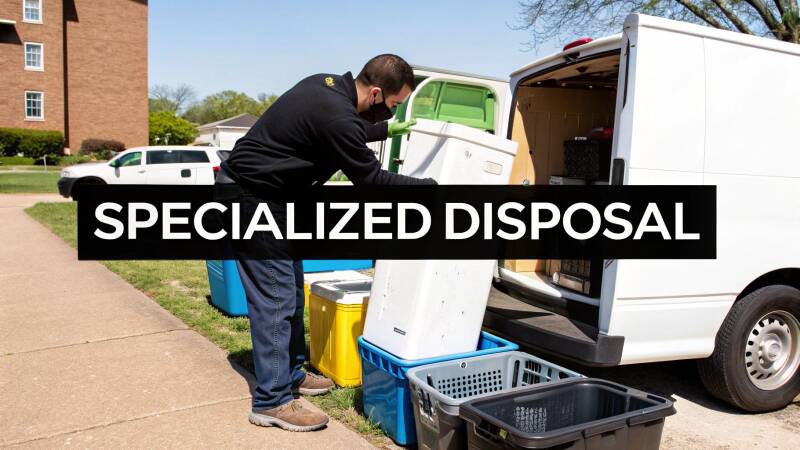
I'm talking about things like old electronics (e-waste), refrigerators, mattresses, and leftover construction debris. Each of these poses a unique environmental puzzle. If they're just tossed into a landfill, we risk leaking hazardous materials directly into our soil and water.
Why Certain Items Need an Expert
So, what makes these items so tricky? A truly knowledgeable junk removal team knows the ins and outs and, more importantly, has the right partnerships to dispose of them correctly.
- E-Waste (Electronics): Your old computer, that dusty TV in the basement, even old cell phones—they're all packed with toxic stuff like lead, mercury, and cadmium. If these end up in a landfill, they can eventually seep into the groundwater. Not good.
- Appliances: That old fridge or AC unit contains refrigerants (think Freon), a nasty greenhouse gas. A certified technician has to safely capture this gas before the appliance's metal can be scrapped and recycled.
- Mattresses: These are a nightmare for landfills. They're big, they don't crush down, and the springs can get tangled in and damage expensive landfill machinery. Specialized facilities are needed to tear them down and separate the foam, fabric, and steel for recycling.
- Construction Debris: You can't just dump a mix of wood, concrete, drywall, and scrap metal. Responsible haulers take this to a dedicated Construction and Demolition (C&D) facility where everything gets sorted for reuse or recycling.
This level of detail is critical. For instance, there's a specific process for getting rid of an old lawnmower because it probably has leftover gas and oil. If you're curious, this guide explains how to dispose of old lawn equipment the right way.
The Business of Responsible Disposal
As more people care about where their junk ends up, the demand for these specialized services is booming. We're not just talking about a niche market anymore.
Electronic waste removal alone was valued at USD 2.1 billion in 2024. The market for handling construction debris is even bigger, projected to climb to USD 4.0 billion by 2035. You can read more about the growth in specialized junk removal services and see just how important this has become.
My advice? When you're talking to a potential junk removal company, ask them directly how they handle these tough items. A vague answer is a red flag. A confident, detailed explanation about their certified partners and specific facilities tells you you're dealing with a professional who takes their environmental promises seriously.
Hiring a team that knows what they're doing isn't just about feeling good. It ensures you're following local disposal laws and genuinely making a sustainable choice.
Your Go-To Eco-Friendly Removal Checklist
Alright, you've done the research. You know what makes a junk removal company genuinely eco-conscious, what questions to ask, and how to spot the real deal from the greenwashers.
Let's pull all that knowledge into a straightforward checklist you can reference right before you pick up the phone. This isn't just about hiring a hauler; it's about choosing a partner who shares your commitment to sustainability.
The Final Vetting Steps
Before you commit, take a moment to run through these last few checks. A truly green company won't just welcome these questions—they’ll have the answers ready.
- Confirm their donation partners. Have you double-checked the websites of local charities they mentioned? A quick look at a local Goodwill or Habitat for Humanity site can often confirm a corporate partnership.
- Get a clear, all-inclusive quote. Make sure the price you're given is the price you'll pay. Are there any vague terms or potential add-ons for labor, transport, or specific disposal fees?
- Ask about their e-waste plan. Did they give you a specific, confident answer about where electronics go? They should mention certified e-waste recyclers by name.
- Verify their sorting process. Do they actually sort items back at their warehouse to pull out every last recyclable or donatable item? Or do they just make a quick stop at a charity on the way to the dump?
- Scan reviews for eco-mentions. Look past the generic "they were fast and friendly" comments. Do any past customers specifically praise their responsible disposal or recycling efforts?
Taking these few extra minutes doesn't just help you clear out your clutter. It's how you make a conscious choice to support companies doing the right thing, reduce what goes into our landfills, and contribute to a healthier community. For more insights like these, feel free to explore our other junk removal tips and resources.
Got Questions? We've Got Answers
Even with the best game plan, a few questions always come up when you're trying to hire the right junk removal service. Let's tackle some of the most common ones I hear from clients to clear up any confusion and help you make your decision.
Does "Eco-Friendly" Mean "More Expensive"?
Not at all. In fact, you might be surprised to find that it often offers better overall value. While it's true there's extra labor involved in sorting materials for donation and recycling, a smart, sustainable company knows how to turn that effort into savings.
By selling scrap metal, recycling cardboard and plastics, and avoiding hefty landfill "tipping fees," they can actually lower their own operational costs.
A company that’s serious about donation and recycling has more ways to make money than just your hauling fee. These efficiencies often allow them to offer prices that are just as good, if not better, than the "haul-it-all-to-the-dump" guys.
The trick is to always get a clear, all-in quote upfront so there are no surprises.
What's a "Landfill Diversion Rate" and Why Does It Matter?
A landfill diversion rate is a simple but really telling number. It’s the percentage of everything a company picks up that they successfully keep out of the landfill—either through donation, reuse, or recycling. So, if a company has a 70% diversion rate, it means only 30% of what they haul ends up as garbage.
When you're comparing companies, asking for this rate is one of the best ways to see who's genuinely committed and who's just using "eco-friendly" as a buzzword. A truly green company will be proud to tell you their average or target rate. It’s a real, measurable sign of their environmental commitment.
Do I Have to Sort Everything Before the Crew Arrives?
Nope, that's what you're hiring them for! A huge part of the service is that the crew handles all the heavy lifting and sorting for you. They’re trained to quickly categorize items right on the spot as they load the truck.
That being said, if you have a little extra time, doing some pre-sorting can definitely speed things up. For example, you could:
- Gather all clothes and textiles into bags for donation.
- Pile any obvious, non-recyclable trash in one corner.
- Set aside electronics or anything you know needs special handling.
It’s absolutely not required, but a little prep work can make the pickup go even smoother. Just give the crew a heads-up about what you’ve already sorted when they show up.
Ready to clear your clutter the responsible way? D&B Complete Home Services INC. provides professional, eco-friendly junk removal across New York and Connecticut, ensuring your items are donated or recycled whenever possible. Get your free, transparent quote today by visiting the D&B Complete Home Services website.
Add comment
Comments