What is the true construction debris removal cost? This guide explains pricing models, key factors, and ways to save money on your next project in NY & CT.
What Is the Real Construction Debris Removal Cost?
Staring at a mountain of renovation waste can feel pretty overwhelming, but figuring out the cost to remove construction debris shouldn't be. For a smaller job in the NY and CT area, like cleaning up after a bathroom remodel, you’re probably looking at a cost between $300 and $800. For bigger projects, like a full demolition cleanup, costs often start at $1,500 or more.
Breaking Down Your Debris Removal Estimate
When a professional hauler gives you a quote, that number isn’t pulled out of thin air. It’s a careful calculation based on what it will really take to get your site cleared—factoring in labor, complexity, and the actual cost of disposal. It’s less like buying a product off the shelf and more like hiring a skilled team for a specific task.
To really nail down your budget, you have to look past the pile itself and think about what goes into hauling it away safely and responsibly. The final price tag is almost always a mix of how much stuff you have, how heavy it is, and how the hauling company structures its pricing.
Core Pricing Structures
Most reputable companies, including our team here at D&B Complete Home Services, rely on a few standard pricing models. Once you know how they work, you can compare quotes much more effectively and understand exactly what you’re paying for.
Here’s a quick rundown of the common ways debris removal is priced:
At-a-Glance Guide to Debris Removal Pricing Models
This table breaks down the most common ways companies charge for hauling construction debris. It's a great starting point for understanding the quote you'll receive.
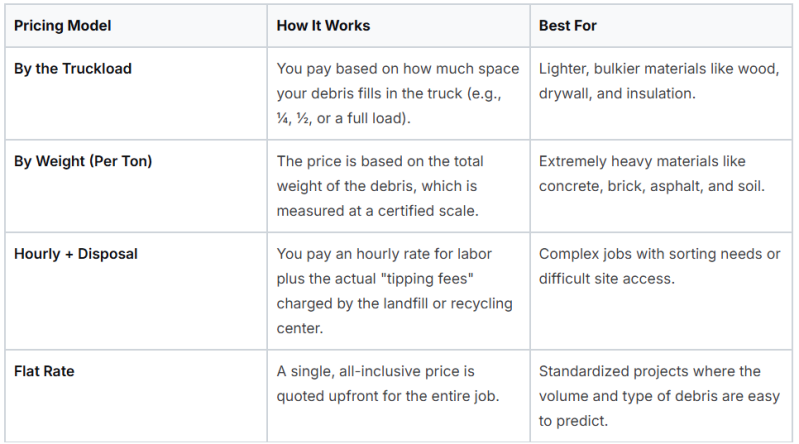
As you can see, there isn't one single "right" way to price a job. The method usually depends on the type of debris you have.
- By the Truckload: This is probably the most common approach you'll see. The price is based on volume—how much of the truck your junk takes up. It’s a simple, visual way to price jobs with lighter but bulkier items like broken-up drywall or old lumber.
- By Weight (Per Ton): When you're dealing with seriously heavy stuff like concrete, brick, or dirt, pricing by weight just makes more sense. A small, dense pile of shattered concrete can easily weigh more than a huge, fluffy pile of insulation, and disposal facilities charge by the ton.
- Combined Approaches: Let's be honest, most job sites have a mix of everything. In those cases, you’ll often get a quote that blends volume and weight to give you the most accurate and fair price possible.
The big takeaway here is that volume and weight are the two main drivers of your cost. A small pile of heavy rubble can easily end up costing more to haul than a massive pile of lightweight debris because tipping fees at the landfill are almost always based on weight.
Getting a handle on these pricing basics is the first real step in planning your cleanup budget. It lays the groundwork for understanding all the other little things—like labor, site access, and material types—that ultimately shape your final invoice.
The Four Core Pricing Models Explained
Getting a handle on your final construction debris removal cost all comes down to understanding how companies put together their quotes. It’s a bit like a restaurant—some charge by the plate, others offer an all-you-can-eat price. Debris removal is similar, with different models based on what you're tossing and how much of it you have. Knowing these four main methods will help you compare estimates like a pro and get the best bang for your buck.
This quick visual breaks down the big three factors—volume, weight, and the overall size of your project—that shape the final price tag.
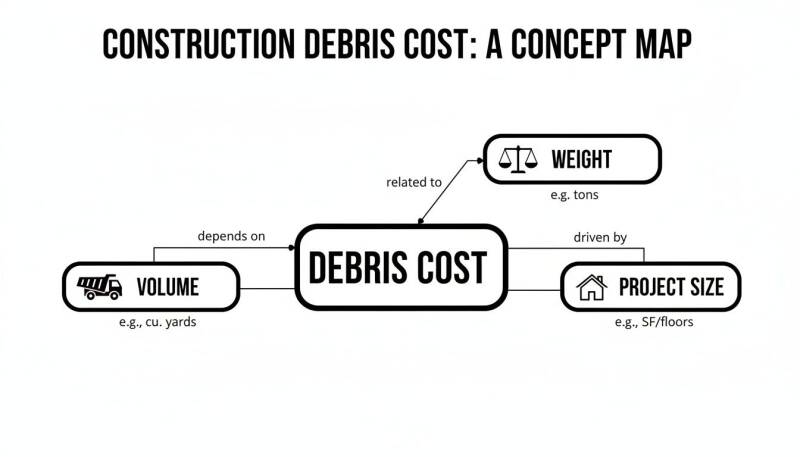
As you can see, there's no one-size-fits-all number. It's always a balance between how much space your junk takes up and how much it actually weighs.
Pricing By the Truckload or Volume
This is probably the most common and easy-to-understand pricing model you’ll run into. Just think of it like renting space in a moving truck—you’re paying for the portion of the truck your debris fills.
A company will usually give you a price based on common truckload fractions:
- A quarter truckload: Perfect for small cleanups, like the leftover drywall from a simple patch job.
- A half truckload: This often covers the mess from a standard bathroom remodel.
- A full truckload: You’re looking at this for bigger jobs, like a total kitchen demolition.
This method is ideal for materials that are bulky but not super heavy. Things like wood scraps, old insulation, broken drywall, and discarded fixtures are perfect candidates for volume-based pricing because their main cost driver is the space they hog, not their weight.
Pricing By the Cubic Yard
While it’s a lot like truckload pricing, charging by the cubic yard offers a much more precise measurement. It’s the same concept as buying mulch for your garden; you get it by the cubic yard to ensure you have exactly what you need.
A cubic yard is a standard unit of volume measuring three feet long, three feet wide, and three feet high. It allows for a more detailed and accurate quote, especially when you have an oddly shaped pile of junk where "half a truck" just feels too vague.
This approach is fantastic when you need a very specific estimate for a known amount of material. For example, if your contractor knows that demolishing a small deck will create about 4-5 cubic yards of wood and debris, they can budget far more accurately using this method.
Pricing By Weight or Per Ton
Now, when you’re dealing with seriously heavy materials, volume doesn't tell the whole story. Mass is what matters. That’s where pricing by weight, or per ton, becomes the go-to standard. Landfills and recycling centers charge disposal "tipping fees" based on weight, and hauling companies simply pass that cost structure on to you.
This model is pretty much a given for jobs involving:
- Concrete and Asphalt: Even a small pile of broken concrete can weigh a literal ton.
- Brick and Stone: Debris from an old fireplace or a torn-up walkway is incredibly dense.
- Soil and Sand: Any project that involves excavation generates heavy, compact waste.
It’s a crucial distinction. A small, dense pile of rubble can easily cost more to get rid of than a huge, lightweight pile of wood. This is exactly why a professional on-site look is so important—they can gauge the density of your debris and know right away if a weight-based model makes more sense.
Pricing By Hourly Labor Plus Disposal Fees
Sometimes, a job is more involved than just loading up a truck and driving away. That’s when an hourly pricing model enters the picture. Here, you pay for the crew's time on your property plus the actual disposal fees charged by the landfill or recycling center.
This structure is the best fit for jobs that demand a lot of hands-on work before the hauling even starts.
- Interior Demolition Cleanup: Imagine workers having to bag up debris from a second-story renovation and carry everything down piece by piece.
- Sorting Materials: A mixed pile of wood, metal, and concrete often needs to be separated for proper recycling.
- Difficult Access: If the junk is stuck in a basement, attic, or a backyard with no direct truck access, it’s going to take more time and effort.
This model gives you total transparency, since you'll see a clear breakdown of labor costs separate from the disposal charges. The sheer scale of this work is reflected in the global construction waste management market, valued somewhere between USD 204.48 billion and USD 232.1 billion in 2024. If you're curious, you can dig into more market research on construction waste trends to see how the industry is evolving.
What Actually Determines Your Final Bill
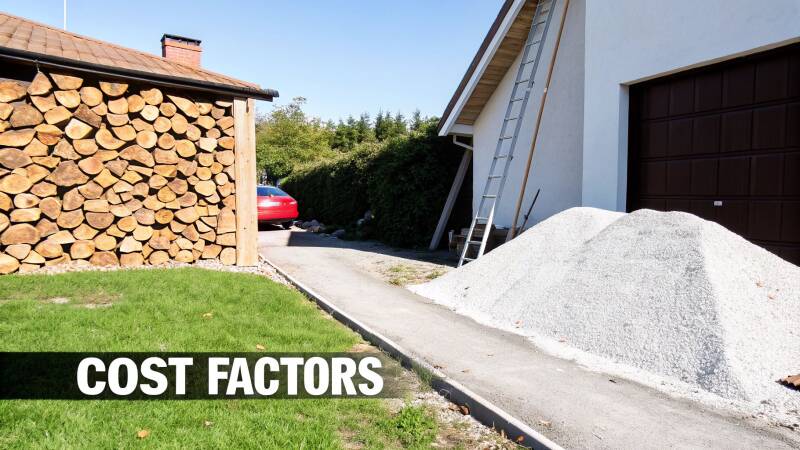
While the basic pricing models give you a good ballpark, they don't paint the full picture. A handful of other critical factors can really swing your final construction debris removal cost. Think of it like a trip to the grocery store: two shopping carts can have wildly different totals if one is full of potatoes and the other is full of prime rib. The same logic applies here—what you’re tossing, where it is, and how tough it is to get to all play a major role.
Knowing these variables ahead of time is the best way to avoid any surprises when the invoice arrives. For example, a small, dense pile of busted-up concrete can easily cost more to haul away than a much larger, lighter pile of drywall and wood scraps. That’s because the disposal facilities charge "tipping fees" based on weight, not just how much space the junk takes up.
Material Type and Weight
Hands down, the single biggest factor in your final bill is the type of debris you have. Different materials have vastly different weights and disposal rules, which directly hits the bottom line. It’s something a pro crew can size up in a second, but it’s helpful for every property owner to understand.
Here’s a quick breakdown of how materials compare:
- The Heavy Hitters: Concrete, brick, asphalt, soil, and tile are incredibly dense. We're talking serious weight. This stuff is almost always priced by the ton because even a small pile can tip the scales at thousands of pounds, driving up those disposal fees.
- The Bulky but Light: Think wood, drywall, insulation, and cardboard. These materials are bulky and take up a lot of space, but they're relatively lightweight. They’re usually priced by volume (per truckload or cubic yard) because it’s the space, not the weight, that's the main concern.
- Hazardous Materials: Things like asbestos, materials coated in lead paint, old insulation, or certain chemicals are in a league of their own. They require specialized handling and disposal by law. This means certified pros, proper containment, and transport to designated facilities—all of which adds a significant cost.
The key takeaway is simple: Density dictates dollars. A small, neat pile of an old concrete patio will almost always cost more to remove than a much larger, messier pile of lumber from a deck demolition.
Site Accessibility and Location
Where the debris is located on your property is nearly as important as what it’s made of. The easier it is for our crew to back up the truck and load everything, the less labor time is needed. That translates directly into savings for you.
Imagine two scenarios. In one, all the renovation waste is piled neatly in the driveway, right where the truck can park. Easy. In the other, the junk is scattered through a basement or a second-floor room, forcing the crew to haul everything down stairs and across the yard. That second job is going to cost more simply because of the extra labor involved.
Key things that affect accessibility include:
- Proximity to the Truck: Can the truck park right beside the pile?
- Obstacles: Are there stairs, narrow hallways, tight gates, or steep hills in the way?
- Location on Property: Is the debris tucked away in an attic, basement, or backyard with tricky access?
Each of these adds time and physical effort to the job, which is a major component of your final construction debris removal cost.
Labor and Loading Requirements
The amount of hands-on work needed to get your debris from the ground into the truck is a major cost driver. This goes beyond just carrying things; it often involves some on-site prep and sorting. If the crew has to spend time breaking down large items—like an old shed or oversized chunks of drywall—that extra labor will be factored into the price.
Similarly, if you have a mixed pile with wood, metal, concrete, and drywall all jumbled together, the crew may need to sort it. Separating materials is often required for proper recycling and can sometimes lower disposal fees, but the labor to do the sorting adds to your overall cost. This is why getting a firm, on-site estimate is the only way for a company to accurately assess all these moving parts and give you a quote you can count on.
Real-World Cost Examples for Common Projects
Pricing models are great in theory, but nothing beats seeing real numbers when you're trying to budget your construction debris removal cost. Let's walk through a few common renovation jobs we see all the time here in New York and Connecticut. These examples should give you a solid baseline for what to expect.
Every project is different, creating its own unique mix of materials, weights, and volumes. This is key to understanding why a small, heavy pile of debris can sometimes cost just as much to haul away as a larger, lighter load.
Small Bathroom Gut and Remodel
A standard bathroom demolition is probably one of our most common requests. It usually means tearing out an old toilet, vanity, flooring, a shower insert or tub, and some drywall. It might not look like a massive pile, but the materials can be deceptively heavy.
- Typical Debris: You're looking at old ceramic tile, a heavy porcelain toilet and sink, a fiberglass tub, drywall, and maybe some wood from the vanity.
- Estimated Volume: All told, this usually takes up about one-quarter to one-third of our junk removal truck.
- Cost Range: For a straightforward job like this, homeowners can typically expect to pay somewhere between $300 and $550. The final price often depends on access—is the debris piled neatly in the garage, or does it need to be carefully carried down from a second-floor bathroom?
Complete Kitchen Demolition
Tearing out an entire kitchen is a whole different ballgame. This kind of job generates a huge amount of mixed debris, from bulky but lightweight cabinets to extremely heavy countertops and old appliances. It’s this combination of sheer volume and significant weight that makes the cleanup more involved.
The sheer variety of materials is what defines a kitchen demolition. You're dealing with wood cabinets, laminate or stone countertops, old appliances, flooring, and large sections of drywall, all of which need to be handled and loaded efficiently.
This mix of light and heavy items is a perfect example of why getting an on-site estimate is the only way to get a truly accurate quote. If you want to see what a space looks like after we're done, you can check out the before and after results of our work.
Backyard Deck Removal
Taking down an old, weathered deck is another popular project that creates a lot of uniform but bulky waste. The main material is pressure-treated lumber, but you also have to account for old nails, screws, and sometimes heavy concrete footings.
- Typical Debris: It's mostly wood planks, railings, and support beams. That weight adds up fast, especially if the wood is damp.
- Estimated Volume: A medium-sized deck, say around 200 sq. ft., can easily fill half a truck or more. That translates to about 5-8 cubic yards of material.
- Cost Range: The construction debris removal cost for a deck this size usually lands between $450 and $800. If we also need to break up and haul away concrete footings, the price will lean toward the higher end because of that significant extra weight.
Basement Finishing Cleanout
When a basement gets finished or remodeled, the debris is often a little bit of everything. You'll find leftover framing lumber, scraps of drywall, rolled-up old carpeting, insulation, and all the packaging from new materials. A big factor here is always accessibility, since every single piece has to be carried up and out from below ground.
To make things even clearer, here’s a quick table that breaks down these common jobs.
Sample Project Cost Estimates in NY & CT
This table gives you a snapshot of estimated cost ranges for common renovation and demolition debris removal jobs. Remember, these are for illustrative purposes and your actual cost may vary.
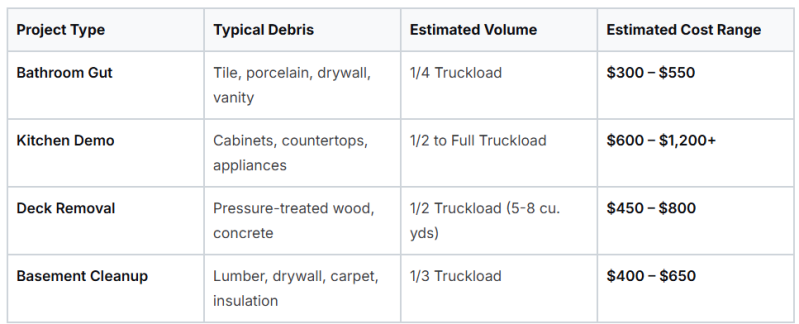
As you can see from these examples, the final price is always a blend of volume, weight, material type, and the labor involved. By keeping these scenarios in mind, you can get a much better feel for the costs associated with your own project.
Smart Ways to Lower Your Debris Removal Cost
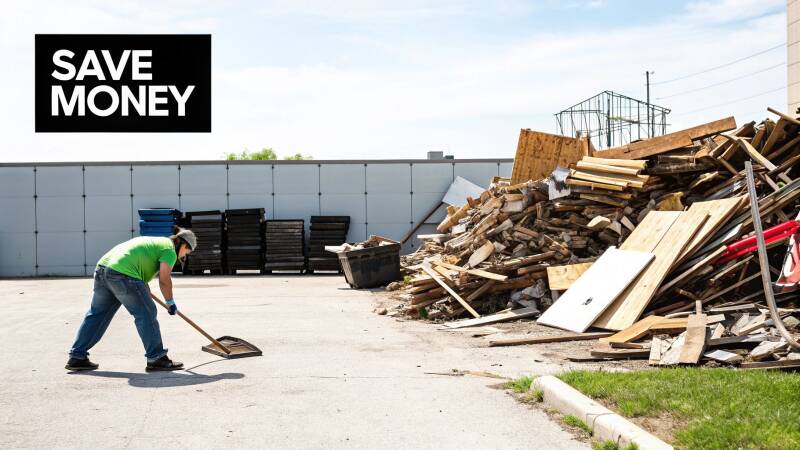
While many factors that set your final bill are fixed, you have more influence over your construction debris removal cost than you might realize. A bit of planning and a little sweat equity can make the whole process smoother and more efficient, which always translates into savings.
The basic idea is simple: the less time our crew spends on your property sorting, dismantling, and hauling debris from hard-to-reach places, the more affordable the job will be. Here are a few practical strategies to help you get the most bang for your buck.
Organize and Sort Your Debris First
One of the best things you can do to cut costs is to sort your materials before we even show up. Different types of waste come with different "tipping fees" at landfills and recycling centers. A big, messy pile of mixed wood, concrete, and metal is a hassle to process and almost always costs more to dump.
By taking the time to separate your debris into clean, distinct piles, you make the disposal process much more straightforward.
- Wood Pile: Group all your lumber, plywood, and framing scraps here.
- Masonry Pile: Keep concrete chunks, bricks, old tile, and asphalt together.
- Metal Pile: Gather up any pipes, wiring, fixtures, and other metal items.
This simple step can often result in lower disposal fees because sorted materials are much easier to direct toward recycling.
Sorting isn't just about saving money—it's about responsible disposal. When you separate materials, you make it easier for us to divert items away from landfills and toward recycling facilities, which is a win for both your wallet and the environment.
Consolidate Everything in One Place
How easy it is to get to your debris plays a huge role in labor costs. If you have junk scattered across a basement, the backyard, and a second-floor bedroom, our crew has to spend valuable time and energy just gathering it all. That extra labor will show up on your final invoice.
You can sidestep this completely by consolidating all your construction debris into a single, accessible location. The best spot is usually your driveway or front yard—anywhere our truck can pull right up. This lets our team work quickly, minimizing their on-site time and, in turn, lowering your labor charge. Making the job easier for the crew is a direct path to reducing your construction debris removal cost.
Break Down Bulky Items
Volume is a major pricing factor, especially with lighter materials like drywall, insulation, and lumber. Big, awkward pieces can take up a surprising amount of space in a truck, often leaving a lot of wasted air. You can easily shrink the total volume by breaking down bulky materials before we arrive.
For example, spending just a few minutes flattening cardboard boxes or breaking down large sheets of drywall or old shelving can make a huge difference. This simple prep work can compact your pile significantly, sometimes even enough to fit it into a smaller, cheaper truckload category. For more smart strategies, check out our complete guide with more helpful junk removal tips and resources.
This focus on efficiency and recycling is at the heart of how we operate. It's also part of a larger industry trend. The market for non-hazardous construction waste is enormous, projected to reach USD 186.4 billion in 2024, with a growing emphasis on recycling these valuable materials. You can read more about it in this construction waste market analysis.
Choosing the Right Partner for Your Cleanup
Knowing what drives your construction debris removal cost is one thing, but picking the right company to handle the job is what truly makes or breaks the experience. A great partner does more than just haul away junk—they communicate clearly, offer transparent pricing, and deliver reliable service every step of the way.
It all comes down to professionalism. You want a team that respects your property, works efficiently, and handles every last piece of debris with care. The right company can turn a messy, stressful cleanup into a simple, seamless process.
Our Straightforward Cleanup Process
We've designed our entire service to make your life easier. No more vague phone estimates or confusing pricing games. Our mission is to give you a firm, fair price and then get the job done right, without any last-minute surprises.
Here’s how our simple, clear-cut process works:
- Schedule a Free, On-Site Visit: We find a time that works for you and come out to see the debris in person. This is the only way to give you a truly accurate, no-obligation quote based on the actual amount of material, its weight, and how easy it is to access.
- Get a Firm, All-Inclusive Price: After assessing the job, we'll give you a single, upfront price. That number covers all labor, hauling, and disposal fees. What we quote is what you pay. Period.
- We Handle Everything: Once you give us the green light, our professional, uniformed team gets to work immediately. We do all the heavy lifting, loading, and sweeping up, so you don’t have to lift a finger.
Why Choose D&B Complete Home Services
We’re not just another hauling service; we’re a complete property solution for homeowners, contractors, and real estate agents throughout New York and Connecticut. Our deep knowledge of the local disposal facilities across Westchester, Putnam, Dutchess, and Fairfield counties helps us work efficiently and keep costs down for you.
Choosing a partner for your cleanup is about trust. You need to know the team on your property is fully insured, experienced, and committed to leaving your space better than they found it.
We also put a huge emphasis on eco-friendly disposal. We take the time to sort materials, pulling out everything that can be recycled or donated to keep as much waste as possible out of our local landfills.
Better yet, our skills don't stop at removal. We offer a whole range of solutions to get your property ready for whatever comes next. You can explore the full scope of our services for demolition, repairs, and remodeling. Think of us as your one-stop partner, dedicated to delivering professional results and giving you total peace of mind.
Still Have Questions About Debris Removal Costs?
Even after breaking down the pricing, you probably have a few practical questions running through your mind. That’s completely normal. To make sure you're confident about the process, we've put together answers to the questions we hear most often about construction debris removal costs.
Think of it as a final run-through to clear up any loose ends before we get to work.
What Kind of Construction Debris Can You Take?
This is a really important question, because not all debris is the same. We're set up to handle just about any non-hazardous material that comes from a construction, renovation, or demolition job.
More often than not, our trucks are hauling away things like:
- Wood and Lumber: Scraps from framing, old deck boards, plywood, and trim pieces.
- Drywall and Plaster: Whether it's full sheets, broken chunks, or old-school lath and plaster.
- Concrete and Masonry: Think broken-up patios, old bricks, or a pile of ceramic tiles.
- Metals: We take old piping, light fixtures, electrical wiring, and other scrap.
- Insulation and Carpeting: Pulled-up carpet rolls and old fiberglass or foam insulation are no problem.
The main thing to know is we can't handle hazardous materials. Things like asbestos, anything covered in lead paint, or certain chemicals require special disposal methods by law, which is a different type of service.
Will I Need a Permit for Debris Removal?
For the actual hauling service? Almost certainly not. Usually, any permits you need are linked to the construction project itself—the thing creating the mess—and your general contractor typically handles that part.
The only exception is if a large dumpster or our truck needs to sit on a public street for a while. In that case, your city might require a permit. It's something we can easily figure out and advise you on when we come for the on-site estimate.
It's good to remember that a permit for your project and the rules for disposal are two different things. While you likely don't need a special permit for us to show up, everything we haul has to be disposed of according to state and local environmental laws.
How Do You Actually Get Rid of the Debris?
We're serious about responsible, eco-friendly disposal. For us, it’s not just about a quick trip to the dump. Our whole process is built around a "recycling-first" mindset to keep as much as possible out of the landfill.
Once we've loaded up your debris, we take it to a proper transfer station for sorting. Materials like clean wood, metal, concrete, and cardboard are separated and routed to specialized recycling centers. This approach doesn't just help the environment; it also helps keep disposal costs down by avoiding hefty landfill fees.
Why is an On-Site Visit So Crucial for an Accurate Quote?
A quick estimate over the phone can only ever be a rough guess. Seeing the job in person is the only way we can give you a firm, guaranteed price for your construction debris removal cost. When we're on-site, we can see what a phone call can't show us: the real volume, the mix of heavy and light materials, and any tricky access points. This no-obligation visit ensures the price we quote is the price you actually pay. No surprises, no hidden fees.
Ready to clear out that construction clutter for good? D&B Complete Home Services INC. makes it simple with straightforward pricing and professional service. We'll get your site cleaned up and ready for what's next. Schedule your free, no-obligation on-site estimate today!
Add comment
Comments