Our complete guide to office furniture removal services. Learn how to plan, price, and execute your office clear-out for a smooth, sustainable process.
Clearing out old office furniture isn't just a chore—it’s a full-blown project. From navigating tight hallways with heavy desks to figuring out what to do with everything, it can quickly become a headache for business owners and property managers. For any office move, downsize, or renovation, bringing in professional office furniture removal services is almost always the smartest path to a smooth, hassle-free experience.
Your Guide to Clearing Out Old Office Furniture

This guide is your roadmap to getting the job done right. We’ll walk through the entire process, from creating an inventory to the final sweep-up, so you know exactly what to expect. The goal is to help you sidestep the common pitfalls of a DIY removal, like scuffed walls, employee injuries, or even fines for improper disposal.
Think of a well-executed clear-out as a strategic business move. It keeps your downtime to a minimum, protects your property, and ensures you stay on the right side of your building management's rules.
Why Professional Removal Is Usually the Best Choice
At first glance, handling furniture removal yourself might seem like a good way to save money, but the hidden costs and risks can pile up fast. A professional service brings the muscle, the right equipment, and the know-how to get the job done safely and efficiently.
And then there's the environmental side of things. It’s staggering, but in the United States, a whopping 8.5 million tons of office furniture and equipment end up in landfills every single year. This statistic, often highlighted by the Environmental Protection Agency, shows just how critical responsible disposal is—something a professional junk removal service is built to handle. You can learn more about this challenge from recent industry reports on office waste.
A full-service removal partner isn't just hauling away junk; they're providing a complete solution. This means they handle disassembly of complex cubicle systems, navigate tricky stairwells without a scratch, and make sure every possible item is donated or recycled.
Hiring experts is especially important in the busy commercial hubs across New York and Connecticut, where just getting a truck to the curb can be a logistical puzzle.
Office Furniture Removal DIY vs Professional Service
Deciding between a DIY clear-out and hiring a professional team really comes down to weighing your time, budget, and tolerance for risk. To make it clearer, here’s a breakdown of how the two approaches compare.
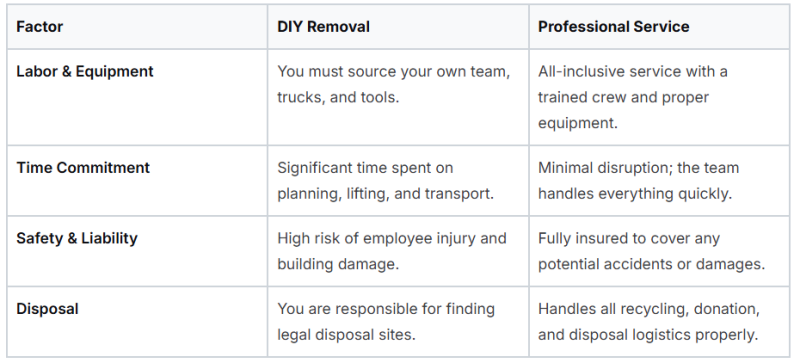
While the DIY route might look cheaper on paper, the value of a professional service becomes obvious when you factor in the efficiency, safety, and peace of mind they provide. For most businesses, the investment pays for itself by preventing costly mistakes and saving you valuable time.
How to Plan Your Office Furniture Removal
A successful office clear-out doesn't just happen. It all boils down to a solid plan, and that plan starts long before you ever get a quote from a removal service. Putting in the work upfront is the single best way to avoid last-minute headaches and ensure the whole project runs like clockwork.
First things first: you need to get a handle on exactly what you’re dealing with. This means walking the entire space—every office, conference room, and storage closet—and creating a thorough inventory. I know it sounds tedious, but trust me, this is the most important part of the entire process.
Don’t just jot down "10 desks." Get specific. A truly useful list would look more like, "10 laminate L-shaped desks, 72x72 inches" and "15 fabric-upholstered task chairs on casters." The more detail you can give a removal company, the more accurate their estimate will be.
Create a Detailed Inventory List
This list is the bedrock of your removal project. It’s the document that tells potential movers exactly what they’re up against. A great inventory captures a few key details for every single item.
- Item Type: Be descriptive. Is it a "3-drawer metal filing cabinet" or a "solid wood executive desk"?
- Quantity: The total count for each specific item.
- Condition: Make a quick note: is it in good, fair, or poor shape? This is critical if you plan on donating or reselling anything.
- Dimensions: For the big stuff—conference tables, cubicle walls, massive shelving units—grab a tape measure and get some rough dimensions.
A quick tip from the field: Grab a pack of colored dot stickers. Use them to create a simple visual system. Green can mean "keep," yellow for "donate/sell," and red for "junk/recycle." When the removal crew shows up, they can see the game plan at a glance just by looking at the colors.
Deciding the fate of each piece of furniture ahead of time is your next big task. This helps the removal company map out their logistics. Items ticketed for donation might head to one truck, while materials destined for the recycling facility go to another.
Assess Building Access and Logistics
With your inventory locked in, it’s time to think about the physical reality of getting everything out of the building. Any experienced removal service will ask about these things, so having the answers ready will get you a faster, more accurate quote.
Think through the entire path from your office door to the loading dock. What obstacles are in the way? We’ve seen all kinds of project challenges, from navigating tight hallways to dealing with strict building rules. You can get a sense of how tricky a job can be by looking at different before-and-after project scenarios.
Be ready to answer these questions:
- Elevator Access: Will you need to book a freight elevator? Find out its dimensions and, just as importantly, its weight capacity.
- Stairwells: Are stairs the only option? Measure their width and be mindful of any tight corners. That beautiful 12-foot boardroom table probably isn’t making it down a narrow, winding staircase.
- Loading Docks: What are the hours? Are there any specific rules your property manager enforces for using the loading bay?
- Parking: Where can a large removal truck park legally and safely? Will you need to secure a city permit for the space?
Nailing down this information gives you a clear scope of work. It allows you to communicate precisely with office furniture removal companies, helping you get a fair quote and avoid surprise fees on the day of the job. A good plan is truly your best defense against a stressful clear-out.
Understanding Removal Costs and Getting Accurate Quotes
Trying to budget for an office furniture removal can feel like you're guessing in the dark. But for professional services, it’s not a random number—it’s a straightforward calculation based on the specifics of your job. Once you know what they're looking at, you can get a price you can actually count on.
When it comes to the quote, the biggest factor is almost always volume. Most companies will price the job based on how much truck space your items will fill. Think in terms of a quarter-truck, half-truck, or even a full truckload. A few stray chairs and a desk will obviously be much cheaper than clearing out an entire floor of cubicles and heavy filing cabinets.
Key Factors That Influence Your Quote
Beyond just the sheer amount of stuff, a few other details really shape the final price. A removal company has to figure out the total time and labor it will take to get the job done safely and without a hitch.
To get the most accurate quote possible, be ready to share these details:
- A Detailed Inventory: Don't just say "desks and chairs." A clear list, with rough dimensions for the big stuff, gives the company a solid idea of the total volume.
- Accessibility Details: This is a big one. Is your office on the fifth floor with a single, slow service elevator? Or is it on the ground floor with a loading dock right outside? The easier it is for the crew to move items out, the less you'll pay in labor.
- Disassembly Needs: Things like sprawling conference tables, complex cubicle systems, or custom built-in shelving all need to be taken apart. That requires extra tools and time, which will be factored into the cost.
Pro Tip: When you call for an estimate, do yourself a favor and send photos or even a quick video walkthrough of the space. It gives the estimator visual context that a list just can't provide. They can spot potential headaches like tight corners or narrow doorways, which means you'll get a much more realistic quote right from the start.
This quick infographic shows the simple planning process that sets you up for an accurate quote.
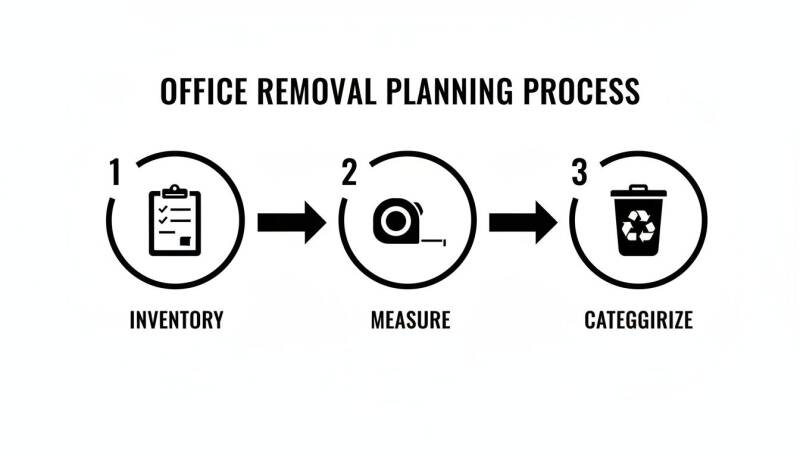
Honestly, following these three steps—making an inventory, measuring, and categorizing your items—is the key to a smooth, transparent removal project without any last-minute surprises.
The Role of Disposal Methods in Pricing
Where all your old furniture ends up also plays a part in the cost. Just hauling everything to the local landfill is one way to do it, but reputable office furniture removal services are increasingly focused on more sustainable options, which can affect the pricing.
For example, coordinating a donation involves more than just dropping off a desk. It means sorting items, making sure they're in donatable condition, and transporting them to a specific charity. Recycling is even more labor-intensive, as it requires breaking items down into their raw materials like metal, wood, and plastic. This eco-friendly approach is more important than ever. In the UK alone, offices send about 300 tonnes of furniture to landfills every workday.
A recent report highlighted a major disconnect: while 86% of organizations believe their furniture management is sustainable, half of them still end up sending it all to general waste. You can explore the full report on office waste habits to see just how wide that gap is.
While greener services might have a different price tag, they offer real value by helping you meet corporate responsibility goals and shrink your environmental impact. Always ask a potential provider how they handle disposal and what costs are involved. A good company will be happy to walk you through their process and explain any related fees.
What to Do With the Old Furniture: Donation and Recycling
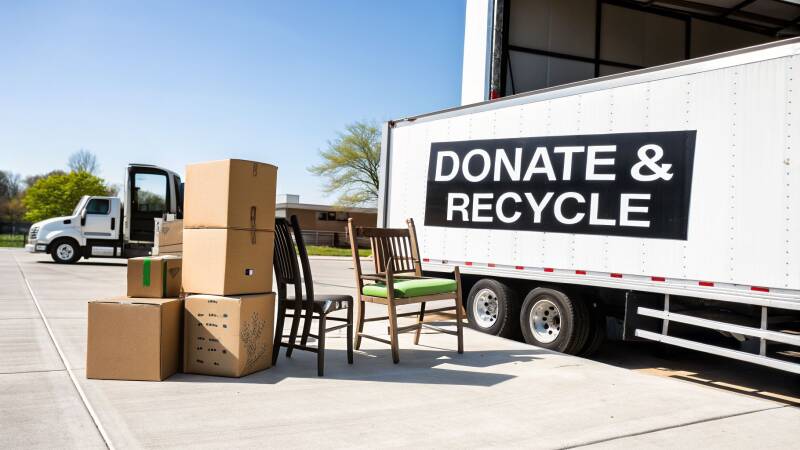
When you're clearing out an office, the absolute last thing you want is for everything to end up in a landfill. That's not just a waste—it's a missed opportunity. A good clear-out plan is your chance to handle things responsibly, and working with professional office furniture removal services makes it so much easier. They have the logistics and local network to give your old items a second life.
This isn't just a "feel-good" choice; it's a necessary one. Think about it: the average piece of office furniture lasts about 8-12 years, which means there's a constant stream of desks, chairs, and cabinets being decommissioned. Back in 2018, this cycle generated over 12 million tons of office-related waste in the U.S. alone. Seeing numbers like that really drives home why we need to embrace eco-friendly disposal options.
Give Your Furniture a Second Life Through Donation
Before you write something off as "junk," stop and really look at it. Could someone else use it? Many local charities, startups, schools, and nonprofits would be thrilled to get quality office furniture. A desk or a set of chairs that no longer matches your brand might be the perfect solution for an organization running on a shoestring budget.
So, how do you know if an item is a good candidate for donation? Here’s what we look for:
- Functionality: It has to work. A chair with a wobbly leg or a filing cabinet with a jammed drawer isn't helpful to anyone.
- Condition: Items need to be clean and presentable. We're talking no major stains, deep gouges, or torn upholstery. Light wear and tear is usually fine.
- Demand: Standard items are always the easiest to place. Think task chairs, simple desks, conference tables, and basic storage cabinets.
The real shortcut here is to let your removal service handle it. We’ve built relationships with local charities over the years, so we know exactly who needs what and what their quality standards are. It saves you from making a dozen phone calls just to get a "no."
Recycling What Can't Be Reused
What about the items that are too worn out or broken for donation? That's where recycling comes in. Modern office furniture is a complex mix of materials—metal frames, wood desktops, plastic arms, fabric cushions, and foam padding. Tossing it in a dumpster means all those valuable resources go to waste.
This is another area where a true professional removal company stands out. We don't just haul things away; we have a process for dismantling items to separate the different materials.
Here’s a quick breakdown of what happens to the pieces:
- Metals: The steel from desk frames, aluminum from chair bases, and metal from filing cabinets are all highly recyclable and get sent to a scrap metal facility.
- Wood: Desktops and shelves made of solid wood or particleboard can often be ground into mulch or repurposed.
- Plastics: Things like chair armrests, caster wheels, and cable trays are sorted by type and sent to specialized plastics recyclers.
By choosing a service that puts recycling first, you're doing more than just decluttering. You're participating in the circular economy, reducing landfill pressure, and conserving raw materials. If you'd like more ideas for clearing out your space responsibly, check out our guide on junk removal tips and resources. It’s a responsible business practice that also happens to be a great part of any company's social responsibility story.
Choosing the Right Furniture Removal Partner
Picking the right crew for your office cleanout can make or break the entire project. This is probably the most important decision you'll make. Get it right, and the process is smooth and efficient. Get it wrong, and you could be looking at property damage, surprise fees, and a logistical headache you didn't sign up for.
Think about it this way: you wouldn't hire an unvetted contractor for an office renovation. So why would you hand over your clear-out to the first person you find with a truck? The stakes are surprisingly high. A professional office furniture removal service brings much more than just muscle; they bring precision, safety, and accountability.
Your Vetting Checklist: The Absolute Must-Haves
Before you even start comparing prices, you need to make sure any company you're considering meets a few basic standards. These aren't just suggestions—they are essential protections for your business, your building, and your own peace of mind.
Here’s what to look for right out of the gate:
- Proof of Insurance: This is completely non-negotiable. The company absolutely must have general liability insurance (to cover accidental dings, scrapes, or worse in your building) and worker's compensation insurance for their crew. Don't just take their word for it—ask to see the actual certificate of insurance.
- A Strong Track Record: Check out their customer reviews on sites like Google and Yelp. You're looking for consistent, positive feedback from other businesses. Pay attention to comments about their punctuality, professionalism, and how they handled any unexpected issues.
- Transparent Pricing: A reputable company will give you a clear, itemized quote with no vague "miscellaneous" fees. They should be able to walk you through exactly what you're paying for, from the labor and truck time to any specific disposal or recycling surcharges.
A huge red flag is any company that gives you a flat price over the phone without asking detailed questions. A true pro will want to know about your inventory, building access, elevators, and parking before giving you an accurate estimate.
Key Questions to Ask Potential Providers
Once you have a shortlist of companies that pass that initial check, it’s time to dig a little deeper. You want to find a team that has real experience with projects just like yours. Asking the right questions can quickly separate the seasoned pros from the amateurs.
Be sure to ask them:
- Have you worked in commercial buildings in our area before? A local crew will already know the typical challenges, from navigating one-way downtown streets to dealing with the specific rules set by building management companies in your city.
- What's your process for donation and recycling? Ask for specifics. A company truly committed to responsible disposal should be able to name the local charities and recycling facilities they work with and explain how they sort materials.
- How do you handle disassembly for things like cubicles or large conference tables? This question helps you understand their technical skill. Do they have the right tools and training to break down complex furniture without damaging it or the surrounding space?
- How flexible is your scheduling? Can you work with our timeline? If you're on a tight deadline with a lease ending, you need to know they can accommodate you. This might mean working after business hours or on a specific weekend.
Finding the right team is about so much more than just hauling away unwanted stuff. If you need help clearing out your space, you can learn more about what to expect from professional junk removal services and how they operate. Ultimately, choosing a full-service, local partner is your best bet for making sure the job gets done right from start to finish.
Got Questions? We’ve Got Answers About Office Furniture Removal
Even with the best-laid plans, a few practical questions always come up before a big office clear-out. We hear them all the time from business owners and facility managers who just want to know what to expect on the day. Getting these details sorted out ahead of time is the key to a stress-free project.
Let's dive into some of the most common questions we get about office furniture removal services and give you the straightforward answers you need.
How Long Does an Office Clear-Out Actually Take?
This really depends on the scale of the job. For a small office with, say, four desks and some chairs, an experienced crew can often be in and out in just a couple of hours. But if we're talking about clearing out a large, multi-floor space packed with cubicle systems, that could easily be a full-day project or even stretch over several days.
A few things will affect the timeline:
- The sheer volume of furniture: This is the single biggest factor. More stuff simply takes more time.
- The amount of disassembly required: Those big L-shaped desks or massive conference tables don’t just walk out the door. Complex pieces need to be carefully taken apart first.
- Building logistics: We always have to factor in the building itself. Is there a freight elevator we can use? How far is the walk to the truck? Are stairs involved? All these little things add up.
The best way to get a solid time estimate is to have a professional team do a quick on-site or virtual walkthrough. For bigger jobs, you'll want to book well in advance to make sure all the logistics can be coordinated properly.
Can You Take Old Computers and Electronics, Too?
Yes, most full-service removal companies can handle e-waste, but it’s critical to confirm this with your provider when you book. E-waste covers everything from old computers and monitors to printers, copiers, and servers. These items are full of materials that can’t go into a landfill and require certified disposal.
Make sure your chosen company works with certified e-waste recycling facilities. This ensures all those old electronics are handled responsibly and their components are recovered or disposed of safely. When you ask for a quote, be specific about the electronics you have so the cost and disposal plan are accurate.
What Can I Do to Get Ready for Removal Day?
A little bit of prep work on your end can make a huge difference in how smoothly and quickly everything goes. The first, most important step is to have employees clear out all their personal items from desks, filing cabinets, and credenzas.
Once that's done, try to gather any small, loose items you want removed into a central spot. Most importantly, make sure you have a clear and unobstructed path for the crew to move furniture from the office to their truck. This might mean talking to your building manager to reserve the freight elevator or block off a section of the loading dock. If you’ve already sorted items for donation, just be sure to label them clearly so nothing gets mixed up.
For a reliable partner to handle your next commercial clear-out in New York or Connecticut, trust the experts at D&B Complete Home Services INC. We provide fast, professional, and eco-friendly office furniture removal tailored to your needs. Learn more and book your service today!
Add comment
Comments