Can you scrap refrigerators for profit? Discover how to do it safely, legally, and profitably in our 2026 guide covering rules, values, and pro tips.
Can You Scrap Refrigerators? A Profitable 2026 Guide
When your old refrigerator finally gives up the ghost, you're left with a big, heavy box and an even bigger question: what do you do with it? Before you start figuring out how to haul it to the dump, you might be wondering if there's any cash to be made by scrapping it.
The Short Answer: Yes, You Can Scrap Refrigerators
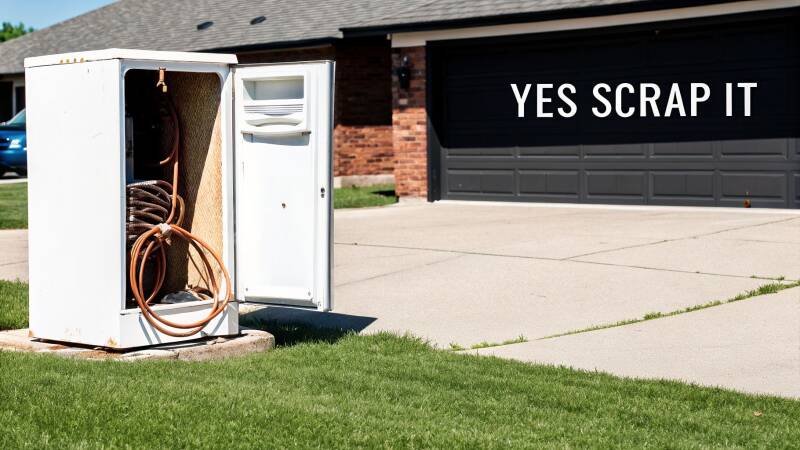
The quick answer is a definite yes. Scrapping a refrigerator is not only possible, but it's often a much better choice than sending it to a landfill. It's a great way to recycle and maybe even put a few dollars in your pocket.
However—and this is a big however—it's not as simple as just dropping it off at the nearest scrap yard. There are rules you need to follow.
Think of an old fridge less as a single piece of trash and more as a bundle of different materials. Some of those materials are valuable, while others are hazardous. Successfully scrapping it means knowing how to separate the good from the bad.
What's Inside a Scrap Refrigerator?
An old refrigerator is like a mini-treasure chest for a scrapper. It’s filled with different metals, and knowing what’s what is the key to understanding its potential value.
Here's a quick breakdown of what you'll typically find:
- Steel: The frame and outer shell are almost all steel. It’s heavy, which is good, but it's a ferrous metal and doesn't fetch a high price.
- Copper: This is where the real value is. You'll find copper in the compressor motor and the tubing on the back. It’s a much more valuable non-ferrous metal.
- Aluminum: Another valuable non-ferrous metal, aluminum is often found in the evaporator coils and freezer components.
- Plastic: The shelves, drawers, and door liners are plastic. Unfortunately, this usually has little to no value at the scrap yard.
Key Insight: The money you make from scrapping a fridge comes from the non-ferrous metals—the copper and aluminum. A small handful of clean copper can easily be worth more than the entire steel casing.
The Two Sides of Scrapping a Fridge
Scrapping an appliance correctly is all about balancing the opportunity for cash with the responsibility of safe disposal.
The opportunity is pretty straightforward. You're taking an appliance that's served its purpose and turning its metal components back into raw materials. It's good for the environment and can net you a small payout for your effort.
The responsibility side, though, is where things get serious. Refrigerators contain hazardous materials that are heavily regulated by the U.S. Environmental Protection Agency (EPA) under the Clean Air Act. Specifically, we're talking about refrigerants (like Freon) and the oils inside the compressor. If released, these substances can harm the ozone layer and contribute to climate change.
This is why you can't just take a pair of pliers and start cutting lines yourself—it's illegal, unsafe, and will get your fridge rejected by any reputable scrap yard. Federal law requires a certified technician to properly and safely recover these chemicals before the appliance is crushed or shredded. Trying to do it yourself can lead to hefty fines.
So while you absolutely can scrap a refrigerator, the full answer is: "yes, but only if it's done right." This guide is here to show you exactly how to do that, from preparing the unit to finding the right people to handle the hazardous stuff.
To give you a quick overview, here's a summary of the most important points.
Refrigerator Scrapping At a Glance
This table breaks down the essential dos and don'ts when you're ready to scrap an old refrigerator.
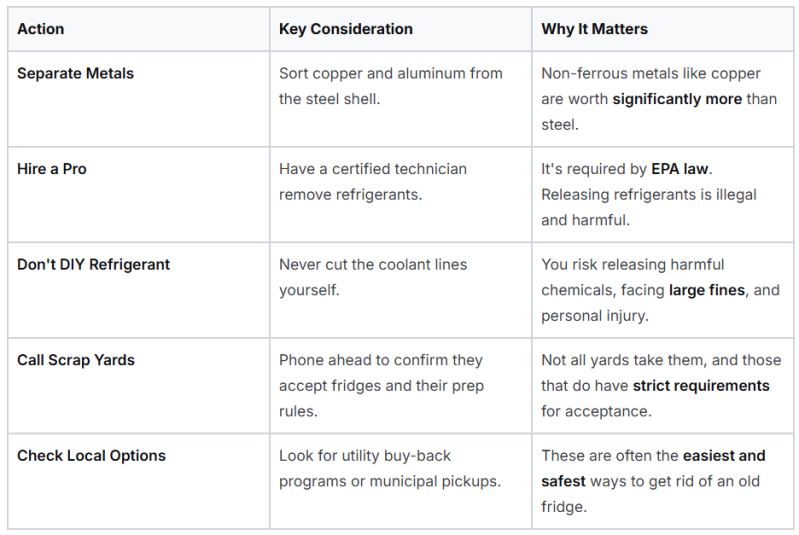
Following these guidelines will ensure you handle the process safely, legally, and in a way that maximizes any potential payout.
So, you've got an old fridge you need to get rid of. Before you start wrestling it to the curb, you should know that refrigerators aren't treated like regular junk. You can’t just drop one off at the scrap yard as-is, and there are some serious rules and risks involved.
Think of an old refrigerator less as a simple metal box and more as a regulated appliance packed with hazardous materials. This special treatment is for some very strict legal and environmental reasons.
The biggest issue is the nasty stuff inside the compressor: refrigerants, like Freon, and contaminated oils. These substances are heavily regulated by the U.S. Environmental Protection Agency (EPA) under the Clean Air Act. Trying to take a fridge apart yourself isn't just dangerous—it's illegal and can come with some eye-watering fines.
It’s a lot like scrapping a car. You wouldn't just crush a car without draining the gasoline, oil, and antifreeze first, right? A refrigerator needs the same professional attention to have its hazardous components safely removed. This isn't just a bureaucratic hurdle; it’s an essential step to protect our environment.
The Environmental Impact of Improper Disposal
There's a heavy-duty reason for all this red tape. The chemicals humming away inside your old fridge are incredibly destructive if they get into the atmosphere. Refrigerators from the old days are often filled with chlorofluorocarbons (CFCs) or hydrochlorofluorocarbons (HCFCs)—the notorious chemicals responsible for chewing holes in the Earth's ozone layer.
Even newer models pose a threat. While they don't harm the ozone layer, they typically use hydrofluorocarbons (HFCs), which are potent greenhouse gases. Some HFCs are more than 1,000 times more effective at trapping heat in the atmosphere than carbon dioxide. When an old fridge is left to rot in a landfill and these gases leak out, they become a direct contributor to climate change.
This environmental awareness is changing how we handle old appliances. The global fridge recycling market was valued at $5.6 billion in 2023 and is on track to nearly double, hitting $10.8 billion by 2032. This growth is fueled by stricter laws and a better public understanding of the risks. Every year, over 40 million refrigerators are scrapped globally, allowing for the recovery of millions of kilograms of refrigerants, metals, and plastics that can be put back to use. You can learn more about this industry and its impact by reading the latest findings on global fridge recycling trends.
The Legal Consequences You Need to Know
The EPA doesn't mess around when it comes to the illegal release of refrigerants. Section 608 of the Clean Air Act is crystal clear: only EPA-certified technicians have the legal authority to recover refrigerants from appliances like refrigerators. That means you absolutely cannot just cut the lines yourself to get it done faster.
A scrap yard or metal recycler is legally prohibited from accepting a refrigerator unless they have verified that the refrigerant has been properly removed and recovered. Fines for non-compliance can be severe, reaching tens of thousands of dollars per violation.
For homeowners here in New York, the penalties are particularly steep, with fines for violations potentially hitting $25,000. This is exactly why any reputable scrap dealer will demand documentation or a tag from a certified technician, proving the unit has been safely and professionally evacuated.
Here’s what you need to remember about the rules:
- Professional Removal is Mandatory: Only an EPA-certified technician can legally and safely handle the refrigerants.
- Documentation is Required: You’ll need proof of proper refrigerant recovery before a scrap yard will even look at your old fridge.
- Significant Fines Exist: Getting caught illegally venting refrigerants or trying to improperly dispose of a unit can lead to major financial penalties for both individuals and businesses.
Trying to navigate these legal and environmental minefields is not a DIY project. The complexity and serious consequences make it obvious that calling in a professional isn't just the easy way out—it's the only responsible way. By hiring a qualified service, you ensure you're in compliance with the law, protecting the environment, and keeping yourself safe from huge fines and legal trouble.
How to Prepare Your Refrigerator for Scrapping
So, you’re ready to get that old refrigerator out of your house. Before it gets hauled away to a scrap yard or picked up by a professional service, there are a few key things you need to do. Think of it less like major surgery and more like getting a car ready to sell—you're not rebuilding the engine, just cleaning it out and making sure it's safe for the next person to handle.
Taking care of these simple prep steps makes the entire process smoother and safer for everyone involved, from you to the person hauling it away.
Your Simple Preparation Checklist
Your part in this process is all about basic cleaning and safety. By tackling these few tasks, you’ll help prevent nasty odors, mold, and any hazards during transport.
Here’s exactly what you need to do:
- Pull the Plug: This is step one, and it's non-negotiable. Unplug the refrigerator from the wall at least 24 hours before it's scheduled to be moved. This gives the unit plenty of time to defrost completely and come to room temperature, which is crucial for preventing a soupy, messy puddle from forming during transport.
- Empty and Scrub It Down: Take everything out—food, drinks, that forgotten jar of pickles in the back. Once it's completely empty, give the inside a good cleaning with soap and water or a simple vinegar solution. A clean fridge won't start smelling or growing mold while it sits waiting for its final destination.
- Secure the Doors: This is a big one for safety. Once the fridge is clean and dry, tape the doors shut with strong packing tape, rope, or a bungee cord. This keeps them from swinging open and causing damage or injury while the appliance is being moved. It's also an important step to prevent small children or animals from accidentally getting trapped inside if the unit is sitting on a curb or in a garage.
Once you’ve done this, the unit is clean, secure, and ready for the professionals. For more great advice on clearing out unwanted items, check out our guide on effective junk removal tips and resources.
A Critical Warning: What You Should Never Do
While the steps above are perfectly safe for you to handle, there's a line you absolutely must not cross: messing with the refrigerant lines.
Warning: Under no circumstances should you try to cut, puncture, or otherwise drain the copper tubing on the back of your refrigerator. This system is filled with pressurized refrigerant gas (like Freon) and oils that are harmful to you and the environment.
Seriously, leave this part to the pros. Tampering with the refrigerant system is not a DIY project. It’s not only incredibly dangerous but also illegal. Under Section 608 of the Clean Air Act, only an EPA-certified technician is legally allowed to handle and recover these materials.
Ignoring this warning can lead to some nasty consequences:
- Serious Injury: The refrigerant is under high pressure and can cause severe frostbite or other chemical-related injuries if it makes contact with your skin.
- Environmental Damage: These chemicals are known to deplete the ozone layer and are powerful greenhouse gases.
- Hefty Fines: Getting caught illegally venting refrigerants can result in fines that run into the tens of thousands of dollars.
Your job is to clean and secure the appliance. The hazardous material disposal is a task for trained, certified technicians who have the proper equipment and legal authority to do it right.
Where the Real Scrap Value in a Refrigerator Lies
When you look at that old refrigerator sitting in your garage, you probably see a single, heavy appliance. But a scrap yard professional sees something completely different. To them, it’s a collection of materials, and the real money isn't in the big, bulky frame—it's hidden deep inside.
Think of it like this: the heavy steel casing, which makes up most of the fridge's 150-200 pounds, is what's known as a ferrous metal. That just means it contains iron. It's magnetic and, unfortunately, doesn't fetch a high price. The real treasure is in the non-ferrous metals, like copper and aluminum, which are far more valuable pound for pound.
Getting a handle on this difference is what separates a worthwhile trip to the scrap yard from a waste of time and gas. So when you ask if you can scrap a fridge for money, the answer really depends on whether you can get to these high-value parts.
Anatomy of a Scrap Fridge
So, where is all this good stuff? When a refrigerator is properly dismantled, a few key materials are what everyone's after. Each one has its own value and place in the recycling world.
Here’s a quick breakdown of what a pro is looking for:
- Steel Shell: This is the main body and doors. It's low-value steel but adds a lot of weight, which scrap yards track as tonnage.
- Copper Tubing: Look at the back of the fridge, connected to the compressor. This is the jackpot for most scrappers.
- Aluminum Fins and Coils: You'll often find these behind the unit or inside the freezer. They're another valuable non-ferrous metal.
- Compressor (Sealed Unit): That heavy, black, dome-shaped motor on the back is packed with copper windings inside its steel case.
- Copper Wires: The power cord and all the internal wiring contain copper that can be stripped and sold separately.
Key Takeaway: The 5-10 pounds of copper tubing and wiring you can pull from a single fridge could easily be worth more than the entire 150-pound steel frame. That’s the basic math behind scrapping refrigerators.
Before you even think about those parts, though, the first steps are simple and safe. This quick chart shows what you should—and absolutely should not—do yourself.
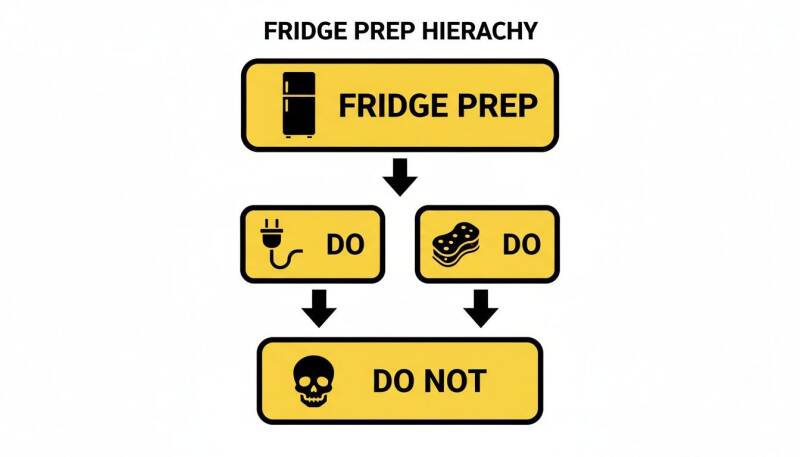
As you can see, unplugging and cleaning it out are your jobs. Messing with the refrigerant lines is a major no-go.
Why Non-Ferrous Metals Drive Profit
To really drive this point home, let's talk numbers. Scrap prices change all the time, but the gap between metal types is always massive. For example, scrap steel might only bring in $0.10 to $0.20 per pound. Clean copper, on the other hand, can go for $3.00 to $4.00 per pound, sometimes even more.
This huge price difference is what powers the entire appliance recycling industry. In 2025 alone, the home appliance recycling market processed nearly 55 million units, and refrigerators made up a staggering 45% of that volume. You can learn more about this trend by checking out a detailed home appliance recycling market report. Fridges are simply loaded with valuable materials, making them profitable to process even with the cost of handling hazardous components.
The compressor is the perfect example of this value mix. A scrap yard might buy the whole sealed unit for a flat, lower rate. But a serious scrapper might take the time to break it open and pull out the pure copper motor windings inside, multiplying its value. It’s a dirty, tough job, which is why most people—and even some yards—don’t bother.
Your Disposal Options: DIY Scrapping vs. Professional Removal
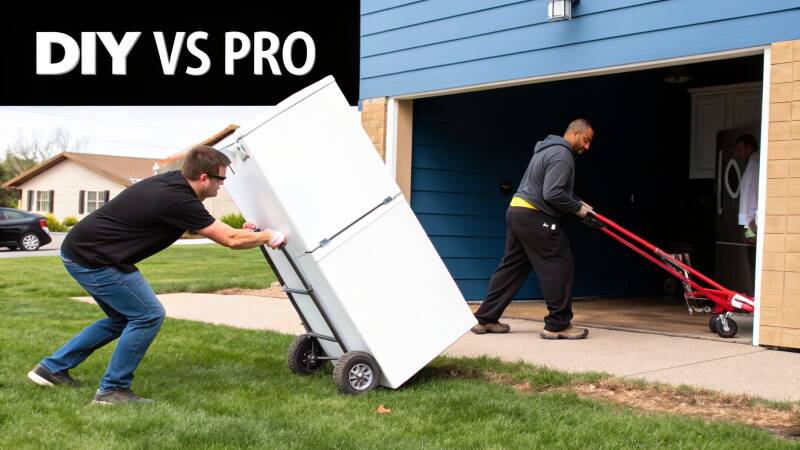
Alright, you've learned about the regulations and what it takes to get a fridge scrap-ready. Now comes the big decision: do you roll up your sleeves and tackle this yourself, or do you make a call and have someone else handle it?
This is the classic trade-off between your time and effort versus paying for convenience and safety. The DIY route might sound tempting if you're just thinking about that potential cash from the scrap yard. On the other hand, professional removal is a simple, one-call solution that takes every bit of the headache away—for a fee. Let's walk through what each path really looks like.
The DIY Scrapping Journey
Choosing to scrap a refrigerator on your own is a much bigger commitment than most people realize. It's not just a quick trip to the dump. It’s a project filled with logistical puzzles, surprise costs, and some very real safety hazards.
First up, you have to deal with the refrigerant. As we've covered, this is non-negotiable. You’ll need to find and pay an EPA-certified technician to come to your property and properly drain the system. Right off the bat, that service fee is eating into any profit you hoped to make.
Once the fridge is legally "clean," the real muscle work starts. These things are beasts, weighing anywhere from 150 to over 300 pounds. You're going to need a heavy-duty dolly, strong straps, and at least one other person who's willing to help you wrestle it out of the house without scratching floors, denting walls, or throwing out a back.
Then you have to get it to the scrap yard. If you don't own a pickup truck, you're renting one. Add up the rental fee, gas, and mileage, and watch your expenses grow. After all that, you finally get your payout, which might be disappointingly small—or worse, you could end up having spent more than you made.
The Professional Removal Path
Now, let's look at the flip side. When you hire a professional junk removal company like D&B Complete Home Services INC., that long to-do list shrinks to a single item: make one phone call.
A professional crew shows up and handles everything. They have the proper dollies, equipment, and experience to get that bulky appliance out of your home safely, whether it's sitting in the garage or stuck down in a basement with a tight staircase.
The real value of hiring pros is the complete transfer of responsibility. You don't have to think about EPA compliance, lifting injuries, or property damage. It’s no longer your problem.
These teams are insured, which means if something accidentally gets dinged or scratched during removal, it's covered. They also have the process down to a science, ensuring your old fridge is disposed of in full compliance with every single law. You get the ultimate peace of mind. Seeing how cleanly a professional team works on other jobs, like in before-and-after galleries of home service providers, can really show you the difference expertise makes.
DIY Scrapping vs. Professional Removal: A Head-To-Head Comparison
To help you see it all in one place, we’ve put the two options side-by-side. This table breaks down which approach wins on the factors that matter most when you just want that old appliance gone.
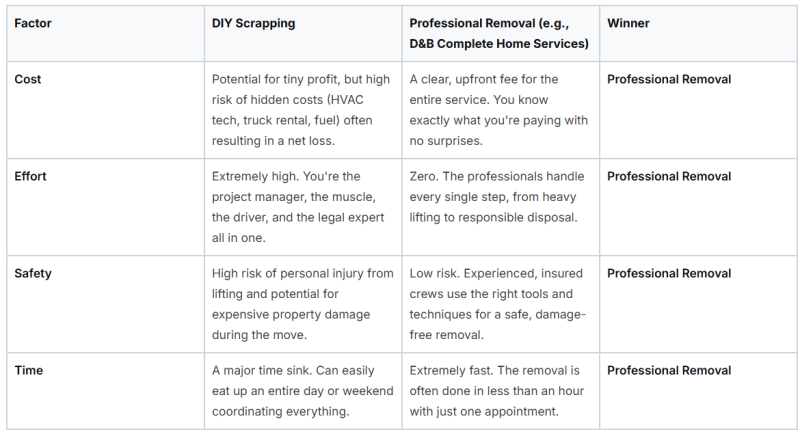
When you look at the complete picture, the choice becomes pretty clear. While the DIY spirit is great for many projects, the combination of legal hoops, physical risk, and hidden costs makes scrapping a fridge yourself a tough sell. For sheer convenience, safety, and guaranteed peace of mind, professional removal is the hands-down winner.
Why a Professional Service Is the Smarter Choice
After considering the legal minefields, the physical risks, and the sheer hassle involved, it becomes pretty obvious. For most people wondering if they can scrap a refrigerator themselves, the best answer is almost always to call in a professional. It turns a complicated, high-risk chore into one simple, hands-off task.
Think about it like this: you could try to fix a major plumbing leak yourself. That means spending your Saturday watching tutorials, buying a bunch of tools you’ll only use once, and just hoping you don’t end up flooding the kitchen. Or, you could call a master plumber who gets it done right in an hour. Getting rid of an old fridge is the exact same principle.
The All-in-One Solution for Property Owners
When you hire a full-service junk removal company, you're not just paying someone to haul away an appliance. You're handing off every single one of the headaches we've talked about.
- You're legally covered. A professional service has certified technicians who handle refrigerants according to strict EPA laws. This protects you from fines that can reach up to $25,000.
- No one gets hurt. Trained crews show up with the right equipment—dollies, straps, and experience—to move a 300-pound appliance without wrecking your floors, walls, or their own backs.
- It's just plain easier. You don't have to find a technician, rent a truck, or try to line up schedules. You make one appointment, and everything is handled from start to finish.
- It’s genuinely responsible. Good companies have a system in place. They know exactly where to take the fridge to ensure it's recycled correctly and doesn't just end up leaking toxins into a landfill.
This is exactly why so many homeowners, landlords, and real estate agents have a reliable junk removal team on speed dial. If you're a real estate agent staging a home for sale or a landlord cleaning out a rental, time is money. Having a partner who can show up and make the problem disappear is invaluable.
A professional service does more than just provide muscle; it delivers a guarantee. It's a promise of safety, legal compliance, and efficiency that protects your property and gives you total peace of mind.
This is the core of what a team like D&B Complete Home Services INC. provides. The job isn’t just about removing an old fridge; it's about offering a complete, worry-free solution for homeowners and property managers. You can see how full-service junk removal services streamline the entire process for property owners across New York and Connecticut. We're here to handle the heavy, complicated, and risky work so you don't have to.
Frequently Asked Questions About Scrapping Refrigerators
Even after you've decided to scrap your old fridge, a few last-minute questions always seem to pop up. We get it. Here are the straight answers to the things people ask us most often, so you can move forward with confidence.
How Much Money Can I Really Make Scrapping One Fridge?
Let's talk brass tacks: you’re not going to get rich scrapping a single refrigerator. By the time you pay a certified technician to properly remove the refrigerant—which is a step you can't skip—the profit margins get pretty slim.
A determined DIYer might walk away with $10 to $30 after accounting for gas, time, and the sheer effort involved. The real financial benefit isn't what you make, but what you avoid: steep fines for improper disposal or costly damage to your property. Hiring a professional service might have an upfront cost, but it completely removes those risks.
Can I Just Leave My Old Refrigerator on the Curb?
That’s a hard no. In most places, leaving a refrigerator on the curb is illegal, and for good reason. Your local sanitation department almost certainly won't pick up appliances that contain refrigerants, which can lead to a hefty fine for illegal dumping.
More importantly, an abandoned fridge is a serious safety hazard. It’s a tragedy we've seen happen—children or animals can easily get trapped inside. It's a risk that's simply not worth taking.
What Happens to the Hazardous Refrigerant Gas?
When you bring in a certified pro, they don’t just let the harmful gases vent into the atmosphere. They use specialized recovery equipment to safely capture the refrigerant and the contaminated oils inside a dedicated, secure tank.
This captured refrigerant is then sent to an EPA-certified reclamation facility. There, it gets cleaned and purified. It can then be sold back to service older HVAC and refrigeration systems, creating a closed loop that prevents new chemicals from needing to be manufactured.
Do I Have to Take the Doors Off Before Scrapping?
This is a fantastic safety measure, and we always recommend it. If the fridge is going to sit anywhere—even for a short time before pickup—taking the doors off or taping them shut with heavy-duty tape removes any chance of a child or animal getting trapped. It’s a small step that shows you’re handling the situation responsibly, and scrap yards and removal services definitely appreciate it.
What's More Valuable: the Compressor or the Copper Lines?
For a scrapper, the prize is almost always the copper lines. When cleaned up, they're nearly pure, high-value copper that's easy to sell.
The compressor (that heavy, black, sealed unit) also contains a good amount of copper in its motor windings. The problem? It's locked inside a thick steel casing and is incredibly messy and difficult to break open. Most scrappers find it’s not worth the labor. They’ll typically sell the entire sealed unit as-is for a much lower price. The easily accessible copper tubing is the real score.
The global push to recycle appliances like these is huge. Each year, people discard over 10.8 million metric tons of temperature-exchange equipment, but a staggering 22.3% of this e-waste is all that gets properly recycled worldwide. Here in Fairfield and Westchester Counties, having a pro like D&B scrap just one fridge prevents 150-200 kg of CO2 from being released and recovers materials for the circular economy. You can explore latest market insights on home appliance recycling to see how this industry is growing.
Navigating the rules of appliance disposal can feel like a maze, but you don’t have to figure it out on your own. D&B Complete Home Services INC. provides fast and reliable refrigerator and junk removal across New York and Connecticut. Our insured team will handle the heavy lifting, ensure full legal compliance, and manage the eco-friendly disposal. All you have to do is enjoy your clean, clutter-free space. Get your free, no-obligation quote today at https://www.dbcompletehomeservices.com.
Add comment
Comments