
Find your ideal remodeling contractor Orange County partner for 2026. Learn to vet pros, navigate costs, and manage your project with confidence.
Your Guide to Hiring a Remodeling Contractor Orange County
So, you’re ready to start a remodel. It’s an exciting thought, but actually finding the right remodeling contractor in Orange County can feel like a job in itself. Think of this guide as your personal roadmap for navigating the busy OC market, helping you turn a complicated process into a clear, manageable plan.
Navigating The Orange County Remodeling Market
Remodeling a home in Orange County is about so much more than just picking out new tile or a fresh coat of paint. You’re stepping into a unique market where property values are sky-high, building codes can be surprisingly strict, and the best skilled tradespeople are always in demand. Who you choose as your contractor is, without a doubt, the most important decision you'll make for your project's success.
It’s a bit like hiring a captain for a ship. An experienced captain who knows the local waters—like the specific rules for coastal homes in Newport Beach or the quirks of historic houses in Santa Ana—will navigate your project around any potential storms. Someone less familiar with the area could easily run you aground with unexpected costs and frustrating delays.
Why OC Is A Unique Remodeling Environment
The Orange County market has its own set of challenges and opportunities that only a true local pro will know how to handle. These aren't just minor details; they can have a huge impact on your budget, your timeline, and the quality of the finished work.
A few key local factors really make a difference:
- Distinct Building Codes: If you're near the coast, you'll face specific rules about materials and building methods designed to stand up to salt air and moisture. A good contractor knows this and prevents you from having to do things twice.
- High Property Values: A renovation here is a serious investment. The right contractor makes sure the work not only looks great but actually adds real, measurable value to your home.
- A Competitive Labor Market: Getting the best electricians, plumbers, and carpenters on your job requires a contractor who has built strong, long-term relationships in the local industry.
Your Path To A Successful Project
This guide is designed to walk you through everything you need to know. We’ll cover how to set a realistic budget for this area, what to look for when vetting potential contractors, and how to make sense of contracts and bids. The whole point is to give you the confidence to pick a reliable partner who can bring your vision to life—on time and on budget.
A successful remodel is built on a foundation of clear communication, detailed planning, and a partnership with a contractor who truly understands the local environment.
By taking a structured approach, you can sidestep the common headaches and feel good about your investment. For anyone just starting out, it’s vital to understand what a full-service project involves, from the initial demolition to the final walkthrough. If you're curious about what a start-to-finish project looks like, you can learn more about how D&B Complete Home Services INC. supports every stage of the remodeling journey.
Understanding Costs and Timelines for Your OC Remodel
Let's get right to it: money and schedules. If you’ve ever used a national cost calculator for a home project, I have some news for you—you can probably toss those numbers out the window for Orange County. Planning a remodel here is a completely different ballgame.
Think of it this way: a generic online estimate is based on a national average, which is like pricing a car without specifying the make or model. An OC remodel, on the other hand, is more like pricing a high-performance vehicle in a market where premium fuel, expert mechanics, and specialized parts are the standard, not the exception. The sticker shock is real if you're not prepared.
Why Do Orange County Remodels Cost More?
So, what’s driving up the price tag? It's not just that contractors are charging more for the sake of it. The costs are a direct reflection of our unique local market. You’re paying for quality, compliance, and peace of mind in a very demanding area.
A few key things pump up the budget here:
- Skilled Labor Premiums: The best tradespeople—the electricians, plumbers, and finish carpenters who do incredible work—are in high demand. A reputable contractor in Orange County invests in retaining top-tier talent, and that expertise is reflected in the cost.
- Complex Permitting: Each city, from Anaheim to Newport Beach, has its own maze of building codes and regulations. Navigating this requires time, expertise, and a lot of paperwork, all of which add to the project's overhead.
- High-End Expectations: Around here, what's considered "builder-grade" elsewhere is often below the baseline. The expectation for high-quality materials, from custom cabinets to designer fixtures, is simply the starting point.
This infographic gives you a quick visual breakdown of what you're really paying for in an OC remodel.
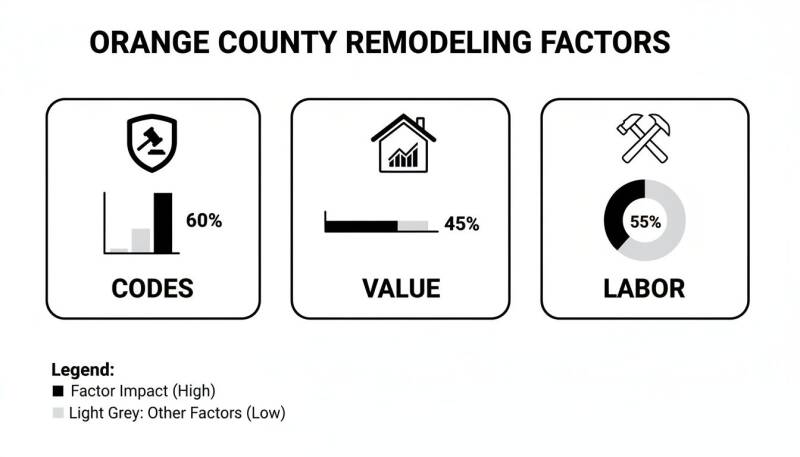
As you can see, it's a blend of stringent codes, high property values that demand quality, and the unavoidable cost of skilled labor in a competitive market.
A Realistic Look at Project Budgets
To ground this in reality, let's talk about some common projects. For 2026, a nice kitchen remodel in Orange County will likely fall between $45,000 and $100,000, and that’s not even for the most high-end custom work, which can easily soar past that. A huge chunk of that—often 40-60%—is dedicated to labor alone.
Looking at home additions, the numbers get even bigger. You can expect to pay anywhere from $150 to $500 per square foot, a figure that often surprises people used to seeing lower national averages. As these detailed remodeling cost insights for Orange County show, your contractor is managing a very complex and expensive operation.
A detailed, line-item bid isn't just a suggestion; it's your only tool for truly understanding where your money is going and for comparing different contractors fairly.
Before the first new wall goes up or the first cabinet is installed, the old has to go. The demolition and cleanup phase is a critical first step. Making sure your site is properly cleared by professionals sets the stage for a smooth project, and you can explore professional junk removal services to handle this messy but essential job.
To help you get a clearer sense of what to expect, I've put together a table outlining typical costs and timelines for popular projects in our area.
Typical Orange County Remodeling Project Costs And Timelines (2026)
Think of these numbers as a solid starting point for your planning. Your final costs will always depend on your specific material choices, the complexity of the job, and the team you hire.
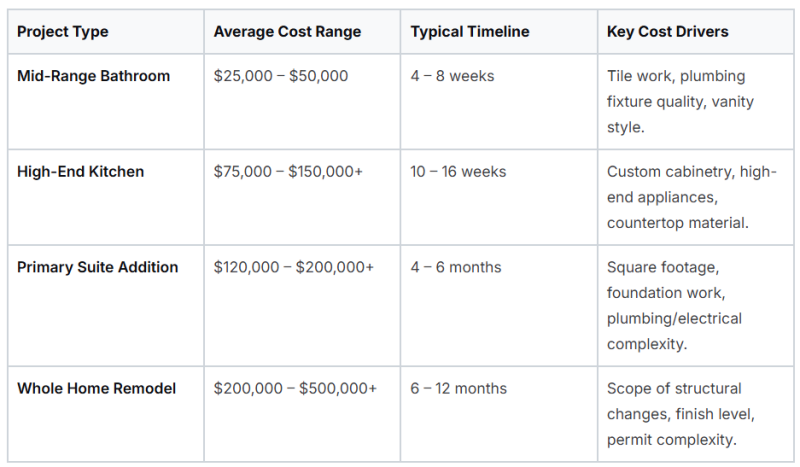
Armed with this information, you can walk into conversations with potential contractors feeling confident and prepared. It’s the best way to ensure your vision and your budget are on the same page from day one.
How To Navigate Orange County Permits And Building Codes
Let's be honest: for most homeowners, the words "permits" and "building codes" bring to mind a frustrating maze of bureaucratic red tape. I get it. But after years in this business, I've learned to see permits for what they really are—your project's official insurance policy.
Think of it this way: a permit is the formal process that guarantees your renovation is safe, structurally sound, and legally recognized. This isn't just about satisfying the city; it's about protecting your home's value and your family's safety. A true remodeling contractor in Orange County won't just know how to handle this; they'll take the entire burden off your shoulders.
Trying to bypass the permit process is a gamble you don't want to take. I've seen the fallout firsthand. A city inspector can slap a stop-work order on your project, bringing everything to a screeching halt. Worse, you could be forced to tear out beautiful, newly finished work or get hit with some pretty hefty fines. And down the road, when you decide to sell, that unpermitted work becomes a massive headache that can tank a deal in a heartbeat.
When Is a Permit Required in Orange County?
So, how do you know if your project needs a permit? While the specifics can differ slightly from Irvine to Anaheim to Huntington Beach, the general rule of thumb is quite consistent. It all comes down to one simple question: is the change structural or just cosmetic?
As a general guideline, you'll need to pull a permit for any project that involves:
- Structural Changes: Any time you're moving, adding, or taking out walls.
- System Upgrades: If you're touching the guts of your home, like electrical wiring, plumbing supply lines, or HVAC systems.
- Exterior Modifications: Projects like altering the roofline, creating new window openings, or building a deck.
- Additions: Building any kind of new square footage onto your home.
On the other hand, purely cosmetic updates usually get a pass. Things like painting, laying down new carpet, or swapping out a faucet in the same spot don't typically require a permit. A seasoned contractor will know exactly which category your project falls into.
A permit isn't just a piece of paper; it's documented proof that your project was built to current safety standards, protecting your family and your investment. This becomes invaluable for both insurance purposes and future resale value.
OC-Specific Codes You Should Know
Orange County isn't just like everywhere else, and our building codes reflect that. Beyond the standard rules, there are local regulations that can have a big impact on your project's design and budget. Hiring a contractor who isn't familiar with these nuances is a recipe for delays and surprise costs.
For instance, any work you do in coastal cities like Laguna Beach or Newport Beach has to answer to the California Coastal Commission, which has very strict guidelines about building near the shore.
On top of that, every single residential project must adhere to California's Title 24 energy standards. These are regulations covering everything from insulation and window efficiency to lighting, all designed to make your new space energy-efficient. And right now, the permit process itself is facing headwinds. Recent data shows permit approvals have fallen 16% below historical averages and are expected to stay that way into early 2026. This can create a bottleneck for starting projects, even with new laws meant to speed things up. You can read more about the California construction market updates to get a sense of the current climate.
Your contractor is your expert guide through this whole landscape. They are the ones responsible for submitting plans, managing the application, scheduling every inspection, and making sure the city officials sign off on every last detail. It's a fundamental part of their job and a huge reason you hire a professional in the first place.
Your Checklist For Vetting A Remodeling Contractor

Let’s be honest—choosing your contractor is the most critical decision you’ll make during this entire remodel. This one choice can mean the difference between a project that feels exciting and collaborative and one that turns into a drawn-out, budget-busting nightmare. A great contractor is a partner. A bad one can ruin the whole experience.
So, how do you tell them apart? It’s not just about a quick online search. You need to put on your hiring manager hat and do some real digging to find a true professional. This is about filtering out the amateurs to find a qualified remodeling contractor in Orange County who will protect your home and your investment.
Beyond the License Number
First thing’s first: verifying a contractor's license with the California Contractors State License Board (CSLB) is non-negotiable. But that’s just the entry ticket. The real due diligence starts with making sure they are fully insured, which is what protects you from huge financial risks.
You need to see proof of two key types of insurance:
- General Liability Insurance: Think of this as "oops" coverage. If a worker accidentally bursts a pipe and floods your new hardwood floors or backs their truck into your neighbor's fence, this policy covers the damage. Without it, that cost could fall squarely on your shoulders.
- Workers' Compensation Insurance: This is an absolute must-have. If a crew member gets injured while working on your property—a fall from a ladder, a tool accident—this insurance covers their medical bills and lost wages. If your contractor doesn't have it, you could be held personally liable.
Don't just take their word for it. Ask for the insurance certificates and call the providers to confirm the policies are active and provide enough coverage for a project of your size.
Reading Between the Lines: Reviews and References
Online reviews on sites like Yelp and Houzz are a good place to start, but you have to learn to read between the lines. Are you seeing a pattern? Maybe multiple clients mention how clean the job site was, or maybe several complain about unexpected delays. Also, pay close attention to how the contractor responds to negative feedback. A defensive or dismissive response is a red flag, while a professional who tries to make it right is a great sign.
But don't stop there. Any truly professional contractor will be happy to give you a list of recent client references. When you call them, dig deeper than a simple, "Were you happy with the work?"
Ask specific questions to get a real sense of what it’s like to work with them:
- "How did they handle surprises or changes to the plan?"
- "Was the crew respectful of your home? Was the site kept clean?"
- "Did the final bill match the original quote, or were there a lot of extra charges?"
- "How was the communication throughout the project?"
These questions will paint a much clearer picture of their day-to-day work ethic. You can see the kind of transformations that earn us happy clients by checking out our before and after project gallery.
Identifying Green Flags and Red Flags
As you start talking to potential contractors, you'll notice certain things that either build your confidence or set off alarm bells. A great contractor is an open book; a questionable one often uses high-pressure sales tactics and offers vague promises.
A true professional is selling you their expertise and a proven process, not just a lowball price. They have systems for everything from bidding to project management because they’ve done this successfully hundreds of times.
To make it easier, here’s a quick comparison of what to look for versus what should make you walk away.
Contractor Vetting Checklist Green Flags vs Red Flags

Taking the time to vet your contractor this thoroughly might feel like a lot of work upfront, but the peace of mind it buys you is priceless. By checking these boxes, you’re not just hiring a contractor—you’re choosing a reliable partner for your renovation.
How To Compare Contractor Bids And Avoid Common Traps

You’ve done your homework, interviewed several contractors, and now you have a handful of bids spread across your dining room table. The problem? They all look completely different. One is a single page, another is a ten-page booklet. This is the moment where the temptation to just grab the cheapest one is strongest.
Take a deep breath. Don't fall for it.
Comparing bids isn't about finding the lowest number; it’s about finding the best value and, just as importantly, the right partner for your project. A suspiciously cheap bid today almost always becomes the most expensive one down the road, after the change orders and "surprises" start piling up. To pick a winner, you have to know what you're looking at.
Estimates vs. Bids: Know the Difference
First things first, let's get the language straight. You’ll hear contractors throw around the terms "estimate" and "bid" (or "proposal") as if they're the same thing. They absolutely are not. An estimate is a ballpark guess, often scribbled down after a quick walkthrough. It's a non-binding number you can't build a project on.
A formal proposal or fixed-price bid, on the other hand, is the real deal. It’s a detailed, multi-page document that spells out the scope, materials, labor, and timeline. This is what you need from every contractor you’re seriously considering. Without it, you're just comparing apples to oranges.
A rock-solid proposal should always include:
- A Detailed Scope of Work: A play-by-play of every single task, from the first swing of the sledgehammer to the final paint touch-up.
- A Line-Item Breakdown: Separate costs for materials, labor, permits, and any specialized subcontractors.
- Material and Product Allowances: The specific brands, models, and specs for things like faucets, flooring, tile, and cabinets included in the price.
- A Clear Payment Schedule: A schedule where you pay as work is completed (milestones), not just on random calendar dates.
- Projected Timelines: A realistic start date and an estimated completion date.
A vague, one-page bid is the biggest red flag in this process. A professional remodeling contractor in Orange County will provide a detailed proposal because it protects both of you. It’s a roadmap that sets clear expectations and prevents misunderstandings before they start.
The Problem with a Shockingly Low Bid
If you have three bids in the same ballpark and one that’s drastically lower, your internal alarm should be blaring. It might look like you’ve found a bargain, but a lowball offer is usually a sign that something is seriously wrong. That contractor is cutting corners somewhere, and you’re the one who will ultimately pay for it.
Here are the most common tricks behind a bid that seems too good to be true:
- Inferior Materials: They’re planning to use builder-grade or knock-off products that look okay at first but will warp, break, or fade in a couple of years.
- Uninsured or Unskilled Labor: They save money by hiring unqualified day laborers off the books. This puts your home at risk, voids your warranty, and leaves you liable if someone gets hurt on your property.
- The "Change Order" Strategy: This is the most common tactic. They intentionally leave things out of the bid to make the initial price look low. Then, once the project is underway and your house is torn apart, they hit you with a constant stream of expensive change orders for items that "weren't included."
A fair, well-priced bid reflects the true cost of remodeling in Orange County. It accounts for the high cost of skilled labor, quality materials that last, and the expertise needed to manage a project correctly. When you learn how to read a proposal, you’ll be able to spot the contractor who offers genuine long-term value, not just a cheap price tag today.
Answering Your Top Remodeling Questions In Orange County
Once you start seriously considering a remodel, the big-picture ideas give way to practical, nitty-gritty questions. This is a good thing! It means you're moving from dreaming to planning, and getting these details sorted out is key to feeling confident enough to hire a remodeling contractor in Orange County and kick things off.
We get asked these same questions by homeowners all the time. Let’s tackle them head-on so you can move forward with clarity.
How Long Does A Kitchen Or Bathroom Remodel Take In OC?
While every project has its own quirks, we can talk about some realistic timelines. A standard bathroom update, maybe a guest bath, will usually take between 4 to 8 weeks from the first day of demolition to the final walk-through. That timeline accounts for the sequence of plumbing, electrical work, tiling, and installing all the new fixtures.
A full kitchen gut and remodel is a much bigger undertaking, typically spanning 8 to 16 weeks. Here in the 2026 Orange County market, things like custom cabinet lead times, waiting on special-order appliances, and the back-and-forth of permit approvals can stretch that timeline. I always tell my clients to build a 20% time buffer into their own schedule. It’s just smart planning for the inevitable surprise. Any good contractor will give you a detailed schedule, but a little flexibility on your end is golden.
What Is A Change Order And How Can I Minimize Them?
A change order is simply an official, documented adjustment to your original contract. It pops up when the scope of work changes, which in turn affects the project's cost or schedule. They generally happen for one of two reasons: either you have a new idea mid-project (like adding heated floors), or the contractor uncovers a hidden issue (like dry rot behind a wall).
Some change orders are just part of the reality of remodeling an older home. But you can drastically reduce the ones you can control with one simple, powerful strategy: plan everything down to the last detail.
The single best way to protect your budget and timeline is to make every single decision before work begins. I’m talking paint colors, tile, light fixtures, cabinet pulls—everything. A rock-solid, highly detailed scope of work is your greatest defense against costly surprises.
What Is The Legal Deposit Amount For A Contractor In California?
The state of California is very strict about this, and the law is written specifically to protect homeowners. A licensed contractor can only ask for a deposit of 10% of the total project cost or $1,000, whichever is less.
If a contractor asks for a huge cash payment or wants 50% upfront, consider it a giant red flag. A true professional operates with a transparent, milestone-based payment schedule that will be clearly written into your contract. You'll pay for stages of the work as they are completed and pass inspection, not before. This system keeps the contractor motivated and ensures you're only paying for real, tangible progress.
Do I Need To Move Out During The Remodel?
This one really comes down to the scope of your project and your personal tolerance for chaos. If you're just redoing a single guest bathroom, you can probably manage to stay in your home. It won’t be fun, but it’s doable.
However, for a major kitchen overhaul or a large-scale renovation hitting multiple rooms, moving out is often the sanest, safest, and healthiest option. Living in an active construction zone is no joke. The non-stop dust, the piercing sound of saws, and a constant stream of workers in your space can be incredibly disruptive.
Talk this through with your potential remodeling contractor in Orange County. A great one will have a plan for containing dust and protecting your home, but you need to be honest with yourself about what you can live with. Sometimes, the price of a short-term rental is a small investment for your peace of mind.
From the messy work of demolition and debris removal to the final touches on a full-scale renovation, having a reliable partner makes all the difference. D&B Complete Home Services INC. offers comprehensive support for every phase of your project, ensuring your home is in professional hands. Learn more about how we can help with your next home project.
Add comment
Comments