
Planning a flooring update? Understand the true carpet replacement cost per sq ft, including materials, labor, and hidden fees for an accurate budget in 2026.
Your Guide to Carpet Replacement Cost Per Sq Ft in 2026
When you're budgeting for new carpet, a good all-in number to start with is $3 to $11 per square foot. That range usually gives you the complete package: the new carpet, the padding underneath, professional installation, and even tearing out and hauling away your old floors.
Breaking Down the Average Carpet Replacement Cost
So, what makes the difference between a $3-per-square-foot job and one that costs $11? It really comes down to the choices you make. Think of it like buying a car—you can get a reliable, no-frills model that gets the job done, or you can opt for a luxury version with premium materials and a much higher price tag. The same principle applies to your carpet project.
Your final invoice is built on four key elements:
- Carpet Material: This is the biggest variable. Your choice of fiber, from budget-friendly polyester to durable nylon or high-end wool, sets the foundation for your cost.
- Padding Quality: Don't overlook the underlayment. Better padding not only feels more comfortable but also protects your carpet and helps it last longer.
- Labor and Installation: This covers the fees for skilled installers who ensure a professional, tight fit.
- Removal and Disposal: You have to account for the cost of tearing out the old carpet and disposing of it properly.
Estimated Carpet Replacement Cost at a Glance
To give you a clearer picture, it helps to see how each piece contributes to the whole. The total cost isn't just one random number; it's a sum of its parts.
Here’s a quick table that shows how these individual costs typically break down on a per-square-foot basis.
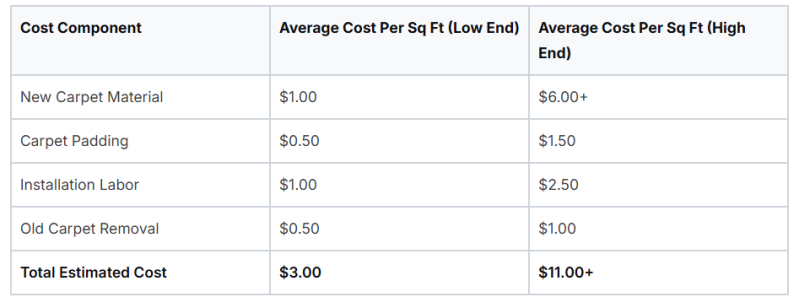
As you can see, your choice of carpet and the cost of labor are the two biggest drivers, but every component adds up.
Recent data from 2026 shows that even in expensive markets like New York and Connecticut, costs generally fall within that same $3 to $11 per square foot window. For a typical 1,000-square-foot space, that means you could be looking at a total project cost anywhere from $3,000 to $11,000.
Of course, national averages often tell a slightly different story. Some figures put the average project closer to $1,780, which shows just how much your location and the specifics of your job can swing the final price. For a deeper dive, you can explore more about these national carpet installation cost averages in a recent report.
Key Factors That Drive Your Total Carpet Cost
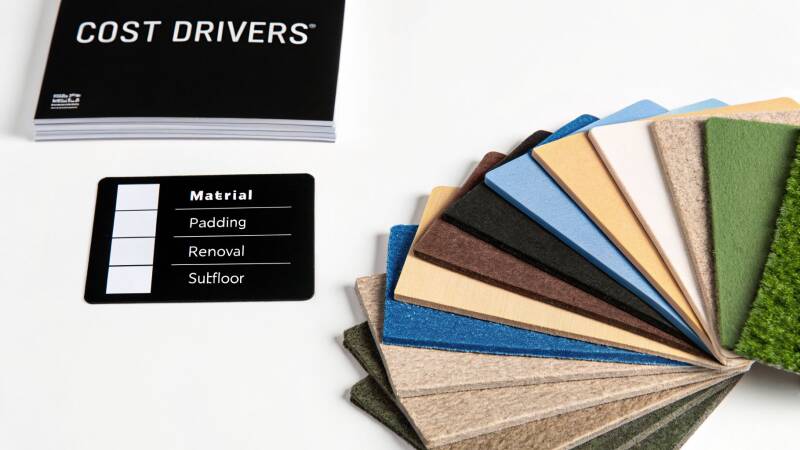
When you get a quote for new carpet, that final number can be a bit of a surprise if you're not sure what you're looking at. The price isn't just for the carpet itself; it's a bundle of different costs that come together to form your total investment. Knowing what these are is the key to creating a budget that works for you and your home.
I like to explain it this way: think of it like building a custom pizza. The base price gets you the dough and sauce, but the final cost really depends on what toppings you add. Premium ingredients like fresh mozzarella and prosciutto will always cost more than standard pepperoni. The same logic applies directly to your flooring.
Your total carpet replacement cost per sq ft is driven by four main "toppings." Let's pull them apart so you can see exactly where your money is going.
Carpet Material and Fiber Type
The single biggest piece of the puzzle is the carpet itself. The fiber you choose has a huge impact on the price, but it also determines how your carpet will stand up to daily life—its softness, durability, and ability to resist stains.
Here’s a quick look at the most common options you'll run into:
- Polyester: If you want vibrant colors and a soft feel on a budget, polyester is a solid choice. It's a great fit for low-traffic spots like a guest bedroom, but it might not hold up as well in a busy hallway.
- Nylon: This is the real workhorse of the carpet world. Nylon is incredibly tough and wear-resistant, which is why it's my go-to recommendation for high-traffic zones like living rooms, stairs, and playrooms. It costs a bit more than polyester, but you get much better longevity for your money.
- Wool: As a natural fiber, wool is the luxury option. It’s unbelievably soft, naturally durable, and an eco-friendly choice, but it definitely comes with the highest price tag.
Beyond the fiber, the quality and style also matter. For example, carpet material prices per square foot can range from $1-$3 for a budget-friendly polyester—perfect for landlords in Dutchess or Putnam Counties—all the way up to $5-$20 for a high-end wool used in luxury flips in Westchester.
For 2026, a good rule of thumb is that quality entry-level carpet starts at $1-$5 per sq ft, a better-grade product runs $4-$8.50, and the best options will set you back $7.60-$17 or more. You can dive deeper into how material choices impact flooring costs to see more detailed pricing tiers.
Padding Quality and Thickness
Carpet padding is the unsung hero of any flooring project. It’s that layer of foam between the carpet and the subfloor, and its impact is massive. I’ve seen it time and time again: skimping on the pad is a classic mistake that can seriously shorten the life of your new carpet.
Expert Insight: High-quality padding acts as a shock absorber. It protects the carpet fibers from getting crushed every time someone walks on them. A good pad not only makes the floor feel more cushioned and luxurious but also prevents premature wear, adding years to your investment.
A decent pad will typically add $0.50 to $1.50 to your carpet replacement cost per sq ft. It might feel like an easy place to trim the budget, but a cheap, flimsy pad breaks down fast. Before you know it, you're left with a flat, uncomfortable carpet that looks old way before its time.
Old Carpet Removal and Subfloor Preparation
Before the beautiful new carpet goes in, the old stuff has to come out. This isn't just a matter of rolling it up and carrying it away. The crew has to remove the old padding, pull up hundreds of staples, and pry out the tack strips that held everything in place. This service generally costs between $0.50 and $2.00 per square foot.
Once the old carpet is gone, the job isn't done. The subfloor needs a thorough inspection. For a perfect installation, you need a subfloor that is clean, flat, and structurally sound. If the installers discover problems like water rot, squeaky floorboards, or uneven surfaces, those repairs have to be made first, which will add to your total cost. If you're tackling a big renovation and have a lot of debris, you might want to look into professional junk removal services to get a truly clean slate.
What You're Really Paying For in Carpet Installation Labor
It’s easy to look at a quote, see the line for labor, and wonder what you're actually paying for. Think of it this way: you could buy a suit off the rack, or you could have one custom-tailored. Professional carpet installation is the custom-tailored version—it's all about the craftsmanship. That expert fit is what prevents buckling, ugly seams, and premature wear, making it a critical part of your carpet replacement cost per sq ft.
On average, you can expect professional labor to run between $1 to $3 per square foot. This isn't just for the time it takes to lay the carpet down. That fee covers all the small, crucial details that lead to a flawless and long-lasting installation.
What's Included in the Installation Fee
So, what does that per-square-foot labor cost actually get you? A pro installer's work is a mix of precision, problem-solving, and sheer hard work from beginning to end.
Here’s a breakdown of what that fee typically covers:
- Precise Measurements: Getting the room's dimensions just right to order the correct amount of carpet, which minimizes waste and saves you money.
- Carpet and Padding Layout: This is a bit like solving a puzzle. They strategically plan where to place seams so they're hidden in low-traffic areas and out of your direct line of sight.
- Trimming and Cutting: Making meticulous cuts to ensure the carpet fits perfectly around tricky spots like vents, door jambs, and built-ins.
- Seaming: Using a special seaming iron and tape, installers fuse two pieces of carpet together to create a bond that’s strong and virtually invisible.
- Stretching: This is essential. Using a power stretcher, they pull the carpet taut across the room. Without proper stretching, you’ll end up with ripples and bumps in no time.
This detailed process is the difference between a floor that looks good for a year and one that looks fantastic for a decade. It's an investment in quality.
Why Labor Costs Vary by Location and Complexity
No two installation jobs are the same, and your quote will absolutely reflect that. A simple, square room is one thing, but a project with unique challenges will naturally have higher labor costs.
Labor is the art and science of the installation. A pro installer anticipates how a room's humidity or an uneven subfloor might affect the carpet over time and takes steps to prevent problems before they start.
Geography plays a huge role in what you'll pay. While national averages for labor can sit around $0.50 to $1.50 per square foot, we've seen those rates climb much higher in certain markets. For instance, costs in the Northeast, particularly in areas like New York and Connecticut, often hit that $1 to $3 per square foot range. This is driven by higher local wages and the complexities of working in older homes. The median hourly wage for installers has been on the rise, directly impacting project prices. You can see more on these current carpet installation cost trends and how they differ from one region to another.
Beyond location, a few other factors can increase your labor costs:
- Stairs: Carpeting stairs is a slow, methodical process that requires a lot of cutting and fitting. It’s one of the most labor-intensive parts of any carpet job.
- Irregular Room Shapes: If your room has multiple angles, nooks, or closets, it demands more planning and intricate cuts from the installer.
- Furniture Moving: Some installers include moving basic furniture in their price, but many will charge an extra fee for handling large, heavy items. It’s always best to clarify this upfront.
Calculating Your Project Cost with Real-World Examples
Seeing the carpet replacement cost per sq ft as just a number doesn't really help you budget. So, let's ground these figures in reality. We’ll walk through a few common scenarios to see how room size, carpet quality, and other little details add up to a final price tag.
Once you understand how these estimates are built, you'll have a much better handle on where your money is going and how you can adjust your own project to fit your budget.
Meet the 'Waste Factor'
Before we get to the numbers, there’s a crucial concept every professional installer works with: the waste factor. Carpet is manufactured in standard roll widths, usually 12 feet or 15 feet. Your rooms, however, are rarely perfect multiples of those dimensions.
To make everything fit seamlessly, installers have to cut and trim, which always creates some leftover material. To account for this, pros add a 10-15% waste factor to your room's total square footage. This isn't about overcharging; it's about ensuring they have enough carpet to handle odd angles, match patterns perfectly, and avoid running short.
Sample Carpet Replacement Cost Estimates by Room Size
To bring this all together, the table below shows how different quality tiers affect the total project cost for three common room sizes. These estimates include the carpet itself, padding, and standard installation labor.
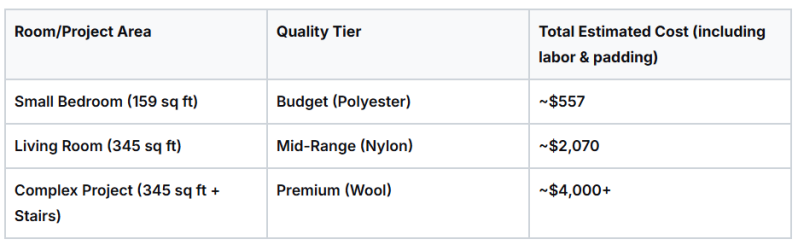
As you can see, the final cost is a direct result of your material choices and the complexity of the job. A premium carpet in a large, complex space will naturally cost significantly more than a budget-friendly option in a small, simple room.
Scenario 1: The Small Bedroom Project
Let's start small with a standard 12' x 12' bedroom. That's 144 square feet of floor space. Adding a 10% waste factor (14.4 sq ft) means we need to buy for roughly 159 square feet.
- Budget-Friendly (Polyester): At about $3.50/sq ft installed, the total comes to around $557. This is a perfectly smart choice for a low-traffic guest room.
- Mid-Range (Nylon): Bumping up to $6.00/sq ft installed brings the total to $954. For a kid's room or home office, that extra durability is often well worth it.
- Premium (Wool): Going all out at $10.00/sq ft installed would cost about $1,590, turning the bedroom into a seriously luxurious and comfortable space.
Seeing how these choices play out in real life can make all the difference. To get a better feel for what you like, it helps to check out some before-and-after home service projects for inspiration.
Scenario 2: The Standard Living Room
Now for a more spacious 300 sq ft living room. The layout might be a bit more complex, so we'll apply a 15% waste factor, bringing our material order to 345 square feet. Since living rooms get a lot of foot traffic, this is a place where investing in quality really pays off in the long run.
Key Takeaway: It's tempting to go with the cheapest option to save money now, but a durable mid-range carpet might last twice as long in a high-traffic area. This can save you the headache and expense of replacing it again in just a few years.
Scenario 3: The Complex Project with Stairs
Finally, let’s look at a tougher job: a 300 sq ft room plus a standard 13-step staircase. Installing carpet on stairs is tricky and time-consuming, so installers almost always add a separate fee per step—often $15-$25 per step—on top of the regular square footage cost.
On top of that, your location plays a huge role in the labor cost, which can dramatically affect your final bill.
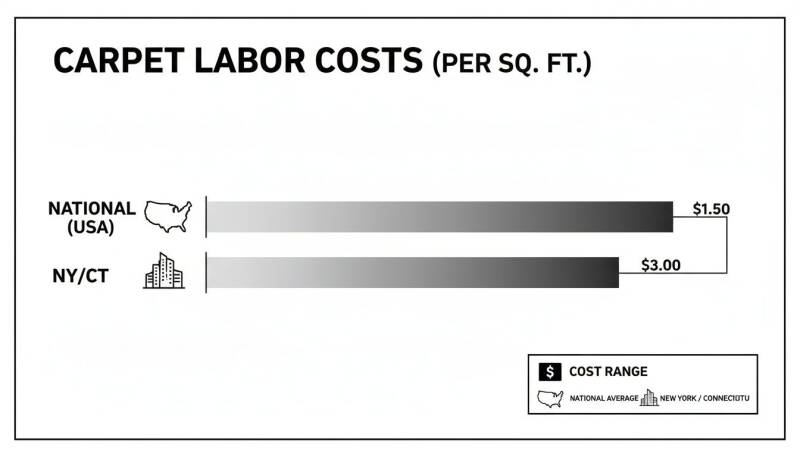
This chart shows it clearly: labor rates in places like New York and Connecticut can easily be double the national average. That's a significant difference that you absolutely need to factor into your budget.
How to Save Money on Your Carpet Replacement
Everyone wants that plush, brand-new carpet feel under their feet, but nobody wants to drain their bank account to get it. The great thing is, you don't have to choose between quality and cost. A few smart decisions can seriously lower your carpet replacement cost per sq ft without forcing you to settle for a floor you won't be happy with.
Think of it this way: some of the easiest savings are found in tasks you can handle yourself. For instance, your installer will happily move all your furniture out of the room, but they'll add a fee for it. Clearing the room yourself is an instant win for your budget. The same logic applies to the old carpet; if you're up for some hands-on work, tearing it out and hauling it away can save you $1 to $2 per square foot.
Think Long Term to Save More
Here’s a classic mistake I see homeowners make all the time: they grab the cheapest carpet off the roll to save a buck today. This almost always backfires. That low-grade carpet might look fine at first, but put it in a busy hallway or living room, and it can start looking worn and matted in just a couple of years. Suddenly, you're right back where you started, paying for another replacement.
Key Insight: The smartest financial move is often investing slightly more in a durable, mid-range carpet and high-quality padding. A resilient nylon carpet might last twice as long as a budget polyester, effectively cutting your long-term flooring costs in half.
This approach gives you a much better return on your investment. You end up with a floor that not only feels more luxurious but also stands up to kids, pets, and daily foot traffic without giving up. Good padding is your carpet's best friend—it acts as a shock absorber, protecting the carpet fibers and adding years to its life.
Strategic Timing and Smart Shopping
Beyond the carpet itself, when you schedule your project can make a real difference. The flooring world has its own busy seasons, particularly in the spring and right before the holidays. If you can wait for the slower months, like late fall or deep winter, you might find installers have more wiggle room on their labor rates.
Here are a few other pro tips to get the most for your money:
- Ask About Remnants: If you only need to carpet a small space like a bedroom or walk-in closet, always ask about remnants. These are the leftover ends of large carpet rolls that stores sell at a huge discount.
- Get Itemized Quotes: Never settle for a single bid. Get at least three detailed quotes that break down the price for the carpet, padding, labor, and removal. This is the only way to truly compare apples to apples.
- Handle Your Own Baseboards: If you're comfortable with a hammer and pry bar, removing and reinstalling your own baseboards is another great way to shave a little off the labor bill.
By combining some DIY spirit with smart material choices and savvy shopping, you can take firm control of your budget and still get a beautiful, long-lasting result.
Your Next Steps for a Flawless Carpet Project
So now you have a much clearer picture of the carpet replacement cost per sq ft. With that knowledge in hand, you're ready for the most important part of the project: finding the right professional to install your new floors. This isn't just about hiring labor; it's about finding a true partner who will get the job done right the first time.
Your first move should be to get at least three detailed, itemized quotes. A good quote isn't just a single number—it breaks everything down line by line. You should see separate costs for the carpet itself, the padding, labor, tear-out of the old flooring, and disposal. This level of detail is a huge sign of a trustworthy installer and lets you compare your options fairly, with no surprises down the road.
A great installer does more than just lay carpet. They’re your project manager, handling everything from the initial, precise measurements to checking the subfloor and cleaning up when they’re done. They take ownership of the job so you can simply enjoy the result.
How to Vet Your Installer
When you start talking to potential installers, you need to do a little homework to protect your investment. Here’s a quick checklist to run through with every contractor you consider:
- Verify Insurance: Ask for proof of both liability insurance and workers' compensation. This is non-negotiable and protects you from any accidents on your property.
- Ask for Local References: A confident pro will be happy to share contact information for recent, local customers. Give them a call and ask about their experience.
- Review Their Portfolio: Look at photos or, even better, in-person examples of their past work. Pay close attention to how they handle seams, transitions to other flooring, and work around tricky corners.
Ready to find a pro you can trust? If you'd like to start the conversation and get an expert opinion on your project, feel free to contact us for a professional consultation.
Frequently Asked Questions About Carpet Costs
Even after you've picked your perfect carpet and have a budget in mind, a few practical questions always seem to pop up before the work begins. Let's tackle some of the most common ones we hear from homeowners so you can move forward with confidence.
How Long Does It Take to Replace Carpet in a 1,500 Sq Ft Home?
A great rule of thumb for a typical 1,500 sq ft home is about 1 to 2 days from start to finish.
Day one is usually all about prep work: the crew will move furniture, tear out the old carpet and padding, and make sure the subfloor is clean, smooth, and ready for installation. The second day is when the magic happens, as they lay down the new padding and expertly install the carpet.
Of course, this timeline can stretch. If your home has tricky angles, lots of stairs, or if the crew discovers subfloor damage that needs fixing, you might be looking at a third day.
Is It Cheaper to Replace Carpet in the Winter?
It certainly can be. The flooring business has its seasons, and winter—especially right after the holiday rush—tends to be slower.
With fewer projects on the books, installers often have more open schedules. This can sometimes translate into more competitive pricing on labor as they look to keep their crews busy. It's a smart time to shop around for quotes.
Pro Tip: Booking your project during a slower season doesn't just offer potential savings. It often means the installation crew is less hurried, giving them more time to focus on the fine details of your home's installation.
Do I Have to Move My Own Furniture?
This is a big one, and the answer is usually no—but it'll cost you. Most installation companies will happily move your furniture for an extra fee, often charged per room or by the hour.
If you're able-bodied and looking to trim the final bill, moving smaller items yourself is a fantastic way to save. That said, for those massive armoires, king-size beds, or delicate antiques, it’s almost always worth paying the professionals to handle it. They have the right tools and techniques to do it safely. Just be sure to confirm how they handle furniture when you get your initial estimate.
Ready to transform your space with new flooring or clear out the old? D&B Complete Home Services INC. offers expert carpet removal, demolition, and renovation services to get your property ready for its next chapter. Find out how we can help by visiting https://www.dbcompletehomeservices.com.
Add comment
Comments