Learn proven methods to haul dirt away efficiently with contractor-friendly tips, gear, and step-by-step cleanup workflows.
How to haul dirt away: A Contractor's Guide to Efficient Cleanup
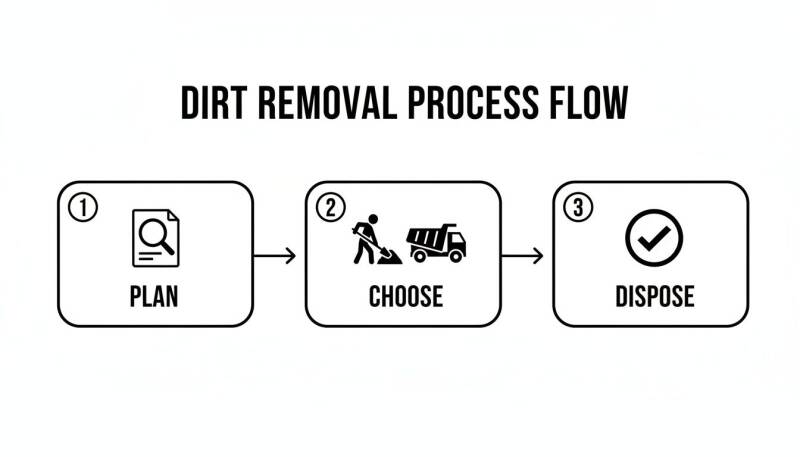
So, you’re finally breaking ground on that new patio, pool, or foundation. It’s an exciting time, but with it comes the one problem nobody really thinks about until it’s staring them in the face: a massive pile of dirt. Now what?
Getting rid of all that excavated soil isn't just a minor chore; it's a project in itself. Let's cut right to the chase—this guide is your complete game plan for hauling dirt away without the common headaches and surprise costs.
Your Dirt Removal Project Starts Here
That mountain of earth is the first real hurdle you'll face. How you handle it from the get-go can make or break your timeline and budget. I’ve seen it happen countless times: a project grinds to a halt because someone underestimated the sheer logistics of dirt removal. It’s a surefire way to turn an exciting home improvement into a messy, expensive nightmare.
This isn't just about moving dirt from point A to point B. It’s about doing it smartly. We’re going to walk through the entire process, covering everything from how to figure out what you’re really dealing with to whether a DIY rental or a professional service makes more sense for you.
What This Guide Covers
We’ll break it all down into practical, manageable pieces so you can get this done right. Here’s what we’ll dig into:
- Calculating Volume & Weight: You'll learn the right way to measure your dirt pile and, just as importantly, how to account for the "fluff factor"—that sneaky expansion that happens when compacted soil gets dug up.
- DIY vs. Professional Haulers: We’ll lay out a real-world comparison of the costs, time, and hidden risks of tackling it yourself versus bringing in an expert hauler.
- Disposal Rules & Regulations: This is a big one. We'll navigate the specific laws for dirt disposal in New York and Connecticut, so you can avoid steep fines and know exactly what "clean fill" means to local authorities.
- Safety & Cleanup: We'll wrap up with actionable tips for keeping your property and everyone on-site safe, plus how to ensure you're left with a clean slate once the dirt is gone.
The core challenge isn't just moving the dirt; it's managing the weight, volume, and local regulations that come with it. A single cubic yard of soil can weigh between 2,000 and 3,000 pounds—a detail that many DIY projects overlook until a truck is dangerously overloaded.
By the time you're done reading, you’ll have a clear, actionable strategy. Whether you're a homeowner gearing up for a big landscaping job or a contractor managing a site, you'll know exactly how to handle that mountain of dirt. And if you decide the job is too big to go it alone, you can learn more about professional hauling solutions from D&B Complete Home Services.
How to Accurately Calculate Your Dirt Volume
Before you pick up the phone for a quote or start looking at truck rentals, you’ve got to know exactly how much dirt you need to move. Guessing is the surest way to overpay for a half-empty truck or, worse, get stuck making multiple trips you never planned for. Nailing this number from the get-go is the most important part of your entire dirt removal plan.
Let's get right to it. The standard unit we use in this business is the cubic yard. To figure this out, you'll need to measure your dig site—the length, width, and depth—all in feet. Multiply those three numbers together.
- Length (ft) x Width (ft) x Depth (ft) = Total Cubic Feet
Got your cubic feet? Great. Now just divide that by 27, since there are 27 cubic feet in one cubic yard. That’s your baseline volume.
From Paper to Reality: The Fluff Factor
Here’s a rookie mistake I see all the time. That dirt you're digging up has been tightly compacted in the ground for who knows how long. As soon as your shovel hits it, it expands. We call this the "fluff factor" or "swell," and it can increase your soil's volume by a surprising 25% to 50%.
Think about it: you calculate a neat 10 cubic yards of dirt. But once it's dug up and loose, that same dirt could easily fill 12.5 or even 15 cubic yards of space in a dumpster. If you don't account for this, your estimates are going to be way off.
As a rule of thumb, I always tell people to multiply their initial cubic yard calculation by 1.3. This accounts for a 30% swell and gives you a much safer, more realistic number to work with.
Let’s walk through a quick example. You're putting in a 10-foot by 15-foot patio and need to dig down 6 inches (that’s 0.5 feet).
- 10 ft (Length) x 15 ft (Width) x 0.5 ft (Depth) = 75 cubic feet
- 75 cubic feet / 27 = 2.78 cubic yards
Now for the reality check. Let's apply that fluff factor: 2.78 x 1.3 = 3.61 cubic yards. All of a sudden, your pile is nearly a full cubic yard bigger than you first thought. Seeing how the numbers change shows why you need a solid plan from start to finish.
Don't Forget About Weight
Finally, let's talk about weight. Volume tells you how much space the dirt takes up, but weight determines what can actually move it. This is just as critical.
The numbers can vary wildly. A cubic yard of dry, loose topsoil might weigh around 2,000 pounds. But that same cubic yard of dense, wet clay? That can easily hit 3,000 pounds or more.
Consider that most standard pickup trucks are only rated to handle about 1,500-2,000 pounds in the bed. That means you might not even be able to safely haul a single cubic yard of heavy dirt. Knowing both the volume and the likely weight is the only way to choose the right equipment, stay safe, and avoid damaging your vehicle or breaking the law.
DIY Haul or Hire a Pro? Making the Right Call
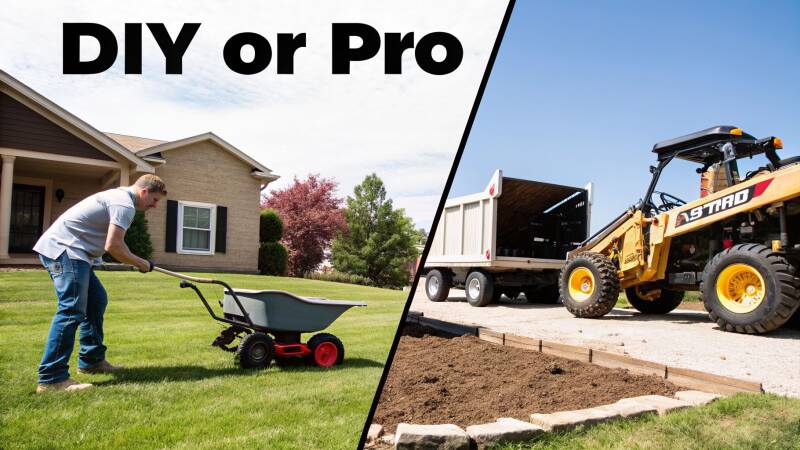
Alright, you’ve got your numbers. You know how much dirt you’re dealing with, and you have a good sense of the weight. This is the crossroads where you decide: do you roll up your sleeves and tackle this yourself, or do you bring in a professional hauling service?
There’s no single right answer—it really comes down to your budget, your timeline, and, most importantly, how much back-breaking labor you’re really up for.
The Gritty Reality of DIY Dirt Hauling
On the surface, renting a truck and doing it yourself seems like the budget-friendly route. You grab a shovel, a wheelbarrow, and dedicate a weekend to the cause. But I’ve seen it a hundred times: the hidden costs and headaches start piling up faster than the dirt.
When you go DIY, you’re not just the muscle; you're the project manager. That means you’re on the hook for everything, from finding the right truck to figuring out where you can legally dump the dirt.
Here’s a quick rundown of the real-world expenses you can expect:
- Truck Rental: A small dump trailer or a one-ton truck capable of handling a few thousand pounds can easily run you a couple of hundred bucks for the day.
- Fuel Costs: Hauling heavy dirt is a surefire way to kill your gas mileage. Those multiple trips back and forth to the disposal site add up fast.
- Disposal Fees: Transfer stations and landfills charge by weight. Tipping fees typically range from $35 to over $100 per ton. Remember that cubic yard of wet, heavy soil? That alone could set you back a pretty penny just to get rid of it.
- Your Time: Let's be honest, what’s your weekend worth? Are two full days of shoveling dirt how you want to spend it?
And that doesn't even touch on the physical toll. Moving several tons of dirt by hand is exhausting, and it’s a quick way to pull a muscle or throw out your back if you’re not used to that kind of work.
The Professional Hauling Advantage
This is where hiring a team like D&B Complete Home Services completely changes the game. You're not just renting a truck; you're tapping into a streamlined system built for this exact task.
A professional crew brings the right experience and, crucially, the right equipment. A skid-steer can fill a dump truck in minutes—a job that would take one person hours with a shovel and wheelbarrow. That speed turns what could be a multi-day ordeal into a task that’s often done and dusted in a single morning.
The biggest benefit? Peace of mind. A pro team handles all the logistics—legal disposal, the right equipment to protect your lawn and driveway, and full insurance coverage. You just point at the pile, and it disappears.
To help you visualize the trade-offs, here’s a simple side-by-side comparison:
DIY vs. Professional Dirt Hauling Comparison
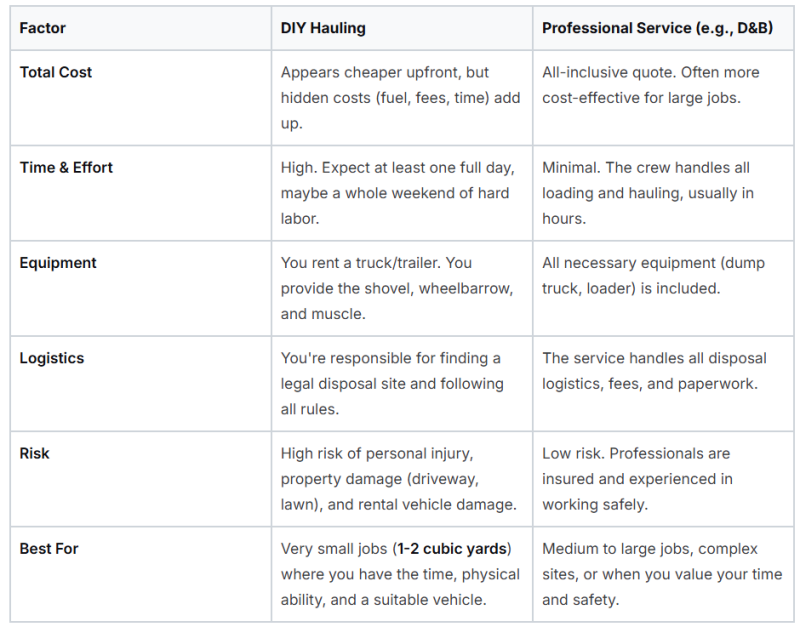
The bottom line is that for anything more than a small garden project, the value a professional service provides becomes clear very quickly.
And it’s a common need—renovation and landscaping projects generate a ton of excess soil. Globally, the construction waste market hit USD 232.1 billion in 2024, and residential projects accounted for 40.6% of that. So if you're staring at a mountain of dirt, you're definitely not alone.
Better yet, if your pile is a mix of dirt, rocks, concrete chunks, or other debris, a professional hauler is your best bet. Most DIY truck rentals have strict rules against mixed materials. A full-service company can manage it all. At D&B, our junk removal services are designed for these exact situations, making even a messy cleanup a simple, one-call solution.
So, Where Does All That Dirt Go? Handling Disposal in New York & Connecticut
Okay, you've got a pile of dirt. Now for the tricky part. Getting rid of it in places like Westchester, Putnam, Dutchess, and Fairfield counties isn’t as simple as finding a spot to dump it. Local regulations are tight for a reason, and trying to get around them with illegal dumping can land you some seriously hefty fines.
Knowing how to properly dispose of your soil is every bit as important as the digging itself.
The Magic Words: "Clean Fill"
Your main destination will be a licensed transfer station or a landfill that specifically accepts clean fill. This is a term you absolutely need to know.
From a hauler's perspective, clean fill is pure, natural earth. We're talking about soil, clay, sand, and gravel with nothing else mixed in. If your pile contains chunks of concrete, old roots, splintered wood, asphalt, or any other junk, it’s not clean fill. It’s that simple.
Disposal sites are incredibly strict on this. Show up with a truckload of contaminated soil, and they'll turn you right around. It’s a huge waste of your time, effort, and money. This is honestly one of the biggest reasons people hire pros—we know exactly what to look for and where each type of material can legally go.
A Word of Caution: Before you move a single shovelful, be confident your dirt is "clean." If the soil is coming from a property with a long history, an old industrial site, or anywhere chemicals might have been used, you may even need professional testing. Skipping this step can lead to major environmental and legal headaches.
It's a bigger issue than most people realize. The EPA reported that in 2018 alone, construction and demolition projects generated over 600 million tons of debris in the United States. To keep our local landfills from overflowing, following the rules for soil disposal isn't just a good idea—it's essential.
Your Disposal and Reuse Options
If you've confirmed you have genuine clean fill, you’ve got a few paths forward here in New York and Connecticut.
- Local Transfer Stations: Your first call should be to your town or county's public works department. They can point you to the right facilities. Make sure to ask about their specific rules for soil, their operating hours, and how they charge—it's almost always by weight (per ton).
- Private Landfills: Some private disposal sites also take clean fill, and it's worth checking their rates. A quick search for "clean fill disposal near me" will give you a list, but always call them first to confirm they'll accept your load.
- Find a New Home for It: This can be the cheapest and best option. Post an ad on a local Facebook group or Craigslist offering "free clean fill dirt." You'd be surprised how many landscapers or neighbors need dirt for a grading project and will happily take it off your hands. It can save everyone a trip to the dump.
Figuring all this out takes time, from calling around to verify the rules to arranging the actual transport. For some more ideas on handling project leftovers, you might find our junk removal tips and resources helpful.
When you bring in a professional hauler, you're getting more than just a truck and a driver. You're paying for the peace of mind that comes from their expertise in compliance, logistics, and responsible disposal. It ensures your project gets done right, without any lingering regulatory worries.
Job Site Safety and Final Cleanup Practices
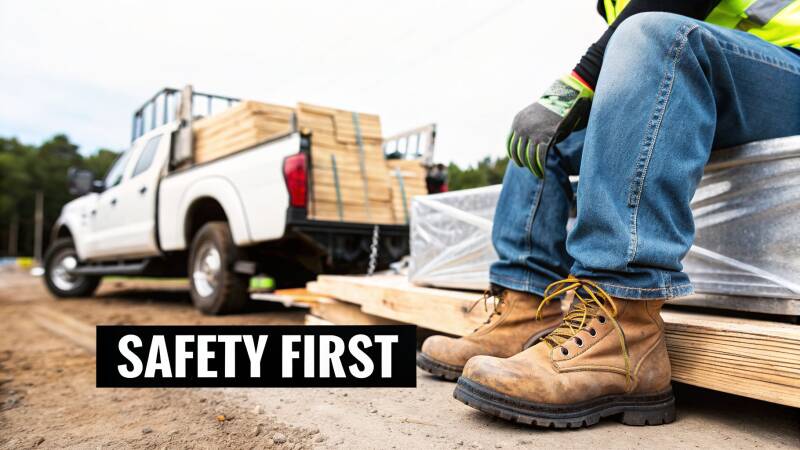
Let's be blunt: moving thousands of pounds of dirt is serious work. It’s not just about getting the soil from point A to point B. This is where a project can go sideways fast, leading to damaged property or, far worse, personal injury. Safety isn’t just a buzzword; it's a mindset that has to cover every step, from the first scoop of dirt to the final sweep of the broom.
Before anyone even thinks about picking up a shovel, we need to talk about Personal Protective Equipment (PPE). This is your first line of defense. At the very least, everyone on site should be wearing steel-toed boots, heavy-duty work gloves, and safety glasses. No excuses.
Protecting Yourself and Your Property
Once you’re properly geared up, the physical work starts—and so do the risks. You’ve probably heard it a million times, but it bears repeating: lift with your legs, not your back. A thrown-out back is one of the most common DIY project injuries, and it often comes from trying to lift too much, too fast.
Protecting your property is just as critical. A skid steer might save you hours of back-breaking labor, but it can absolutely destroy a lawn or crack a driveway in minutes. A professional crew knows this and will use ground protection mats or choose smaller, more agile equipment to navigate tight spaces. If you're renting the machinery yourself, walk the path from the street to the dig site first. Plan exactly where you'll drive to avoid tearing up your yard or running over a sprinkler head.
Thinking about safety on a small scale is one thing, but the consequences of mishandling excavated materials can be massive. Tragic events like the 2015 Shenzhen landslide, where a mountain of excavated dirt collapsed, are a grim reminder of the physics involved. Closer to home, large-scale cleanups after disasters like Hurricane Harvey highlight why strict regulations and professional hauling practices are so crucial. You can discover more insights about the challenges of large-scale waste management and how these events shape the rules we follow.
Securing the Load for Transport
Okay, the truck is loaded. Before you put it in drive, you have one more crucial safety check. An uncovered or poorly secured load of dirt is a major hazard on the road. Flying dust can blind drivers behind you, and stray rocks or clumps of soil can easily crack a windshield.
- Use a Heavy-Duty Tarp: Don't cheap out here. You need a tarp that can handle highway speeds without shredding.
- Get It Taught: Use plenty of bungee cords or tie-downs to pull the tarp tight over the entire load. Make sure wind can't get underneath it and turn it into a parachute.
- Don't Overfill: A good rule of thumb is to leave at least 6 inches of clearance between the top of the dirt and the sides of the truck bed. This prevents spillage on turns and bumps.
The Final Professional Touch
The last of the dirt is gone, but the job isn't done. The final cleanup is what really separates a professional job from an amateur one. A pro leaves the site looking neat and ready for whatever comes next.
This means getting out the brooms and sweeping every bit of tracked dirt and mud off your driveway, sidewalk, and street. Over at the excavation area, take a rake and smooth out any deep ruts or messy piles left behind by the equipment. This last bit of effort makes a huge difference, leaving you with a clean slate for the next phase of your project.
When to Call a Professional for Dirt Hauling
There's a real satisfaction in tackling a project yourself, but when it comes to hauling dirt, you can hit a tipping point fast. Knowing when to put down the shovel and pick up the phone is the key to keeping your project safe, on schedule, and within budget.
The most obvious sign you need a pro is the sheer size of the job. If you’re digging out a pool, prepping a home addition, or pouring a new foundation, the volume of soil is simply too much for a DIY approach. What looks like a manageable pile can quickly become several tons of material—a weight that's both impractical and unsafe to haul dirt away without commercial-grade equipment.
Key Scenarios for Professional Hauling
It’s probably time to call for help when you run into these common situations:
- Tight Timelines: Let's be realistic. A team with skid steers and dump trucks can clear a site in hours, not the days it would take with a wheelbarrow and pickup truck.
- Tricky Job Site Access: Is your project on a steep hill or in a backyard with a narrow gate? Pros have the right equipment to navigate these challenges efficiently, saving you the back-breaking work of maneuvering a wheelbarrow up and down slopes.
- Mixed Debris: Excavation rarely produces just clean soil. If your dirt pile is mixed with large rocks, old roots, and chunks of broken concrete, a professional service is set up to handle and dispose of it all correctly.
A professional hauler isn't just a truck driver; they're a logistics partner. They manage compliance, transport, and disposal, solving the entire problem so you can focus on the next phase of your project.
For homeowners and contractors in New York and Connecticut, D&B Complete Home Services provides a reliable, no-hassle solution. We take on dirt removal projects of all sizes, guaranteeing a fast, clean, and professional result every single time.
Your Top Questions About Hauling Dirt, Answered
If you're staring at a mountain of dirt from your latest project, you’ve probably got a few questions swirling around. We get it. After years of handling these exact jobs, we've heard them all. Let's get you some clear answers so you can plan your next steps without any surprises.
How Much Does It Cost to Haul Away a Yard of Dirt?
The price tag for hauling away a single yard of dirt can be all over the map, usually landing somewhere between $150 and over $400 per cubic yard.
So what causes that huge swing in price? It really boils down to three things:
- Your Location: Every town and county has different disposal fees (often called tipping fees). We've seen them as low as $35 per ton and as high as $100+ per ton, which makes a massive difference in the final bill.
- Site Accessibility: A clean pile of dirt sitting right on the driveway is the cheapest scenario. But if that dirt is in a tight backyard, requiring wheelbarrows and extra labor to get it to the truck, the cost will naturally go up.
- The Dirt Itself: Not all dirt is created equal. Dry, fluffy topsoil is relatively light. Wet, dense clay, on the other hand, is incredibly heavy. Since disposal facilities charge by weight, heavier soil means higher costs.
Can I Just Put Dirt in a Regular Dumpster Rental?
It's a tempting idea, I know: just toss the dirt in a rental dumpster, right? Unfortunately, this almost never works. Standard dumpster rental companies have very strict rules against filling their bins with soil, and it comes down to simple physics.
First off, dirt is unbelievably heavy. A single cubic yard can easily weigh up to 3,000 pounds. That kind of weight can blow past a dumpster’s legal limit, making it dangerous and illegal to haul on the road.
You'll find that most dumpster contracts either forbid soil entirely or allow only a tiny amount. If you try to fill a big roll-off with dirt, you’re setting yourself up for hefty fines or an outright refusal to pick it up. Then you’re left with the same dirt pile, plus a new, expensive problem.
What Is Considered Clean Fill Dirt?
This is probably the most important term to understand when you're getting rid of soil. Clean fill is just what it sounds like: natural earth that hasn't been contaminated. This means soil, clay, sand, and small, naturally occurring rocks are okay.
What it cannot contain is anything else. If your dirt is mixed with grass clippings, roots, stumps, concrete chunks, plastic, trash, or any other man-made debris, it’s no longer considered clean fill.
Disposal sites and recycling facilities are incredibly strict about this. They will inspect your load and will turn you away if it's contaminated, leaving you to figure out how to sort it all out. Making sure your dirt is clean from the start is the key to a hassle-free disposal.
When the questions get complicated and the dirt pile gets too big, let D&B Complete Home Services INC. provide the simple answers and professional muscle. Get your free estimate today and let us handle the heavy lifting.
Add comment
Comments