
Feeling stuck discarding old furniture? Discover practical, real-world options from donation and selling to recycling and professional removal in NY & CT.
Your Smart Guide to Discarding Old Furniture
So, you're standing there, staring at that old couch or wobbly dresser, and wondering what to do with it. Getting rid of old furniture doesn't have to be a massive headache, but the first move is always the same: a quick, honest look at its condition. This little step is what separates a piece that's ready for a new life from one that’s truly at the end of the road.
Your First Step Before Discarding Old Furniture
Before you even think about lifting that heavy armoire or trying to wrestle a mattress out the door, taking a few minutes to evaluate it can save you a world of time, money, and back pain. Seriously. The path you take—selling, donating, recycling, or calling in the pros—all comes down to the item's current state.
Being realistic from the get-go is key. It prevents that frustrating moment when a donation center turns you away or a potential buyer on Marketplace points out a flaw you hadn't considered. This isn't just about saving you a headache, either. It’s about making a responsible choice that keeps usable furniture out of our already-crowded landfills.
Assess What You Have
Okay, it’s time to look at your furniture with a critical eye. We all get used to our own stuff, so try to see it the way a stranger would. Ask yourself a few practical questions:
- Is it sturdy? Give it a good shake. Do the legs wobble? Are the drawers stuck or do the doors hang crooked?
- What does the surface look like? We're not talking about minor scuffs. Look for deep scratches, big water rings, or veneer that's peeling off.
- How's the fabric? For sofas and chairs, check for obvious rips, major stains, or any funky smells. Is the color faded or the fabric worn thin in spots?
- Does it still work? A dresser with a drawer that won’t open, or a bed frame with a cracked slat, has pretty limited appeal.
Here's a solid rule of thumb I always tell people: If you wouldn't feel good about giving it to a friend to use in their home, it’s probably not a great candidate for donation or resale without some serious work.
This whole process can feel a bit overwhelming, so a visual guide can really help clarify your next move.
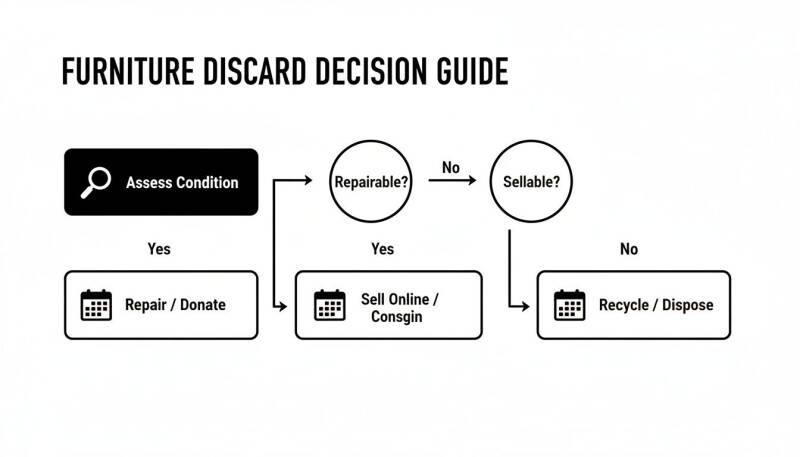
This flowchart cuts through the noise and points you toward the most practical disposal option based on what you're working with.
Furniture Disposal Decision Matrix
To make it even simpler, I've put together this quick-reference table. It helps you weigh your options based on the furniture's condition and how much time and effort you're willing to put in.
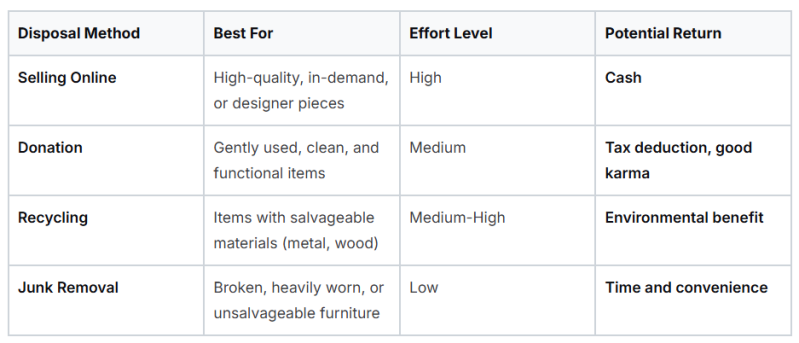
Think of this table as your cheat sheet. Match your item and your situation to the right row, and you'll have your answer.
It's clear people are looking for better ways to handle unwanted items. The global furniture recycling market was valued at $12.7 billion in 2021 and is on track to hit $16.8 billion by 2025. This shift means more and better options are popping up for homeowners who want to do the right thing. If you're interested in diving deeper, you can find more helpful junk removal tips and resources on our site.
Give Your Furniture a Second Life: Selling vs. Donating

So, you've decided your old furniture is still in pretty good shape. Fantastic! This is your chance to do something great with it instead of just sending it to the curb. Giving your old pieces a second life is easily the most rewarding and sustainable way to go, both for your community and your wallet.
The big question now is whether to donate or sell. Honestly, it usually boils down to the item's value versus how much time you're willing to spend. Selling can definitely put some cash in your pocket, but it takes work. Donating is often the faster way to clear out a room while knowing you're helping someone out.
Finding a Good Home: Local Donation Options
For those of us in Westchester, Putnam, Dutchess, and Fairfield counties, we're lucky to have several fantastic local organizations that are happy to take gently used furniture off our hands. It's a much better feeling than watching a perfectly good table get crushed in a landfill.
Many of these charities will even come to you and pick up larger items, which is a lifesaver when you're dealing with a sectional sofa or a heavy armoire.
A few of our go-to local spots include:
- Habitat for Humanity ReStore: With locations right in our service area, they take a huge variety of furniture, appliances, and even building materials. Your old dresser could help fund an affordable home for a local family.
- The Salvation Army: A household name for a reason. They're well-known for offering free furniture pickups, and your items help support their adult rehabilitation programs.
- Goodwill: Much like The Salvation Army, Goodwill directs the proceeds from your donated goods to fund vital job training and employment services for people who need a hand up.
A quick pro-tip: Always check the charity's website or give them a call before you schedule anything. They all have specific rules about what they can accept, and a quick check saves everyone a headache later on.
Turning Your Old Furniture into Cash
Got a piece that's particularly stylish, antique, or from a popular brand? Selling it is a great move. Online marketplaces have made it easier than ever to find a local buyer who is looking for exactly what you have.
Platforms like Facebook Marketplace and OfferUp are my top recommendations for furniture. They're free, simple to use, and connect you with people right in your area, which is essential when you can't exactly ship a dining set.
To get your item sold fast, you need to make your listing pop. Here’s what I’ve learned works best:
- Stage a Mini Photoshoot: Good lighting is everything. Pull the piece away from the wall, clear the clutter around it, and snap photos from every angle. If there's a small scratch, take a picture of it—honesty sells.
- Write a Killer Description: Don't just say "brown couch." Include the dimensions, the brand name if you know it, and a clear description of the condition. Think like a buyer and use keywords they might search for, like "mid-century modern dresser" or "sturdy oak dining table."
- Price It to Move: Do a quick search for similar items in your area to see what they're selling for. If you price your item just a little bit below the average, you'll get a lot more interest, and a much quicker sale.
Whether you donate or sell, you’re giving your old furniture a new chapter instead of a final one. It’s a win for the environment, a win for the community, and maybe even a little win for your bank account.
Making Sense of Local Recycling and Waste Rules

So, what happens when a piece of furniture is just too far gone for a second life? When it's broken, stained, or simply worn out, responsible disposal is your final option. But this isn’t as simple as dragging it to the curb and hoping for the best. Both New York and Connecticut have specific local rules for discarding old furniture, and getting it wrong can lead to a fine.
Every town has its own playbook for bulk waste, and believe me, they can be wildly different. What works in a town in Westchester County might not be the right way to do it over in Fairfield. The very first thing you should do is check the website for your local municipality’s sanitation or public works department. That’s where you’ll find the official rules of the road for getting rid of large items.
How Curbside Bulk Pickup Actually Works
Most towns do offer some kind of curbside collection for bulky items, but it’s never a free-for-all. You can’t just haul a massive sectional to the end of your driveway on a whim and expect it to disappear.
From my experience, here are the common restrictions you'll run into:
- You almost always have to schedule it. This usually means calling ahead or filling out a form on the town's website to book a specific pickup day.
- There are strict limits on how much you can put out. Many towns cap it at 1-3 large items per pickup, so this route won't work for a full estate cleanout.
- Some items are flat-out prohibited. Things like mattresses, electronics, or anything with hazardous materials are typically excluded from regular bulk collection.
Ignoring the rules—like forgetting to schedule or putting out too much stuff—is the fastest way to get a citation from code enforcement. It’s always worth the five minutes it takes to double-check.
The biggest mistake I see people make is assuming all furniture is the same in the eyes of the sanitation department. A metal bed frame might be considered recyclable scrap, but a particleboard bookshelf is often just plain trash. Knowing what you have is half the battle.
Decoding Local Furniture Recycling
Recycling is a fantastic, eco-friendly choice, but it does take a bit more legwork. Not all furniture is created equal at the recycling center; whether an item can be recycled comes down to what it’s made of.
Here’s a general guide to what’s usually recyclable:
- Metal: Things like bed frames, filing cabinets, metal table legs, and old patio furniture are almost always accepted.
- Untreated Wood: Solid wood from a simple table or chair can sometimes be recycled, but anything laminated, painted, or pressure-treated is usually a no-go.
- Clean Mattresses: Some specialized facilities will actually break down mattresses and box springs to recycle the metal coils and foam components separately.
For those of us in the Northeast, we're actually in a great position to make these greener choices. North America is at the forefront of the global furniture recycling market, driven by strong environmental awareness. This means our local communities often have better systems in place for this kind of thing. You can learn more about these furniture recycling market trends. When the local rules feel a bit complicated, that’s where professional services can step in to make sure your old items are handled the right way.
When to Call in the Pros for Junk Removal
Let’s be real for a moment. While the DIY spirit is admirable for a small end table or a manageable chair, some furniture disposal jobs are just plain overwhelming. There are times when trying to muscle through it yourself isn't just a hassle—it's a bad idea.
This is less about giving up and more about making a smart call to save your time, energy, and maybe even your back.
Think about that monstrous, beast of a sleeper sofa that’s been lurking in your basement for a decade. Or the solid wood, floor-to-ceiling entertainment center from the 90s. These things are heavy. We're talking hundreds of pounds. Trying to wrestle one of those out the door is a perfect recipe for pulled muscles, gouged walls, and scratched hardwood floors. This is exactly when a professional team is worth every penny.
Another clear sign it's time to call for backup is when you’re dealing with a whole house full of furniture, not just a single piece. Estate cleanouts, major downsizing projects, or clearing out a cluttered rental property can leave you staring at a mountain of unwanted stuff. The sheer logistics of coordinating that kind of volume are enough to make anyone's head spin.
The Hidden Costs of a "Free" DIY Haul
Doing it yourself might seem like the cheapest option at first glance, but the costs have a funny way of adding up. It's not just about your sweat and effort; there are real dollars and cents involved.
Let’s quickly run the numbers on what a "free" disposal project actually looks like:
- Renting a Truck: Unless you’ve got a heavy-duty pickup sitting in the driveway, you're renting one. That's easily $50-$100 (or more) for just a few hours, and that’s before you factor in mileage and gas.
- Paying at the Dump: Your local transfer station or landfill isn't a free-for-all. They charge by weight, and old, dense furniture can lead to a surprisingly steep bill.
- Your Time is Money: This is the big one people forget. What’s your weekend worth? A Saturday spent wrestling with a dresser is a Saturday you can't get back.
When you factor it all in, the DIY route can get surprisingly close to the cost of hiring a pro, but it comes with 100% of the headache.
The true benefit of a professional service isn't just about the heavy lifting. It's about getting a complete, end-to-end solution. They handle everything—the loading, the transport, and navigating the disposal process—so you don't have to lift a finger or a phone.
DIY vs Professional Junk Removal: A Cost and Effort Comparison
To really see the difference, let's break down the true costs, time, and potential headaches of handling furniture disposal yourself versus hiring a team like D&B.
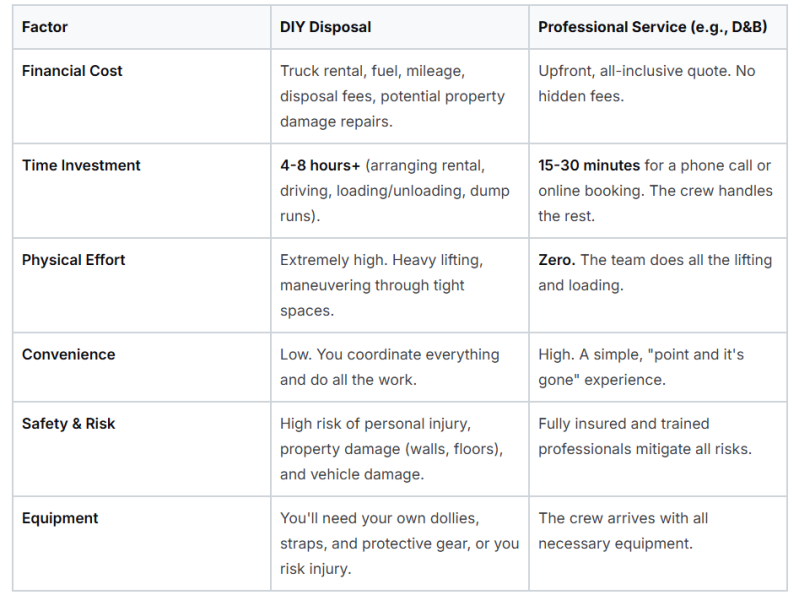
Seeing it laid out like this makes the choice a lot clearer. For anything more than a single, simple item, the value of a professional service becomes undeniable.
Scenarios That Absolutely Demand Professional Help
Some situations just aren’t cut out for a DIY approach. If any of these sound familiar, picking up the phone is by far your safest and most effective move.
One of the most critical is dealing with potentially infested furniture. If you have even the slightest suspicion of bed bugs or other pests, trying to haul that piece through your home is a surefire way to spread the infestation. Professionals are trained to contain and dispose of contaminated items according to health and safety regulations.
Likewise, tackling an entire home cleanout under a tight deadline—like getting a property ready for sale—requires a level of speed and efficiency that a dedicated crew brings to the table. Instead of losing weeks to countless back-and-forth trips to the dump, a professional team can clear out a home in just a few hours.
This is where the D&B team shines. If you’re facing a big project, you can learn more about our comprehensive junk removal services and see how we can take the entire burden off your shoulders.
Getting Your Furniture Ready for a Hassle-Free Pickup
So, you’ve scheduled the pickup. Whether it’s a charity truck or a professional junk removal crew heading your way, a little bit of prep work can make a world of difference. Honestly, taking a few minutes now will save you a ton of headaches later.
Think about it: moving a heavy, awkward sleeper sofa through a narrow hallway is just asking for scuffed walls and scratched floors. A little prep isn't just a nice thing to do for the movers; it’s about protecting your home and making sure everything goes off without a hitch.
Map Out a Clear Exit Route
First things first, clear a path. Seriously, walk the exact route the furniture will take from its current spot all the way out the door. Your goal is to create an obstacle-free runway for the crew.
Be on the lookout for anything that could get in the way:
- Stuff on the floor: Kick those shoes into a closet, roll up area rugs, and get any stray toys out of the way.
- Things on the walls: In tight hallways or stairwells, it’s a good idea to take down pictures, mirrors, or small shelves. A stray elbow can easily knock something off.
- Fragile items: Move any floor lamps, decorative vases, or small side tables that are along the path.
Clearing the way lets the team work quickly and, more importantly, safely. It’s the easiest way to prevent an “oops” moment.
Protect Your Walls, Floors, and Doorways
Even the most careful movers can have an accidental bump or scrape. Your door frames and floors are the most likely victims when wrestling with a bulky armoire. But don't worry, a few simple tricks can prevent costly damage.
If you have hardwood, tile, or laminate, your best bet is to lay down some old blankets, flattened cardboard boxes, or even towels along the exit path. This gives you a layer of protection against scratches. For doorways, you can temporarily tape some cardboard to the frames—it’s a great shock absorber for those inevitable bumps.
A five-minute job of taping cardboard to a door frame is a lot less painful than spending hours patching and repainting a nasty gouge. It's a tiny bit of effort that can save you a big repair bill.
A Little Disassembly Goes a Long Way
Some pieces are just too big to fit through a standard doorway. Think about that king-size bed frame, a sprawling dining room table, or that huge sectional sofa. This is where a little disassembly can be a game-changer.
You don’t need to be a furniture-building expert. Most of the time, it's as simple as unscrewing the legs from a table or detaching a headboard from the bed frame. Suddenly, one massive, unmovable object becomes several easy-to-carry pieces.
If you’re looking at a piece and have no idea where to start, or you just don’t have the right tools, don't sweat it. When you schedule your pickup, just contact our team for advice—we come prepared to handle disassembly on the spot.
Common Questions About Getting Rid of Old Furniture
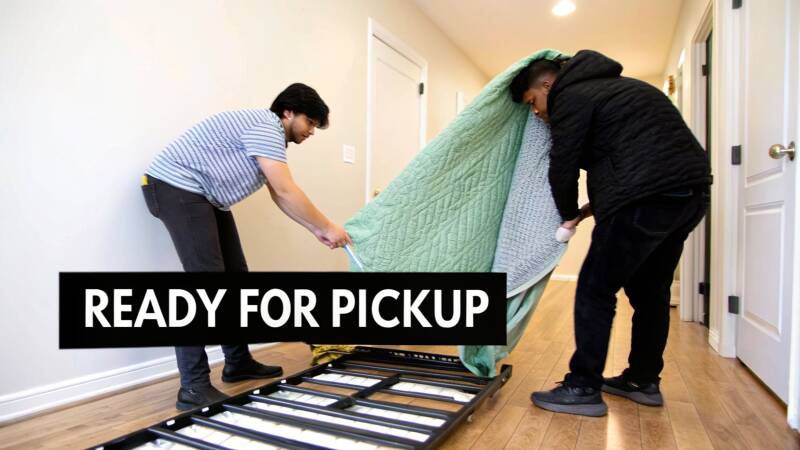
Even with the best plan, a few tricky questions always seem to pop up when it's time to haul away old furniture. Having done this for years, we've heard them all. So, we've put together answers to the most common snags people run into.
Knowing how to handle these situations will save you time, headaches, and maybe even a fine. Let’s clear up the confusion so you can get your project done smoothly.
How Do I Handle Infested Furniture?
Finding pests like bed bugs in a mattress or sofa is a tough situation. The immediate urge is to just drag it out of the house, but that's a surefire way to spread the infestation. First rule: do not donate it. Charities and thrift stores cannot accept infested items and will reject them on the spot.
To dispose of it safely, you need to completely seal the item in heavy-duty plastic sheeting. Use strong packing tape to cover every single seam, making it totally airtight. Once it's wrapped, you have to label it clearly with something like “BED BUGS” to warn sanitation workers. Honestly, this is a job best left to pros. We’re trained to handle contaminated items safely and in line with local health codes.
What’s the Most Eco-Friendly Way to Dispose of Furniture?
Hands down, the greenest option is to give your furniture a second life. If it's still in decent shape, donating or selling it keeps it in use and out of a landfill. That’s the gold standard.
When an item is truly at the end of its road, recycling is the next best thing. You'll want to find local facilities that can break down the materials—think metal from a bed frame, untreated wood from a table, or foam from cushions. The absolute last resort should be the landfill, where furniture takes up a massive amount of space and contributes to greenhouse gases.
A good junk removal company will always sort items for donation and recycling first. Hiring a professional is actually a great eco-friendly choice because we have the partnerships and processes to divert as much as possible from the dump.
Can I Just Leave Furniture on the Curb?
Please don't do this. It might seem like the easiest way out, but in most towns across New York and Connecticut, it's considered illegal dumping and can get you fined. You can't just leave a couch on the curb with your regular trash and hope for the best.
Most municipalities require you to schedule a special bulk waste pickup ahead of time. They also usually have limits on how many items you can put out and what types they'll accept. Before you haul anything to the curb, always check your local sanitation department's website for their specific rules.
How Much Does Professional Removal Cost?
The price for professional furniture removal really depends on a few things. The main factor is how much stuff you have—a single recliner is obviously going to cost less than clearing out an entire living room. Where the furniture is located also matters. An old dresser in a third-floor walk-up or a heavy sofa in the basement requires more labor, which can affect the price.
Most reputable companies offer a free, no-pressure estimate right up front, so there are no surprises. The fee you're quoted is typically all-inclusive, covering the crew's time, transportation, and any recycling or disposal fees.
When you add up the cost of a truck rental, gas, dump fees, and the value of your own time and effort, you'll often find that hiring a service like D&B Complete Home Services INC. is a fantastic value. We take care of all the heavy lifting and logistics, giving you complete peace of mind. Learn more about our services and get your free estimate today!
Add comment
Comments