Tackle yard debris removal with confidence. This guide covers costs, DIY vs pro services, and NY/CT disposal rules to help you reclaim your outdoor space.
A Homeowner's Guide to Yard Debris Removal in NY and CT
When most people think about "yard debris," their mind immediately goes to a pile of fallen leaves or some clippings from a weekend of pruning. And sure, that's part of it. But professional yard debris removal is so much more than just a seasonal cleanup.
It’s really about reclaiming your entire outdoor space from whatever’s cluttering it up, whether it grew there or was built there.
What Actually Counts as Yard Debris?
To really get a handle on what a professional service covers, it helps to break yard debris down into two main categories. This is how we at D&B Complete Home Services look at it when helping homeowners across Westchester, Putnam, and Fairfield counties get their property back in order.
Organic Yard Waste
This is all the natural stuff. It's the byproduct of your landscape's life cycle—things that grow, fall, and eventually decay. While it might seem simple enough, the sheer volume can be overwhelming. Proper removal means this material gets a second life through composting or mulching instead of just being dumped in a landfill.
We're talking about things like:
- Branches, Twigs, and Stumps: The classic aftermath of a big storm or a serious tree-trimming job.
- Leaves and Grass Clippings: A single fall cleanup can produce far more than your residential bins can ever handle.
- Old Mulch, Soil, and Sod: When you’re overhauling a garden bed or laying new turf, all the old stuff has to go.
- Fallen Trees: This is a major job that absolutely requires the right equipment and know-how to handle safely.
It's not just about a clean yard; it's about responsible disposal. Back in 2018, the U.S. generated about 35 million tons of yard trimmings. The good news? Thanks to state-level landfill bans and people becoming more aware, the composting rate hit 63%. You can dig deeper into these environmental trends over at the EPA's website.
Inorganic and Structural Debris
Now we get to the man-made items that have seen better days. This is the stuff that’s often heavy, awkward, and a real headache to get rid of on your own. For anyone trying to sell a house or get a rental property ready for new tenants, clearing this kind of clutter is essential for making a good first impression.
This category includes a wide range of items:
- Old Fencing and Decking: Rotting wood panels, busted vinyl fences, or the remains of a deck you finally tore down.
- Broken Patio Furniture: Those rusty metal chairs, that wobbly plastic table, and the sun-bleached umbrella you’ve been meaning to toss.
- Dismantled Sheds or Playsets: That old shed that's more rust than storage, or the swing set the kids outgrew years ago.
- Construction Debris: Leftover bricks, chunks of concrete, scrap metal, and other scraps from an outdoor DIY project.
At the end of the day, professional yard debris removal is the service that fills the gap between basic lawn mowing and a full-blown junk hauling job. It’s a complete solution for getting your outdoor space back, no matter what kind of mess you're dealing with.
Choosing Between DIY and Professional Yard Cleanup
So you’re staring at a mountain of yard debris, and the big question pops into your head: "Should I tackle this myself or just hire someone?" It's a classic dilemma, pitting your wallet against your weekend. The answer isn't always as simple as it seems, and it really comes down to a trade-off between upfront cost and saving yourself a world of time, effort, and unexpected headaches.
Thinking you can knock out a major cleanup in a few hours is a common trap. In reality, you're not just signing up for some manual labor; you're becoming a project manager. You have to handle the logistics, the transportation, and the disposal, all on your own.
This decision tree gives you a good visual of what "yard debris" can actually mean—it's a lot more than just a few branches.
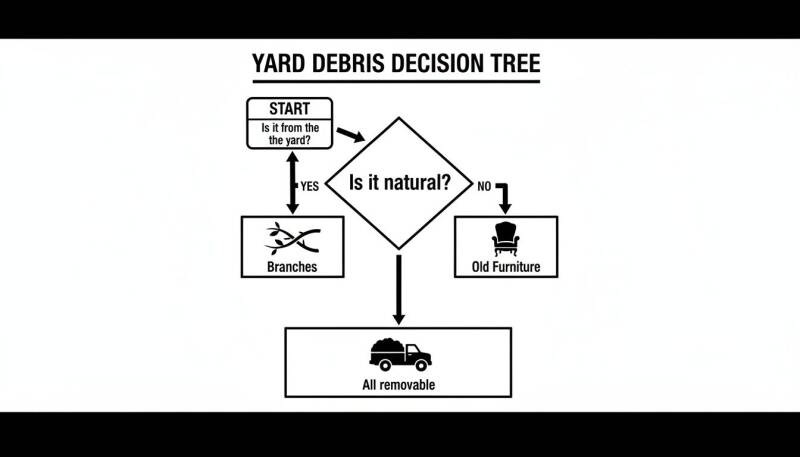
As you can see, yard waste isn't just organic material. It can include all sorts of man-made junk, and each type requires its own disposal game plan.
The Realities of a DIY Cleanup
On the surface, doing it yourself seems like the cheapest path forward. But once you start digging in, the true costs—both in money and in time—begin to pile up.
First, do you have the right gear? We’re talking heavy-duty gloves, quality rakes, maybe even a chainsaw for bigger limbs. These things aren't always just lying around in the garage.
Then comes the biggest hurdle: getting it all off your property. Unless you own a pickup truck, you’re looking at rental fees. On top of that, you have to account for fuel for potentially multiple trips to the local dump or transfer station, which can be surprisingly far away. Each trip burns through your weekend and your gas budget.
And let's not forget the physical toll. A study on home improvement injuries found that over 290,000 people end up in the emergency room each year from using hand tools alone. Lifting heavy, awkward branches or old patio furniture the wrong way is a recipe for a pulled muscle or a serious back injury.
Finally, you have to become an expert on local disposal regulations. Towns across New York and Connecticut have very specific rules. Some transfer stations charge by the cubic yard for yard waste (around $15 per yard in some places) and have separate, higher fees for construction debris. If you show up with the wrong bags or mixed materials, they can fine you or turn your whole load away.
The Professional Yard Debris Removal Advantage
Hiring a pro service like D&B Complete Home Services completely changes the game. What could have been a multi-day ordeal becomes a single, simple phone call. Instead of you trying to piece together a plan, a trained and insured crew shows up with everything they need to get the job done right.
These teams are built for efficiency. They arrive with a large-capacity truck, which means your entire mess is usually gone in one shot. They do all the heavy lifting, sorting, and loading, which means the risk of injury to you is zero. What might take you an entire weekend, they can often clear out in just a few hours.
Even better, a professional team knows the local disposal laws inside and out. They know exactly where to take different types of debris to make sure it’s recycled, composted, or disposed of responsibly. This expertise is a lifesaver, especially when you’re dealing with a mix of organic waste and old materials from a shed tear-down or fence replacement. To see the full scope of what can be hauled away, take a look at our complete junk removal services.
Comparing DIY vs Professional Yard Debris Removal
To make the decision easier, it helps to see the two approaches laid out side-by-side. This table breaks down what you're really signing up for with each option.
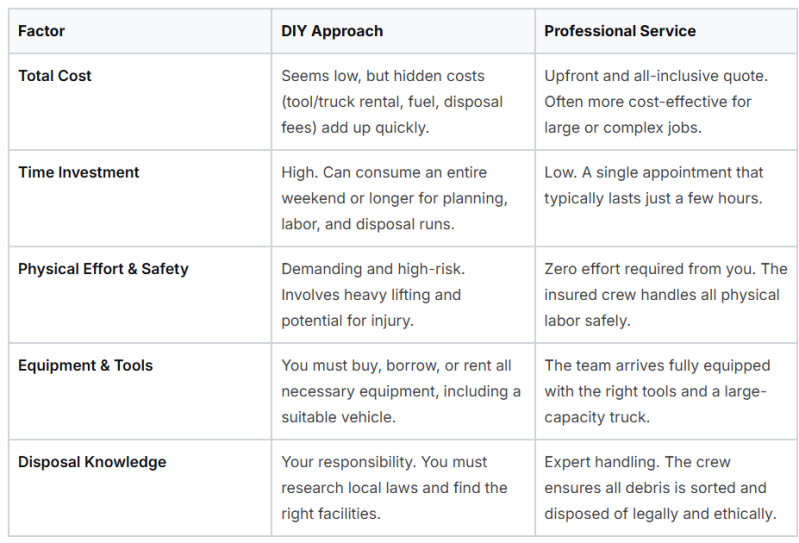
Ultimately, the right choice really hinges on the size and scope of your project. If you're just dealing with a few bags of leaves after raking, the DIY route is perfectly fine. But for a major post-storm cleanup, an estate clear-out, or dismantling an old deck, the value a professional service brings is undeniable.
How Yard Debris Removal Costs Are Calculated
Figuring out the cost of professional yard debris removal isn't like picking an item off a menu. There's no one-size-fits-all price. Instead, the final quote is a blend of several key factors that are unique to your specific cleanup job. Once you understand what goes into the estimate, you can budget smarter and see the real value behind a professional service.
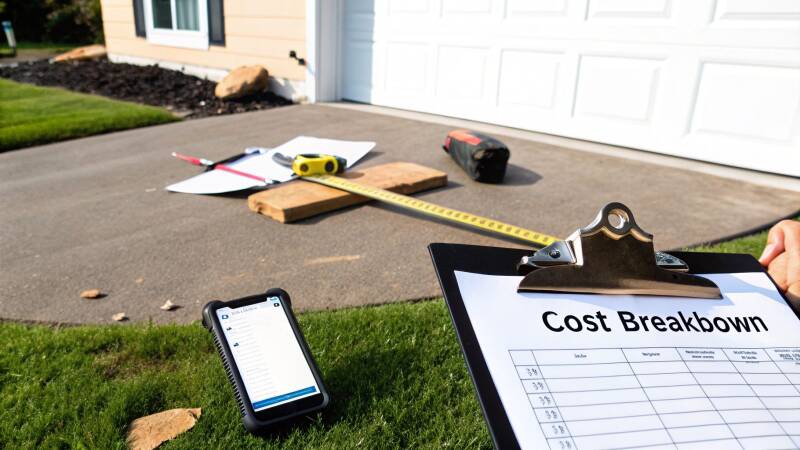
Any reputable company wants to give you a fair, transparent price that covers everything from the crew's time to responsible disposal. This way, there are no surprise fees, and you know exactly what you’re paying for before the team even gets started.
The Volume of Debris
The biggest driver of cost is volume—plain and simple, it's about how much stuff you need gone. Most professional services base their pricing on how much room your debris takes up in their truck.
This makes a lot more sense than pricing by weight. Think about it: a truck full of light, tangled branches takes up just as much space as a much smaller, heavier pile of logs.
- Small Jobs: A few bags of leaves or a small brush pile might only fall under a minimum service charge or a small fraction of the truck's capacity.
- Medium Jobs: Cleaning up after a big landscaping project or getting rid of a dismantled garden shed could fill anywhere from a quarter to half of a truck.
- Large Jobs: Major cleanups after a storm, clearing out an entire property, or hauling away an old deck can easily require a full truckload, sometimes even more than one.
Material Type and Weight
While volume is king, the type of material definitely matters. Heavier, denser stuff is harder to handle and often costs more to dispose of at the local transfer station.
For instance, a load of busted-up concrete from an old patio is far heavier and more labor-intensive to haul than a load of lightweight brush. Because of this, pricing models almost always account for the extra muscle and higher dump fees associated with heavier materials like dirt, concrete, or stone.
Key Takeaway: Be specific when you call for an estimate. Describing your project as removing "old patio materials" versus just "a pile of branches" helps a removal company give you a much more accurate quote right from the start.
Accessibility and Labor Intensity
How easy is it to get to the junk? A pile of branches sitting neatly at the end of your driveway is a simple job. But if that same pile is tucked away in a hard-to-reach spot, the cost will naturally go up.
Here are a few common scenarios that add to the labor cost:
- Location on Property: Debris in a fenced-in backyard with no direct truck access means the crew has to haul everything out by hand or with wheelbarrows, which takes a lot more time.
- Stairs or Obstacles: Having to navigate steep hills, flights of stairs, or tight garden gates adds to the effort and the clock.
- Demolition Needs: If an old swing set or rotted fence has to be taken apart before it can be hauled away, that extra labor gets factored into the final price.
This need for professional help is a growing trend. The global junk removal market is on track to hit $20,000 million by 2025, fueled by urbanization and a greater focus on proper, eco-friendly disposal. This trend shows why so many homeowners in our area—New York and Connecticut included—are turning to experts to manage waste correctly. You can dig into the numbers yourself in the full market analysis on Data Insights Market.
Local Price Estimates and Value
Here in Westchester, Putnam, Dutchess, and Fairfield counties, you'll find competitive pricing that also reflects the high cost of local labor and disposal. A standard post-storm cleanup that fills about half a truck might run you a few hundred dollars. Hauling away a dismantled deck would likely be more, depending on its size and materials.
While doing it yourself might look cheaper on the surface, hiring a professional service often delivers better value. It saves you the hassle of renting a truck, the cost of dump fees (which can exceed $29 per cubic yard for construction materials), and your entire weekend. More importantly, it protects you from the risk of fines for improper disposal and the physical strain of doing all that heavy lifting yourself.
Understanding Local Disposal Rules in New York and Connecticut
Trying to figure out local waste disposal rules can feel like deciphering a foreign language. Every town and county, from Westchester and Putnam in New York down to Fairfield, Connecticut, has its own unique playbook for how you’re supposed to handle yard debris. Getting it wrong isn't just a simple mistake; it can mean frustrating delays and some pretty hefty fines.
This maze of regulations is exactly why a seemingly simple DIY yard cleanup can spiral into a major headache. One town might demand that all branches be cut and bundled to a specific length, while the next one over could have a strict ban on putting any grass clippings in your regular trash. These rules are all about reducing landfill waste and promoting composting, but they put all the pressure on you, the homeowner, to get it right.
If you're a real estate agent staging a property for sale or a landlord prepping for a new tenant, the stakes are even higher. You're on the hook for making sure the property is compliant, and that includes properly getting rid of all that outdoor junk.
Decoding Common Municipal Ordinances
While the details can differ from town to town, most local laws are built around a few key ideas. Getting a handle on these common rules helps explain why bringing in a professional service is often the smartest move.
- Landfill Bans on Yard Trimmings: This is a big one. Many towns across NY and CT simply won't let you send organic waste like leaves, grass, and branches to the landfill. The goal is to keep that material out of the dump and put it to better use.
- Source Separation Requirements: All this really means is that you have to separate your waste at the source—your yard. You can't just toss organic debris like leaves into the same pile as inorganic junk like a broken plastic chair or old pavers.
- Composting and Mulching Mandates: Some areas take it a step further and legally require organic materials to be sent to special composting facilities. This ensures those valuable nutrients go back into the soil instead of rotting in a landfill and producing methane gas.
At the end of the day, the principle is simple: different types of waste need to go to different places. A professional yard debris removal service already has this down to a science, sorting everything on-site to make sure it all ends up where it’s supposed to go.
The True Cost of Non-Compliance
Let's be clear: ignoring these local rules can hit you right in the wallet. Roll up to a transfer station with a truck full of mixed, unsorted debris, and you could be turned away, forced to drive all the way back home and sort it yourself. Even worse, if you're caught dumping illegally or putting the wrong things in the wrong bin, the fines can be staggering—way more than it would have cost to hire a pro from the start.
Here's a perfect example: construction and demolition materials often carry much higher disposal fees than clean, organic yard waste—sometimes costing more than $29 per cubic yard. If you mix the two, you can get stuck paying that higher rate for your entire load. An experienced crew knows how to keep these materials separate to manage disposal costs and stay on the right side of the law. For more practical advice, you can find a ton of helpful info in our other junk removal tips and resources.
Ultimately, hiring a local expert who already speaks the language of the regulations in Westchester, Dutchess, and Fairfield counties is an investment in your peace of mind. It takes a complicated, risky job and makes it simple, guaranteeing your yard debris is handled correctly and ethically, with no surprise headaches down the road.
Getting Ready for Your Yard Debris Removal
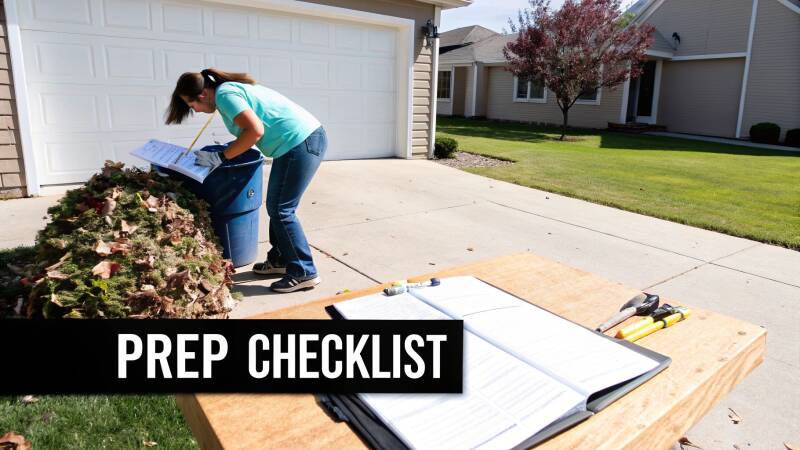
A smooth, efficient yard debris removal doesn't just start when the truck shows up. A little bit of prep work on your end can make a huge difference, making the whole process faster, safer, and even more cost-effective. Think of it like prepping your kitchen before you start cooking—a little organization beforehand saves a ton of hassle later.
When a removal crew has a clear picture of the job, they can give you a much more accurate quote. Taking these steps helps avoid any surprises and gets your yard cleared out in record time.
Step 1: Pile It All Up
Honestly, the most helpful thing you can do is get everything into one spot. If you can, consolidate all that yard waste into a single pile in an easy-to-reach location, like the end of your driveway or a clear area near the curb.
This one step is a massive time-saver. Instead of our team making dozens of trips back and forth across your lawn, they can get right to work loading the truck. It's especially crucial if your property has tricky spots like steep hills or tight gates.
Step 2: Separate Out the Problem Items
While professional services can haul away most organic yard waste, there are some things we legally and safely cannot take. Most removal companies, including us, aren't licensed to handle hazardous materials. Before the crew arrives, do a quick scan and pull these items out of your pile.
Common items we can't accept include:
- Chemicals: Things like pesticides, herbicides, old paint, solvents, or motor oil.
- Flammable Liquids: Gasoline cans and propane tanks are a definite no-go.
- Asbestos: Sometimes found in old shingles or siding mixed in with storm debris.
- Batteries: Car batteries are particularly hazardous due to the corrosive acid inside.
If you find any of these, your local town or county likely has specific guidelines for hazardous waste disposal. Setting them aside beforehand means no delays or safety issues on removal day.
Step 3: Clear a Path for the Team
Picture trying to haul a heavy log or a tangled mess of branches through an obstacle course. It’s not just difficult; it’s unsafe. To help us work quickly and safely, make sure there's a clear, direct path from the debris pile to where our truck will be parked.
This is a simple but critical safety measure. Move cars out of the driveway, and shift any potted plants, garden gnomes, or stray toys out of the way. It prevents accidental damage to your property and protects our crew from trips and falls.
If your pile is in the backyard, double-check that gates are unlocked and can open all the way. It’s a small detail that makes a world of difference.
Step 4: Give Us the Details When You Book
The more you can tell us when you call to schedule your yard debris removal, the better we can prepare. A good description helps us send the right size truck and crew for the job.
Try to have this information handy:
- What’s in the pile? Let us know if it's mostly light stuff like leaves and twigs or heavy items like stumps, concrete, or dirt.
- How much is there? Is it a small mound, or is it a pile big enough to fill a pickup truck? Or two?
- Can you send a photo? A picture is truly worth a thousand words. It’s the single best way for us to give you a solid initial estimate.
By running through this simple checklist, you're not just a client—you're a partner in getting the job done right. Your prep work ensures everything goes off without a hitch, leaving you with nothing but a clean, beautiful yard to enjoy.
Your Yard Debris Questions, Answered
Planning a big yard cleanup is one thing, but it's natural to have a few questions before the crew shows up. Getting straight answers helps you feel confident and know exactly what you're getting. We get a lot of the same great questions from homeowners across New York and Connecticut, so we’ve put them all in one place for you.
What Kind of Yard Debris Can You Take?
This is easily the number one question we hear, and the short answer is: pretty much everything. Think of a professional yard debris service as your complete outdoor cleanup solution. We're not just here for a few bags of leaves; our goal is to clear out whatever is cluttering up your space.
We can haul away a huge variety of materials, including:
- The Green Stuff: All the natural, organic waste you'd expect—fallen branches, old stumps, tree limbs, grass clippings, weeds, and old sod.
- The Hard Stuff: This includes inorganic junk like rotted fencing, dismantled sheds, old decking materials, broken-down swing sets, and unwanted patio furniture.
- Landscaping Leftovers: We also take care of leftover soil, old mulch, pavers, stones, and even chunks of concrete from a busted-up walkway.
Do I Have to Be Home for the Appointment?
We know life is busy, so we try to be as flexible as possible. In a lot of situations, you do not need to be present when we come by, especially if all the debris is easy to get to.
If you’ve stacked everything at the curb or the end of your driveway, our crew can simply pull up, load it all, and handle the payment with you right over the phone. Easy. Now, if the junk is tucked away in a locked backyard or another spot that's tough to access, we'll need you or another trusted adult to be there to grant access and give the final okay on the items to be removed.
How Do You Make Sure My Debris Is Disposed of Responsibly?
This is something we're really passionate about. Just dumping everything in the nearest landfill is the old, lazy way of doing things, and it's terrible for the environment. Our entire process is built around being responsible stewards of the materials we collect.
Here’s a quick look at our eco-friendly approach:
- On-Site Sorting: The first thing we do is separate the organic material (branches, leaves, etc.) from inorganic items like metal, wood, and plastic.
- Recycling & Composting: Clean wood and all the green waste go to local facilities to become fresh mulch or compost. Scrap metal from old furniture or fencing is sent straight to recycling centers.
- Finding a New Home: If an item is still in good shape—think a usable patio set or a swing set the kids outgrew—we do our best to donate it to local charities.
- Last Resort Disposal: Only the absolute last bits that have no other purpose are taken to a licensed transfer station.
This isn't just about cleaning up your yard; it's about doing it the right way. By diverting tons of waste from local landfills, we're all helping to conserve resources and keep our communities cleaner.
How Fast Can You Get My Yard Debris?
We get it. Once you decide you want the junk gone, you want it gone now. That's why we focus on being quick and responsive. In many cases, we can even schedule same-day or next-day appointments, which is perfect for post-storm cleanups or getting a property ready to sell on a tight deadline.
Your best bet for a fast turnaround is to give us a call as early as you can. Even when things get hectic in the spring and fall, we always do our best to get you on the schedule right away. And if you're dealing with something more specific than typical yard waste, our guide on how to dispose of old lawn equipment has some extra pointers.
Ready to reclaim your outdoor space without breaking your back? D&B Complete Home Services INC. offers fast, reliable, and eco-friendly yard debris removal across Westchester, Putnam, Dutchess, and Fairfield counties. Contact us today for a free, no-obligation estimate and let our professional crew handle the heavy lifting for you. Visit us online at https://www.dbcompletehomeservices.com to get started.
Add comment
Comments