Need local junk removal services in NY or CT? Our guide covers pricing, scheduling, and how to choose the right pro for your home or business.
Local Junk Removal Services Your Hudson Valley Guide
The garage was supposed to hold bikes, bins, and maybe one car. Now it holds a broken treadmill, old paint cans, a sagging couch cushion, and boxes nobody has opened since the last move. In a rental, the problem looks different. A former tenant leaves furniture, bags, and damaged shelving behind, and the next showing is already on the calendar.
That is usually when people start searching for local junk removal services. Not because they love hiring help, but because the job has crossed the line from annoying to disruptive. It is taking up space, eating time, and in some cases holding up a sale, turnover, renovation, or repair.
In the Hudson Valley and nearby Connecticut, junk removal is rarely just “stuff goes away.” Access matters. Disposal rules matter. The difference between a curbside pickup and a basement cleanout matters. If you are in Westchester, Putnam, Dutchess, Orange, or Fairfield County, you want a company that understands local logistics and gives you a clear answer about pricing, scheduling, and disposal.
Your Guide to Decluttering with Local Junk Removal
A common call goes like this. A homeowner in Dutchess County wants to clear a basement before a remodel. A landlord in Westchester needs an apartment emptied after a rough move-out. A real estate agent in Fairfield needs a clean, presentable garage before photos. Different properties, same pressure. The clutter needs to go, and it needs to go without creating a bigger mess.
The first mistake many people make is assuming every hauling job is basically the same. It is not. An old mattress at the curb is one kind of job. An attic full of furniture, old electronics, and loose debris is another. An eviction turnover with trash throughout the unit is its own category entirely.
That is why good local junk removal services start with the job type, not just the pile.
If you are sorting out what to remove before calling, D&B’s junk removal tips and resources can help you think through the scope. A little prep makes quotes clearer and prevents the usual “while you’re here” confusion that changes the price on site.
What people usually want to know first
Most neighbors ask the same practical questions:
- What kind of service do I need
- What affects the price in NY and CT
- Can someone come quickly
- Will the company recycle or donate anything
- How do I know I am hiring a legitimate crew
Tip: Before you call, walk the area and group items by type. Furniture, appliances, bagged trash, metal, and construction debris often follow different disposal paths.
A cluttered property feels heavy because it creates decision fatigue. Once the scope is clear, the job becomes much easier to solve.
Understanding the Types of Junk Removal Services
People use the phrase local junk removal services as if it means one thing. In practice, it is more like a cleanup menu. The U.S. junk removal industry is valued at approximately $75 billion according to this industry overview, which makes sense when you see how many different jobs fall under the same label.
Small pickups and single bulky items
This is the simplest category. One mattress. A couch. An appliance. A broken exercise bike. It is usually the right fit when the rest of the property is in decent shape and you just need a few large items gone.
This kind of service works well when:
- The pile is limited: You know exactly what is leaving.
- Access is straightforward: Ground floor or easy stairs keeps the job simpler.
- You want speed: Single-item pickups are often easier to schedule than full cleanouts.
If the item is unusual, check whether the crew handles it. Lawn equipment, for example, can involve separate disposal considerations. This guide on how to dispose of old lawn equipment is useful if you are sorting power equipment, rusted tools, or gas-powered machines.
Volume-based hauling and full cleanouts
This is the classic “garage, attic, basement, shed, or whole-room” job. Instead of pricing a single object, companies often assess how much truck space the load will take.
Volume-based hauling makes sense when the pile is mixed. You may have shelving, boxes, loose debris, old chairs, carpet remnants, and random household items all in one area. The exact inventory matters less than the overall space and labor.
What works here is clarity. Walk the crew through everything that is included before loading starts.
Specialized property cleanouts
Estate cleanouts, hoarding situations, foreclosure prep, and eviction turnovers need a different approach. These jobs can involve emotional stress, tighter timelines, and more sorting.
A few trade-offs come up fast:
- Speed versus sorting: If donation is a priority, the crew may need more time to separate usable items.
- Access versus labor: Packed rooms and narrow stairs add labor even when the truck volume is moderate.
- Presentation versus removal: Realtors and landlords often need the property swept and reset for the next step.
Construction and renovation debris
This category catches a lot of people off guard. Old drywall, trim, flooring, cabinets, tile, and demo debris are heavier and often costlier to dispose of than household junk.
The smartest move is to tell the company exactly what the debris includes. “Renovation leftovers” is too vague. “Drywall, broken vanity, laminate flooring, and bagged tile” is much better.
Key takeaway: The right service type is the one that matches the material, access, and urgency of your job. If you mislabel the job, you usually get a bad quote or a delayed pickup.
Decoding Junk Removal Pricing and Cost Factors
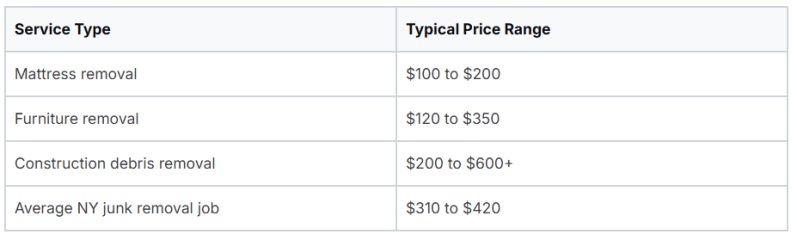
Pricing gets easier to understand when you stop thinking in terms of “truck and two guys” and start thinking in terms of volume, weight, access, and disposal path. In New York, average junk removal costs in 2026 range from $310 to $420 per job, and specific jobs can range from $100 to $200 for a mattress and $200 to $600+ for construction debris, according to this market report.
That range is wide for a reason. Two piles can take up the same space and cost very different amounts to remove.
What moves the quote
A curbside recliner is easier than a sleeper sofa from a second-floor walk-up. A pile of cardboard is lighter than a pile of broken tile. A clean garage cleanout is different from a damp basement with loose debris.
The biggest cost drivers in the NY and CT area are usually:
- Material type: Household junk, furniture, appliances, and construction debris do not all dispose the same way.
- Weight: Heavy loads can cost more even when they do not fill much truck space.
- Accessibility: Stairs, tight hallways, long carries, and detached outbuildings add labor.
- Labor intensity: Disassembly, careful navigation, and sorting all take time.
- Local disposal fees: Regional labor and disposal costs push NY pricing above the national average.
Estimated Junk Removal Costs in NY and CT 2026
How quotes are usually structured
Some companies use volume-based pricing. That means your price follows how much of the truck your load fills. This model works well for mixed loads and cleanouts.
Others rely more on per-item pricing, especially for mattresses, appliances, or bulky pieces. For labor-heavy work, some companies may factor in how difficult the removal is even if they still present the final quote as a flat price.
The best quotes are simple to understand. You should know what is included, what is excluded, and whether the final number could change if the scope changes.
Where people lose value
The cheapest quote is not always the lowest final cost. Problems usually show up in three places:
- Vague pricing: If the company cannot explain how the quote was built, expect surprises.
- Unclear load limits: Customers think “full truck” means one thing, the crew means another.
- Hidden disposal issues: Certain materials trigger separate fees or cannot go with general junk.
Tip: Send clear photos before the appointment, then walk the crew through the exact load on arrival. Good photos save time, but they do not replace an on-site confirmation.
In this area, value usually comes from a clean quote, a crew that shows up ready to work, and a realistic plan for disposal. A low teaser number that changes on site is not a bargain.
How the Junk Removal Process Works
A professional junk removal visit should feel organized from the first call to the last sweep. When it does, customers relax because they know what is happening and what comes next.
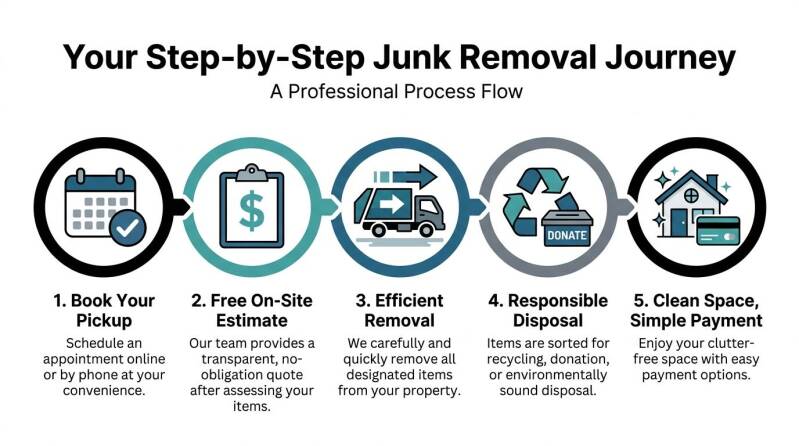
Booking and scheduling
The process usually starts with a phone call, text, or website form. You describe the job, share photos if possible, and talk through location, access, and timing.
For urgent needs, same-day scheduling can be a real differentiator. In competitive NY and CT markets, local operations often reach 70 to 85 percent same-day service fulfillment by using GPS-dispatched fleets and on-site volumetric pricing, as noted by this New London junk removal page.
That does not mean every job gets same-day service. It means well-run companies build their schedules to handle a meaningful share of urgent calls.
The appointment itself
Most solid appointments follow a predictable rhythm:
- Confirmation and arrival window
You get a scheduled time range and a courtesy call or text before arrival. - Walkthrough and final quote
The crew looks at everything that is going. This is when you point out the basement items, detached shed contents, or anything tucked behind furniture. - Approval before work starts
A professional crew confirms the price first. No guessing while they load. - Removal and loading
They carry, disassemble if needed, and load the truck in the most efficient order. - Final cleanup
Basic sweeping and pickup of loose debris should be part of the finish.
What makes the process go smoothly
Customers help the job move faster when they mark what stays and what goes. In a garage or basement, a few pieces of painter’s tape or a clear verbal walkthrough can prevent mistakes.
Crews help by being specific. If there is a reason something cannot be taken, they should say so early, not after half the truck is loaded.
Tip: On mixed-property jobs, keep donation items, trash, and “not sure yet” items in separate zones. That reduces confusion and keeps the estimate accurate.
Payment usually happens at the end once the load is complete. For landlords, agents, and managers, a clean invoice matters just as much as the hauling.
Questions to Ask Before You Hire a Junk Removal Company
Hiring the right crew is less about slick branding and more about clear answers. A company that handles junk professionally should be able to explain pricing, scheduling, protection of the property, and what happens to the material after pickup.

The shortlist of questions that matter
Ask these before you book:
- Are you licensed and insured
If something gets damaged, you need to know the company operates legitimately. - How do you price the job
Volume, item-based, labor-intensive, or a mix. The answer should be direct. - Will I get a written estimate or confirmed on-site quote
Verbal vagueness creates disputes. - What items can you not take
This matters for paint, chemicals, certain electronics, and other restricted materials. - What is your disposal process
“We recycle when possible” is not enough by itself. - Do you offer same-day or next-available scheduling
Important for turnovers, cleanouts, and pre-listing work.
The eco-disposal question often skipped
A lot of companies advertise themselves as green. Fewer tell you what that means in practice. The U.S. junk removal industry average for landfill diversion is only 25 to 30 percent, while reputable firms in regulated areas like NY and CT can reach 40 percent or more, according to this disposal-focused overview.
That makes one question especially useful: What portion of a mixed load do you typically divert through donation or recycling, and how do you decide what qualifies?
You are not looking for a polished script. You are looking for a real process. If the answer is vague, assume the load may be headed mostly to disposal.
Red flags that usually signal trouble
A few warning signs show up over and over:
- Cash-only pressure: It limits accountability.
- No clear business identity: No proper website, business contact info, or service details.
- No proof of insurance: Not worth the risk inside a furnished home or occupied rental.
- Suspiciously low quote: Low numbers often rise once the truck is half loaded.
- Evasive answers about disposal: That can mean poor practices or illegal dumping risk.
For a quick visual overview of what to watch for when comparing providers, this short video is useful:
Key takeaway: The right company does not just remove junk. It protects your property, explains the price, and gives a straight answer about where the material goes.
The Local Advantage Why a Hudson Valley Pro is Your Best Bet
National chains have name recognition. Local crews usually win on fit. In the Hudson Valley and nearby Connecticut, that matters because jobs are shaped by tight driveways, older homes, basement access, transfer station habits, and the fact that many customers need more than a simple pickup.
Where local operators tend to perform better
A local provider usually has a better read on the practical side of the job:
- Scheduling flexibility: Easier to fit in urgent cleanouts when routes are built around the area.
- Local disposal knowledge: The crew already knows where different materials are likely to go.
- Property context: Older colonials, split-levels, walk-out basements, and narrow village streets all change the work.
- Service overlap: Many customers need light demo, repairs, or prep work after the junk is gone.
That last point gets overlooked. On a turnover or pre-sale cleanup, junk removal is often step one, not the whole project.
Why efficiency matters more than marketing
A professional junk removal company should run like an organized field service business, not a guy with a trailer and a phone. In major markets like New York, achieving a gross margin of 86 percent or higher is considered a key indicator of efficient, sustainable operations, according to this KPI analysis. In practice, that kind of efficiency comes from route optimization, truck capacity management, and reducing landfill costs through donation and recycling programs.
Customers may never see those back-end systems, but they feel the results. Better routing supports tighter arrival windows. Smarter load planning supports cleaner pricing. A real disposal process supports fewer shortcuts.
One local example is D&B Complete Home Services INC., which serves Westchester, Putnam, Dutchess, Orange, and parts of Fairfield County with junk removal, demolition, repairs, and remodeling. That combination is useful when a property needs hauling plus follow-up work instead of a one-time pickup only.
Local versus national in plain terms
A national brand can be a fine fit for straightforward jobs. If the load is simple and timing is flexible, either option may work.
For more complicated properties, local often makes more sense. A Hudson Valley crew is usually better positioned to handle the details that turn an ordinary cleanout into a real project.
Reclaiming Your Space with Confidence
Clutter feels bigger when you do not know the next step. Once you know what kind of job you have, what affects the price, how the appointment works, and which questions to ask, the whole process becomes more manageable.
That is the core value of professional local junk removal services. You save time. You avoid the lifting, sorting, and dump runs. You get a cleaner result, and the property moves on to its next use faster.
For homeowners, that might mean getting a garage back. For landlords, it might mean turning a unit. For agents, it might mean getting a listing ready without losing another week. If you want to see how clearing out a space changes the way a property looks and functions, D&B’s before-and-after project gallery gives a practical sense of what that reset can look like.
The best approach is simple. Get clear on the scope, ask direct questions, and choose a company that treats removal like a professional service, not just a haul-away.
Frequently Asked Questions About Local Junk Removal
What items are usually not allowed in a junk removal pickup
Most junk removal companies handle non-hazardous household and commercial items. Restricted materials often include things that require special disposal, such as certain chemicals, paints, fuels, and similar items. Ask before the appointment instead of assuming they can go with general junk.
Do I need to be there the whole time
Not always. For a simple curbside or clearly defined pickup, some customers only need to be present for the quote approval and final confirmation. For mixed loads inside a house, basement, or rental unit, it helps to be available at least at the beginning so the crew knows exactly what stays and what goes.
How much notice should I give before booking
That depends on the season, the size of the load, and whether the job is standard junk, a cleanout, or debris. Some companies can fit in urgent jobs quickly when their schedule allows. Larger cleanouts usually benefit from a bit more planning, especially if access, parking, or coordination with other trades is involved.
How do eviction and foreclosure cleanouts differ from ordinary pickups
They usually involve tighter deadlines, more mixed material, and more decision-making on site. The crew may need to sort obvious trash from reusable items, work around damaged interiors, or coordinate around lock changes, showings, or contractor access. These jobs are less about one bulky item and more about restoring the property to a usable condition.
Is it better to pile everything in one spot before the crew arrives
Sometimes yes, sometimes no. Consolidating items can save time if you already know everything is leaving. But do not create a giant mixed pile if you still need to separate donation items, restricted materials, or things that are staying. Clear grouping is better than one messy mountain.
What is the best way to get an accurate quote
Photos help. A short written list helps too. The most accurate quotes happen when you show the full scope, mention stairs or long carries, and identify special materials like appliances or renovation debris ahead of time.
If you are ready to clear a garage, empty a rental, prep a listing, or remove renovation debris, D&B Complete Home Services INC. handles junk removal, cleanouts, demolition, and related property work across New York and Connecticut. Reach out with photos or a quick description of the job to get the process started.
Add comment
Comments