Discover a construction waste management plan that slashes costs, optimizes material sorting, and boosts recycling for NY and CT projects in 2026.
Construction Waste Management Plan: construction waste management plan 2026
A good construction waste management plan is a lot more than just paperwork. It's your on-site blueprint for boosting efficiency, slashing costs, and staying on the right side of regulations. A solid plan gives you a clear system for reducing, reusing, and recycling debris, turning what most builders see as a headache into a real competitive edge.
Why a Waste Plan Is Your Project's Secret Weapon
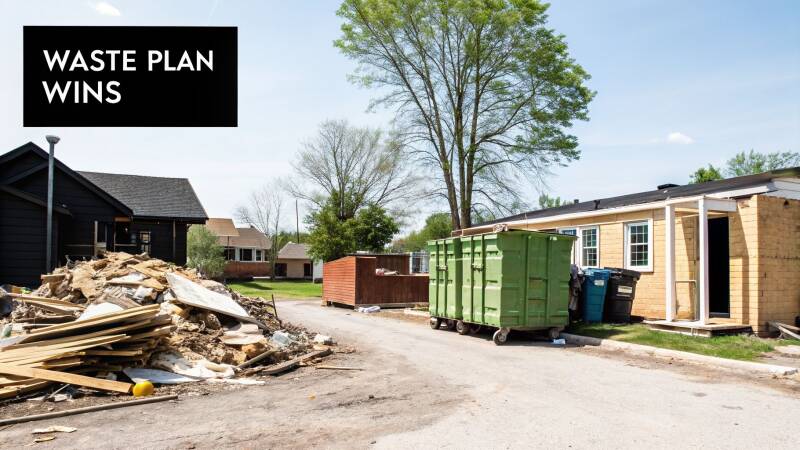
Think of a construction waste management plan (CWMP) as the key difference between a chaotic, money-hemorrhaging job site and a streamlined, profitable one. For any small-to-medium residential or commercial project, the financial and logistical wins are immediate. Without a plan, you’re just paying top dollar to haul mixed debris to a landfill and leaving money on the table.
Let’s put it in real-world terms. Imagine a typical residential gut renovation in Westchester County. Contractor A throws everything—wood scraps, old drywall, metal studs, cardboard—into one big, expensive dumpster. That entire container is headed straight for the landfill.
Now, picture Contractor B, working on a similar project just a few towns over. They have a simple waste plan. They set up separate, smaller bins for clean wood, metals, and concrete. That one small change—sorting on-site—gives them a massive advantage.
Turning Debris into Dollars
The most obvious benefit of a smart waste plan is cost savings. Tipping fees at landfills in New York and Connecticut are steep, and they only ever go up. By diverting materials away from the landfill, you’re directly cutting those disposal costs.
A well-executed construction waste management plan isn’t an expense; it’s a revenue-generating tool. It transforms what most see as trash into valuable assets through strategic sorting and recycling.
But it goes beyond just saving money on fees. Sorted materials often have real market value. Scrap metal, for example, can be sold to local yards, putting cash right back into your project budget. Clean concrete and asphalt can be crushed and reused as aggregate on-site, saving you both disposal fees and the cost of buying new base material. We've even salvaged and donated or resold high-quality doors, windows, and fixtures from our demolition projects, which you can see in some of our before-and-after projects.
Gaining a Competitive Edge
A formal CWMP does more than just pad your bottom line; it seriously boosts your professional reputation. In the United States, construction and demolition activities generate over 600 million tons of waste annually. What's shocking is that up to 30% of that often comes from perfectly good, unused materials—a result of over-ordering or poor planning, which is a common problem on tight job sites in places like Putnam and Fairfield counties.
When you can show you have a plan to handle waste responsibly, you immediately become a better choice for:
- Eco-conscious homeowners who genuinely care about sustainability.
- Property managers trying to meet corporate green building goals.
- Projects aiming for LEED certification, where having a CWMP is non-negotiable.
Ultimately, a proactive waste management plan is just smart business. It makes your site cleaner, protects your profit margin, and marks you as a forward-thinking professional in a crowded market.
Getting to Know Your Waste: The Site Audit
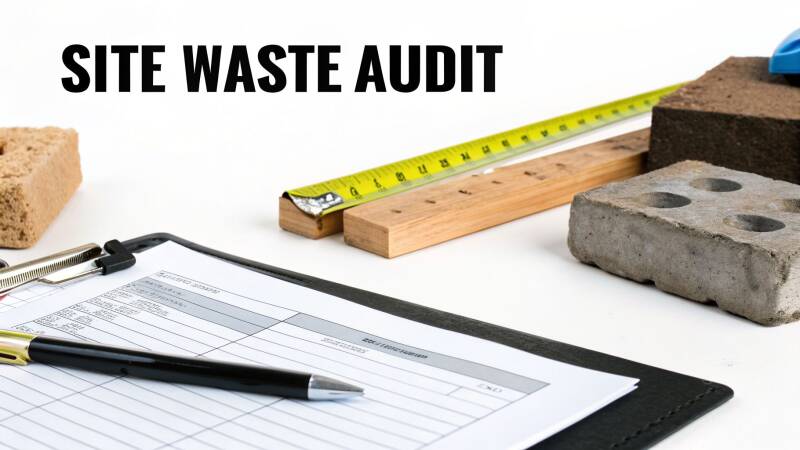
Before you can even think about managing waste, you’ve got to know exactly what you’re up against. This is where a pre-project waste audit comes in. It’s the first and, frankly, most important step. It’s all about walking the site—whether it's a residential remodel in Fairfield County or a small commercial teardown in Dutchess County—and identifying every single thing that’s going to turn into debris.
This isn’t a quick glance around. It’s a methodical walkthrough where you cross-reference what you see with the architectural plans to create a detailed inventory. Doing this upfront gives you a huge advantage. You can anticipate the volume of different materials, plan your sorting strategy, and book the right haulers or recycling services ahead of time. Flying blind is the most expensive way to manage a job site.
Create Your Debris Hit List
Start your audit by walking the property with the sole mission of spotting future waste. Think in layers, just like you build. What’s on the roof? Asphalt shingles. What about the exterior? Brick facade. Then move inside and catalog the drywall, flooring, old fixtures, and insulation.
The goal here is to create a master list. Don't be vague. Instead of just "wood," get specific: is it treated lumber, clean dimensional lumber, or engineered wood like OSB? Each one has a different path for disposal or recycling, so details matter.
Below is a quick-reference guide I've put together to help you identify the most common materials on NY and CT job sites and how to best handle them right from the start.
Common Construction Waste and On-Site Handling Guide
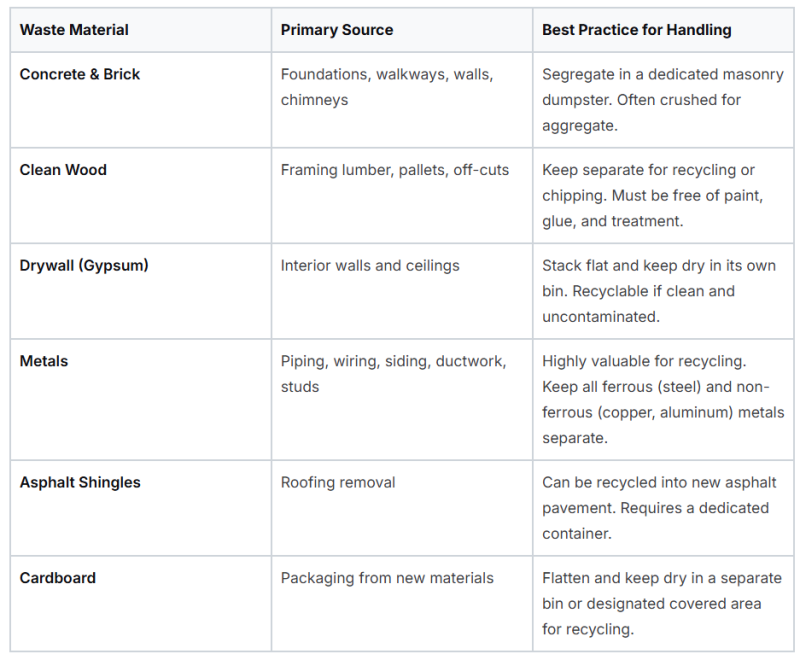
This table is a great starting point, but every job is unique. The more detailed your own list is, the smoother your project will run.
From List to Logistics: Estimating Volumes and Planning for Reality
Once you know what you’re tossing, you need to figure out how much. This can feel like a guessing game, but you can get surprisingly close with some basic math. For a kitchen gut, calculate the square footage of cabinets, countertops, and flooring to get a rough volume of debris. For a small office demo, use the total wall surface area to estimate your drywall waste.
It’s not an exact science, but a well-reasoned estimate is miles better than a shot in the dark. These numbers are what you'll use to order the right size and number of dumpsters, which saves you from paying for empty space or dealing with costly overages.
Don’t forget to size up the site itself. That tight alley behind a commercial building in White Plains or the limited backyard access at a Greenwich home will absolutely dictate your sorting and hauling strategy.
Think through the real-world logistics. Is there room for three separate bins for wood, metal, and concrete, or are you stuck with a single co-mingled dumpster? Can a full-size roll-off truck even make the turn into the driveway? Answering these questions during the audit prevents massive headaches later. A solid plan isn't just about what's on paper; it's about what actually works on the ground.
Crafting Your Waste Reduction and Diversion Strategy
You’ve done the site audit and have a solid list of the materials you’ll be dealing with. Now, let’s turn that list into a real-world action plan that saves you money. Any successful construction waste management plan I've ever put together boils down to three simple, yet powerful, pillars: Reduce, Reuse, and Recycle. Focusing on these three in order will dramatically cut your landfill costs and fatten your project's bottom line.
This is more than just a paperwork exercise to satisfy local regulations. It's a fundamental shift in how you run a job site. Each pillar gives you a chance to make your operation leaner, greener, and more profitable. Let's dig into how to make each one work for you.
First, Reduce What You Bring On-Site
The cheapest and most effective way to manage waste is to never create it in the first place. This "reduce" phase is all about smart planning and ordering with surgical precision. It's time to break the old habit of ordering "plenty to be safe" and move toward ordering "just enough."
Here are a few practical ways to cut down on waste before it even hits your dumpster:
- Order with precision. Pull out your blueprints and use that pre-project audit to get your material counts as tight as possible. For materials like drywall, lumber, and flooring, this directly translates into fewer off-cuts and less waste.
- Demand less packaging. When you place orders, ask your suppliers if they can deliver materials with less plastic wrap, strapping, or cardboard. You'd be surprised how many are willing to accommodate, and some will even take back pallets for reuse.
- Look into prefabrication. For some jobs, using prefabricated components like wall panels or roof trusses can be a game-changer. They're built in a controlled factory setting where waste is minimized, which means less cutting and debris on your site.
I always think of it like a chef in a high-end kitchen. They measure ingredients carefully not just to get the recipe right, but to avoid throwing away expensive food. The same logic applies directly to our building materials.
Second, Reuse Through Smart Deconstruction
Before you fire up the excavator or hand someone a sledgehammer, pause and look around. What can be saved? This "reuse" pillar is where you swap brute-force demolition for methodical deconstruction. It's about carefully taking a structure apart to salvage valuable items that can have a second life.
On a typical residential remodel in Fairfield or Westchester County, there's a treasure trove of salvageable materials. Instead of paying to haul them away as trash, consider saving:
- Doors and Windows: Solid core wood doors, antique hardware, and odd-sized windows are often snatched up by people doing their own restorations.
- Cabinets and Fixtures: Perfectly good kitchen cabinets, bathroom vanities, pedestal sinks, and light fixtures can all be donated or resold.
- Hardwood Flooring: If you remove it carefully, old hardwood has immense character and can be refinished and reused.
- Bricks and Masonry: Clean, whole bricks are fantastic for accent walls, patios, or garden paths.
Donating these items is a fantastic triple-win. You skip the landfill fees, you can get a tax deduction for the donation, and you help community organizations like Habitat for Humanity ReStore provide affordable materials to others.
Third, Recycle with a Clear System
Even with the best plans, you’ll still have debris. That’s where the "recycle" pillar comes in, turning what's left from a cost into a potential revenue stream. The whole thing hinges on a smart, simple sorting system right there on the job site.
The data from your waste audit is key here. You’ll see that some materials dominate the waste stream—for most projects, concrete and masonry make up 40-50% of all debris. Knowing this lets you plan effectively. You could, for instance, bring in a mobile crushing unit to process concrete right on-site, a move that can cut hauling emissions by as much as 30%. Looking into market trends will show how bundled services, combining hauling with metal recovery, are becoming the new standard.
Setting Up for Recycling Success
The secret is making it dead simple for your crew to do the right thing. Use different colored dumpsters or post big, clear signs that leave no doubt about what goes where. Your main sorting categories will probably be:
- Clean Wood: Untreated, unpainted lumber scraps. These can be chipped for landscaping mulch or used as biomass fuel.
- Metals: This is your moneymaker. Keep ferrous metals (steel studs, rebar) separate from non-ferrous (copper pipe, aluminum siding). Scrap yards pay good money for this stuff.
- Concrete & Asphalt: In the NY and CT area, specialized aggregate recyclers take clean concrete and asphalt, crush it, and sell it as road base.
- Cardboard: Make sure all boxes are broken down flat and kept dry. It’s one of the easiest materials to recycle.
Putting a system like this in place is what turns your construction waste management plan from a document in a binder to a daily, money-saving habit. For more ideas on site organization and sorting, check out our general junk removal tips and resources. The same principles of smart sorting apply whether you're cleaning out a garage or managing a multi-story demolition.
Staying on the Right Side of the Law in New York and Connecticut
Look, building a solid waste management plan is half the battle. The other half? Making sure it actually follows the local rules. This isn't just about being a good citizen—it's about avoiding the kind of fines and project shutdowns that can derail your budget and timeline.
The good news is that navigating the regulations in our core areas—Westchester, Putnam, and Dutchess counties in NY, and Fairfield County in CT—doesn't have to be a nightmare. Let's cut through the legal-speak and get straight to what you actually need to do to keep your job site compliant and running smoothly.
The Ground Rules for New York Counties
In places like Westchester, Putnam, and Dutchess, you're answering to both the town and the New York State Department of Environmental Conservation (NYSDEC). While the big-picture principles are the same, the details can change from one town to the next. The permitting process in White Plains might look a little different than it does up in Poughkeepsie, but your waste plan will need to address the same core issues no matter where you are.
The days of tossing everything into one big dumpster are pretty much over, at least if you want to avoid a headache. Material segregation is the name of the game.
Here’s what you absolutely have to get right on your NY projects:
- On-Site Sorting: Many towns will flat-out require you to separate materials right on the job site. This means having dedicated containers for clean wood, metals, cardboard, and masonry. Before the first sledgehammer swings on a demo in Carmel, you need a system in place for sorting this stuff.
- Asbestos Checks (No Exceptions): Before any renovation or demolition begins, you must have the site surveyed for asbestos-containing materials (ACMs). If you find any, a state-licensed pro has to handle the removal, and they have to follow strict protocols. This is a non-negotiable first step.
- Licensed Haulers Only: You can't just call up any guy with a truck. The company you hire to haul away your debris must hold a valid license from the county or state for transporting construction and demolition (C&D) waste. Always ask to see their credentials.
- The Paper Trail: For certain materials, especially anything regulated or hazardous, you need to keep a waste tracking manifest. Think of it as a chain-of-custody document that follows the waste from your site to its final destination, proving you disposed of it legally.
A huge mistake I see contractors make is lumping all C&D debris together. Things like old electronics (e-waste), fluorescent light bulbs, and leftover paint cans are often considered universal or hazardous waste. They are banned from landfills and need to be handled completely separately.
Fairfield County, Connecticut: A Focus on Recycling
Hop over the border into Connecticut, and you're in the jurisdiction of the Department of Energy and Environmental Protection (DEEP). The state is serious about recycling and diverting waste from landfills, and their rules for contractors in towns like Greenwich, Stamford, and Danbury reflect that.
In CT, your waste plan isn't just a formality—it's your playbook for hitting the state's diversion goals. A well-organized site is a compliant site.
Pay close attention to these points in Fairfield County:
- Recycling Isn't Optional: Connecticut law mandates the recycling of cardboard, scrap metal, and glass, among other things. If you don't separate these from your trash, your entire load could get rejected at the transfer station. That means hauling it back, sorting it, and paying for the trip all over again.
- Use Permitted Facilities: Your debris has to go to a DEEP-permitted facility. These sites are tracked and have to report their recycling rates. Getting caught using an unpermitted dump site is a major violation with serious consequences.
- Know the Rules for Wood and Drywall: CT has specific guidance for recycling clean wood (unpainted, untreated lumber) and gypsum wallboard. If you can keep these materials clean and separate, they become valuable recyclables instead of costly landfill trash.
At the end of the day, whether you're working in a Hudson Valley town or a Fairfield County suburb, your waste management plan has to show a real, good-faith effort to reduce, reuse, and recycle. Local building departments are increasingly scrutinizing these plans during the permit application process. A detailed, compliant plan doesn't just get your permit approved faster—it proves you're a professional who knows how to run a clean, responsible job site.
Putting Your Waste Management Plan into Action
A detailed construction waste management plan is a great starting point, but it’s just a piece of paper until you bring it to life on site. Honestly, a plan is useless if it's not put into practice correctly. This is where the real work begins—turning your strategy for sorting, tracking, and training into daily habits for everyone on the crew. The success of your entire effort comes down to these practical, on-the-ground logistics.
Getting implementation right means you have to start thinking like an efficiency expert. Every bin placement, every piece of signage, and every conversation you have with your team contributes to the outcome. It's all about making the right choice the easiest choice for a busy crew focused on getting the project done.
Setting Up an Effective Sorting Station
The heart of your on-site plan is the waste sorting station. I can't stress this enough: where you put your bins and how you label them will make or break your recycling efforts. Don't just shove them in a forgotten corner. You need to integrate them directly into the natural workflow of the job site.
Think about where the waste is actually being made. Put a bin for wood off-cuts right near the miter saw station. Place another for cardboard and plastic wrap near the material drop-off zone. This simple proximity keeps your crew from having to trek across the entire site just to toss a piece of scrap, making them far more likely to sort it correctly.
Here are a few tips I’ve learned over the years for setting up a smart sorting station:
- Color-Code Everything: Use different colored bins for each material stream—green for wood, blue for metal, yellow for cardboard. It’s a visual shortcut that’s much faster for a busy worker to process than reading a sign.
- Use Clear, Visual Signage: Don’t just write "Wood." Use large, weatherproof signs that have pictures of what should and shouldn't go in the bin. A picture of clean dimensional lumber next to a big red "X" over a painted 2x4 is universally understood, no questions asked.
- Prioritize Safety and Access: Make sure your bins don't block fire exits, walkways, or access for delivery trucks. The station has to be easy for your crew to use and just as easy for the hauling company to service.
The goal here is to create a system so simple and intuitive that it requires almost no thought. That's how you turn good intentions into consistent, daily action.
This process flow shows a simplified view of the key stages for compliant waste management in the New York and Connecticut region.
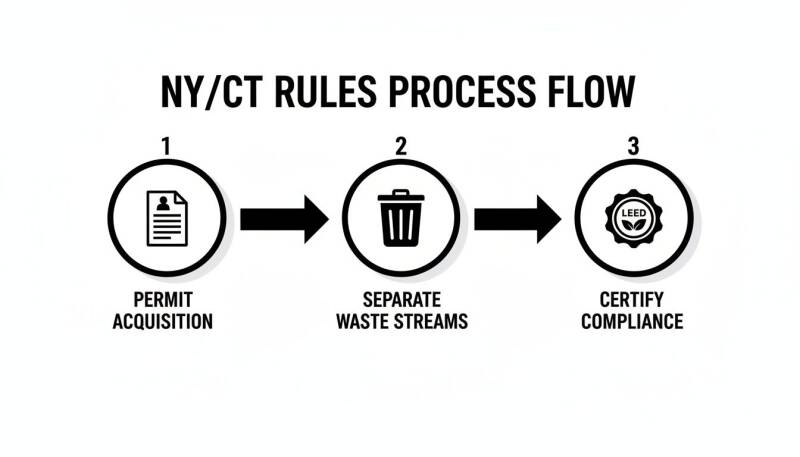
As you can see, compliance starts long before the first wall comes down and continues right through to project certification. That middle step—separating the waste streams—is where the hands-on work really happens.
Training Your Crew for Maximum Buy-In
You can have the best-designed sorting station in the world, but it's completely worthless if your team doesn't use it or uses it wrong. Team training and communication are, without a doubt, the most critical part of implementing your plan. You need everyone on the same page, from your direct employees to the last subcontractor who steps on site.
I always kick things off with a brief but mandatory pre-construction meeting. Walk everyone through the sorting station, explain the "why" behind the plan—cost savings, local rules, a cleaner site—and clearly state the expectations.
The real key to getting crew buy-in isn't threatening fines. It's showing them how a clean, organized site makes their own job easier and safer. When they see the direct benefits for themselves, they're far more likely to get on board.
Appoint a "Waste Champion" on site. This doesn't need to be some formal title, but designate one person—usually a site foreman or a motivated crew member—to be the go-to expert. Their job is to gently correct mistakes, answer questions, and keep an eye on the bins to prevent contamination. Having this single point of ownership creates accountability and ensures the plan doesn't just fall by the wayside a week into the project.
Tracking and Reporting for Success
You can't manage what you don't measure. Tracking your waste is absolutely essential for verifying your recycling rates, calculating cost savings, and creating the documentation you’ll need for local authorities or green building certifications like LEED. It's how you prove your plan is actually working.
Create a simple tracking log and keep it on-site. It doesn't need to be fancy. A clipboard with a basic spreadsheet will do the job perfectly.
Simple Waste Tracking Log Template
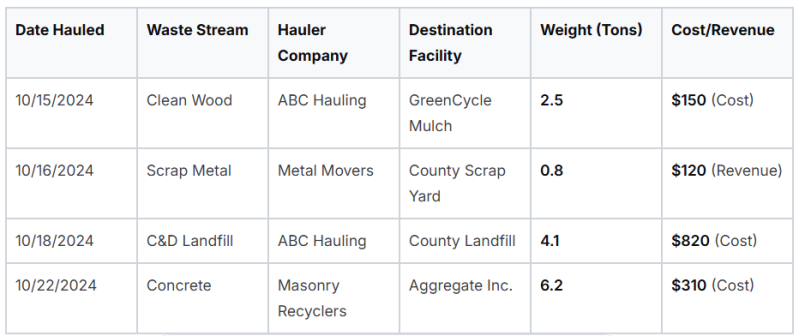
This log gives you a clear, running record of every single load that leaves your site. When the project wraps up, you can tally up the columns to see exactly how much you diverted from the landfill and, just as importantly, how much money you saved—or even earned. These hard numbers are powerful proof of your plan's value. From our experience providing comprehensive junk removal services, we know that detailed tracking is the only way to truly get a handle on project costs and efficiency.
For service providers like us in Fairfield County, CT, and the surrounding NY counties, a robust plan means tackling site-waste inefficiency head-on. The potential is massive; the global C&D market is projected to jump from USD 36.73 billion in 2025 to $52.52 billion by 2030, driven by new technologies that boost recovery rates. In our region, high tipping fees—which can climb 7% annually in states like NY—make waste diversion a financial necessity, not just a green initiative. You can discover more about these market dynamics and what they mean for the industry on Fortune Business Insights.
Got Questions? Let's Talk Real-World Waste Management
Even with the best blueprint, you're bound to have questions when you start putting your first construction waste management plan into practice. I hear them all the time from builders and property owners across New York and Connecticut. Here are some straight-up answers to the most common ones I get, based on years of experience on job sites just like yours.
How Much Time Does This Really Take?
This is always the first question. The honest answer? It takes less time than you'd think, and it's certainly less time than dealing with a stop-work order.
For a small residential job, you might spend a couple of hours on your initial site walk-through and plan. A bigger commercial project might take a solid day of focused effort. But think of it as an investment. That upfront time pays huge dividends later by preventing costly headaches. Once the plan is set and the bins are in place, the day-to-day execution is minimal—just a few minutes here and there to keep things sorted. The real time-saver is avoiding rejected loads, frantic calls to find a last-minute hauler, or failing an inspection.
Is It Really Worth the Hassle for a Small Job?
Yes, 100%. Don't let the "small project" label fool you. A bathroom gut, a deck replacement, or even a garage cleanout generates a surprising mix of debris—old fixtures, drywall, tile, wood, and a mountain of cardboard from all the new stuff.
A simple kitchen renovation can easily generate 1-2 tons of waste. Without a plan, that's a lot of money you're literally throwing in a landfill.
For a homeowner, pulling out scrap metal or donating old cabinets puts cash right back into your pocket. For a contractor, showing up with a clear, professional plan for debris sets you apart from the competition. It's a small detail that helps you win the next, bigger job.
What's the Single Biggest Mistake People Make?
Hands down, the most frequent and expensive error is commingling waste. It’s what happens when someone tosses the wrong material into the wrong bin, usually because of poor signage or a lack of communication.
Imagine this scenario: you've got a dumpster designated for "clean concrete," but someone throws in a bunch of drywall and pressure-treated wood scraps. That entire load is now considered contaminated. The recycling facility will reject it, forcing you to pay to have it hauled again to a landfill, where you'll get hit with much higher disposal fees. It’s an easy mistake to avoid. Your best defense is a simple one: clear, color-coded bins and a quick toolbox talk with the crew before work starts.
When Should I Get a Professional Hauler Involved?
Get your waste hauler on the phone early—long before the first dumpster is even on-site. Don't wait until it's overflowing. A good hauling partner is more than just a truck and a driver; they're a critical part of your planning team.
A knowledgeable hauler can:
- Help you choose the right size and number of dumpsters based on your project scope.
- Advise on what local facilities actually accept, so you're not sorting materials that have nowhere to go.
- Provide all the necessary paperwork, like weight tickets and diversion reports, that you'll need to prove compliance.
Bringing them in from the start makes the logistics seamless and ensures your plan is realistic from day one.
Tackling construction debris can seem like a major challenge, but it doesn't have to be. For projects of any scale in New York and Connecticut, D&B Complete Home Services INC. offers dependable construction debris hauling and on-site support to make your waste plan work. Let us manage the mess so you can focus on building. Visit us online to see how we can help keep your site clean and compliant.
Add comment
Comments