Discover how to dispose of a flat screen TV legally and safely in NY and CT. This guide covers local recycling, donation, and professional removal options.
That old flat-screen gathering dust in the corner is more than just an eyesore—it’s a piece of hazardous waste. In states like New York and Connecticut, simply dragging it to the curb with your regular garbage isn't just bad for the environment; it's also against the law and could get you fined.
Properly disposing of a TV means using an approved method, whether it’s an e-waste recycling program, a retail take-back option, or a professional junk removal service equipped to handle the materials inside.
Why You Cannot Just Throw Away Your Old TV
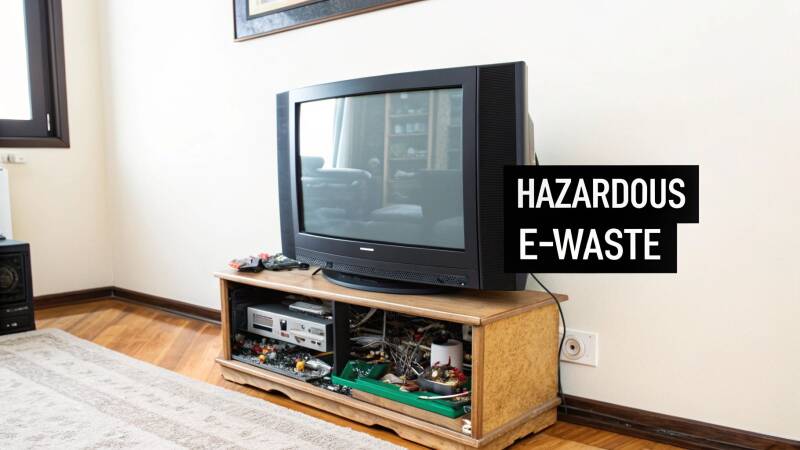
It’s easy to see an old TV as just another bulky item to get rid of. The reality is that flat-screens are considered "e-waste," a special category of trash with strict disposal rules for very good reasons. They’re a world away from your everyday household garbage because of the complex and often toxic components packed inside.
When a TV ends up in a landfill, those materials don't just sit there. Over time, they start to break down and leach into the earth. This toxic soup can contaminate the soil and seep into groundwater, creating a serious risk to local ecosystems and, ultimately, the water we drink.
The Hidden Dangers Inside Your Television
So, what exactly makes a modern TV so hazardous? It’s the cocktail of materials required for that crystal-clear picture. While your TV seems perfectly safe sitting in your living room, its guts contain several substances that are dangerous if handled improperly.
- Lead: This potent neurotoxin is used in the solder that holds the circuit boards together. Even tiny amounts can cause serious health issues if they get into the environment.
- Mercury: Many older LCDs rely on backlights made from cold cathode fluorescent lamps (CCFLs), which contain mercury. It's a highly toxic substance that can lead to severe neurological damage.
- Cadmium: You might find this heavy metal in the phosphors of older screens or in rechargeable batteries. Cadmium is a known carcinogen that builds up in the food chain.
- Flame Retardants: The plastic casing of your TV is treated with brominated flame retardants (BFRs) for safety. But when they're discarded, these chemicals become persistent environmental pollutants.
Disposing of your flat-screen TV the right way isn't just about following the law; it's a critical step in preventing these harmful substances from damaging our local environment in New York and Connecticut.
E-Waste Is a Growing Global Problem
The challenge of what to do with an old TV is a small piece of a much larger puzzle. The global e-waste crisis is spinning out of control. In 2022 alone, the world generated a mind-boggling 62 million tonnes of electronic waste—that’s an 82% jump from 2010.
This mountain of discarded electronics is growing faster than our ability to manage it. You can dig deeper into these e-waste trends and their global impact over at earth.org.
This massive problem has triggered strict local action. States like New York, with its Electronic Equipment Recycling and Reuse Act, have put laws on the books that completely ban e-waste from landfills. These regulations make it clear that the responsibility for safe disposal lies with all of us—consumers, manufacturers, and retailers. Knowing what's inside your TV is the first step toward getting rid of it safely and legally.
Getting Your TV Ready for a Safe Send-Off
Before you haul that old flat-screen TV out the door, there are a couple of crucial things you need to do. This isn't just busywork—it's about protecting your private information and making sure nobody gets hurt in the process. A few minutes of prep now can save you a world of trouble later on.
Think about it: if you have a smart TV, it’s probably holding onto your Wi-Fi password, logins for Netflix and Hulu, and maybe even your browsing history. Just handing it over is a huge privacy gamble. You wouldn't give away a laptop without wiping the hard drive, and the same rule absolutely applies here.
First Things First: Wipe Your Personal Data
For any smart TV, the most important step is a factory reset. This is the electronic equivalent of a fresh start, wiping the slate clean and returning the TV to its original "out-of-the-box" state. All your accounts, passwords, and personal data get erased for good.
The exact steps change a bit from one brand to another, but you're usually looking for something in the settings menu.
- Samsung: Navigate to Settings > General > Reset. You’ll probably be asked for a PIN, which is often 0000 by default.
- LG: Find Settings > All Settings > General > Reset to Initial Settings.
- Sony (Android/Google TV): Go to Settings > System > About > Reset > Factory data reset.
If you're stuck, a quick online search for "[Your TV Brand] factory reset" will pull up specific instructions. It’s a fast process that ensures the next person to plug it in can't peek into your digital life.
A factory reset isn't just a suggestion; it's a must-do for any smart TV. It's the only way to be certain your app logins, Wi-Fi details, and other sensitive data are gone for good.
Disconnect and Prep for the Move
Once the data is gone, it's time to get the TV physically ready for transport. Let's be honest, wrestling with a big, awkward flat screen is a great way to hurt your back or put a new scuff on the hallway wall.
Start by unplugging the TV from the wall and disconnecting everything else—your cable box, PlayStation, soundbar, you name it. Round up all the cords, especially the main power cord, and bundle them neatly with a zip tie or even a rubber band. I usually tape the bundle to the back of the TV so nothing gets lost or becomes a tripping hazard.
It’s also a nice touch to give the screen and frame a quick wipe-down with a dry cloth. If you're donating the TV, it’s just common courtesy. If it’s being recycled, it makes the handlers' job a little cleaner. For more tips like this, check out our other resources on how to get other items ready for a smooth pickup.
How to Handle a Flat Screen Without Breaking It (or Yourself)
Modern TVs are lighter than their old tube-style ancestors, but they are incredibly fragile. The screens are especially vulnerable and their shape makes them a pain to carry solo. It's a bigger risk than you might think—an estimated 15,600 consumers are injured by TV tip-overs each year, which shows just how important careful handling is.
- Get a Helper: Seriously, don't be a hero. For any TV bigger than 32 inches, grab a friend. Lift from both sides, holding the sturdy outer frame and keeping your hands off the screen itself.
- Clear a Path: Before you even lift it, make sure the walkway to your door or car is completely free of shoes, toys, or anything else you could trip on.
- Protect the Screen: The original box is your best friend here. If you tossed it years ago, wrap the TV in a thick moving blanket or even bubble wrap to shield that delicate screen from bumps on the way out.
Taking these simple steps ensures you’re not just getting rid of your flat screen legally, but also safely for you and everyone else involved.
Your Local TV Disposal Options in NY and CT
Alright, so you’ve wiped your data and wrapped up the cords. Now for the big question: where does the TV actually go? If you’re in New York or Connecticut, you've got some solid, legal options. The best path for you really boils down to three things: the TV's condition, how much time and effort you want to spend, and whether you're willing to pay a small fee.
Some routes are completely free but mean you're doing the legwork. Others offer a "hand-it-over-and-forget-it" convenience, but that comes with a price tag. Let's walk through the choices you have right here in our area.
First, let's just double-check the prep work. Is it a smart TV that needs a data wipe? Or a simpler model that just needs to be unplugged? This little flowchart is a great visual reminder of those initial steps.
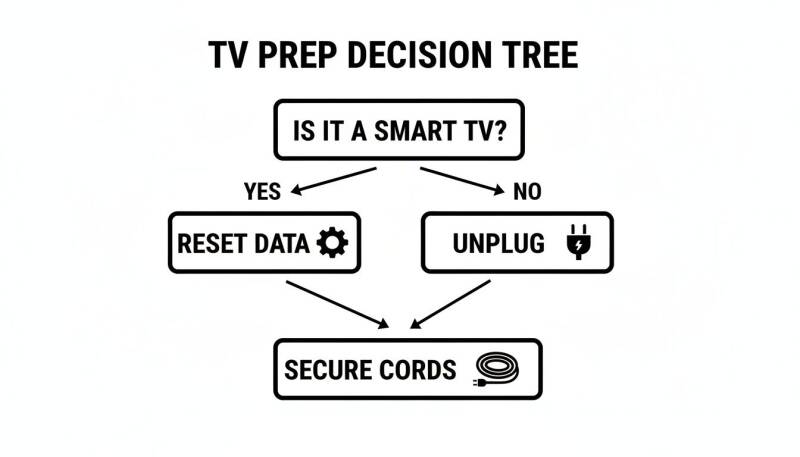
As you can see, for any smart TV, that factory reset is step one. After that, it's all about unplugging and bundling those cords so it's safe to move, no matter which disposal method you choose.
To help you decide, here’s a quick breakdown of your main options.
TV Disposal Options at a Glance
Use this quick comparison to decide on the best disposal method based on convenience, cost, and the effort required.
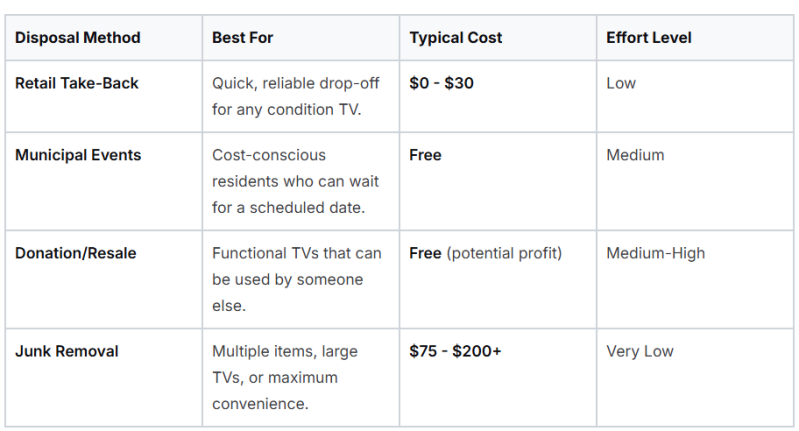
Each path has its place, so let's dig into the details to see which one makes the most sense for your situation.
Check Manufacturer and Retail Take-Back Programs
Honestly, one of the easiest ways to get rid of an old TV is through a take-back program. Thanks to e-waste laws in both New York and Connecticut, the companies that made and sold the TV are required to help you recycle it.
Start by checking the website of the manufacturer—think Sony, Samsung, or LG. They usually have a recycling section where you can type in your zip code and find a certified drop-off center nearby. It's often free and straightforward.
Even better, a lot of big-box stores have their own programs. Best Buy is probably the most well-known. They have a great recycling service at all their stores.
- How it Works: You can bring in up to three electronics per household each day. They do charge a fee for TVs, which is usually around $29.99, but they'll take almost any kind, from old tube TVs to modern flat screens.
- Real-World Example: Let's say your 50-inch TV in your Westchester County home just died. You could load it in your car, drive it over to the Best Buy in Yonkers or Hartsdale, and for about thirty bucks, they'll handle the rest. You can walk away knowing it’s being recycled correctly.
The big win here is predictability. Retailers like Best Buy have this down to a science. I always recommend calling ahead, though, just to double-check their current fees and make sure there aren't any surprise size restrictions.
Find Municipal E-Waste Collection Events
If "free" is your favorite price, then keep an eye on your town's schedule. Municipalities all over NY and CT hold e-waste collection days specifically for residents to get rid of things like TVs, computers, and printers.
These events are really common in counties like Fairfield in CT and Dutchess, Putnam, and Westchester in NY. They'll typically set up at a central spot—like the town hall, a local park, or the highway department—on a specific Saturday.
You just drive up, and the event staff will help you unload your car. It’s a fantastic way to offload a bunch of old electronics at once without opening your wallet. The only catch is you're on their schedule, which might not be when you need the TV gone.
Drop It Off at a Local Recycling Center
Missed the town collection day? No problem. Your local transfer station or county recycling center is your next best bet. Most facilities in our area have a special section just for e-waste. For example, the transfer stations in Orange County, NY, have very clear instructions for residents dropping off electronics.
Before you load up the car, it's absolutely crucial to check the rules for your specific facility. Some might be free for residents, while others may charge a small fee based on the TV's size. A quick search on your county's solid waste authority website or a five-minute phone call will tell you everything you need to know.
It's amazing what's inside these devices. People don't realize that old electronics are packed with valuable materials. Believe it or not, one ton of old computers has more gold in it than 17 tons of raw gold ore. To see just how much valuable stuff we're throwing away, check out these insights on e-waste composition and recycling benefits.
Donate or Sell Your Working TV
If your flat-screen TV still works perfectly fine, recycling it should be the absolute last resort. Finding it a new home is so much better for the environment and can even help out someone in your community.
- Donation: Places like Goodwill or The Salvation Army are often happy to take working TVs. You may even get a tax-deductible receipt. Just be sure to call your local store first to make sure they're currently accepting them, as policies can change.
- Selling: This is my personal favorite if you've got the time. On sites like Facebook Marketplace or Craigslist, a decent used TV can easily fetch $50 to $200, maybe more. That's money you can put toward your new setup.
If you're selling, just be upfront about the TV's condition, post good pictures (with the screen on!), and set up a safe pickup. And remember, that factory reset is a must to protect your personal information. It takes a little more effort to post a listing and chat with buyers, but it's often worth it.
Navigating NY and CT E-Waste Regulations
Figuring out how to get rid of an old flat-screen TV is one thing, but knowing the specific laws in our area is what keeps you out of trouble and avoids potential fines. Both New York and Connecticut have some pretty serious e-waste legislation on the books, and it’s all designed to keep the hazardous stuff inside your TV out of our landfills. These rules aren't just suggestions—they're legal requirements for all of us.
At the center of all this is a term you'll hear a lot: "covered electronic equipment," or CEE. This is the legal jargon for electronics that fall under special disposal laws. Your flat-screen TV is definitely on that list, right alongside computers, monitors, and printers. That means you're legally required to recycle it through an approved channel, not just toss it in the bin.
New York’s Electronic Equipment Recycling and Reuse Act
In New York, the law is crystal clear: it is illegal for you to throw out covered electronics—including your TV—with the regular trash. The NYS Electronic Equipment Recycling and Reuse Act basically puts the responsibility on the manufacturers to provide free and convenient recycling programs for the products they sell. This is a huge win for residents.
What this boils down to for you is that you should never have to pay a fee to recycle your TV if you're using a manufacturer-sponsored program. This is often called a "producer responsibility" model, and it puts the financial burden right where it belongs: on the companies that made the products.
- No Curbside Trash: You absolutely cannot leave your TV on the curb for garbage collection.
- Manufacturer Take-Back: Companies like Sony, LG, and Samsung are required to offer take-back programs at no cost to you.
- Retailer Responsibility: Any store selling these products also has to give you information on how to recycle them.
The big takeaway here? New York law guarantees you access to free and convenient recycling. The state has made it the manufacturer's job to provide a responsible way to dispose of their old products.
Connecticut's E-Waste Law
Connecticut works under a very similar system. The state's e-waste law also bans TVs and other electronics from the trash and makes the manufacturers foot the bill for recycling. This is all about making sure the toxic components inside your flat screen are managed properly instead of leaching into local soil and water.
Most residents can bring old TVs to a municipal transfer station or a special collection event, usually for free. Since the programs are funded by the electronics manufacturers, it’s an accessible service for everyone. The trick is just finding the right drop-off spot in your town.
County-Specific Guidance for Our Area
While state laws set the big-picture rules, the actual "how-to" often comes down to your specific county. Here’s a quick breakdown of what to expect and where to look for info in the communities we serve.
Dutchess, Putnam, and Orange Counties (NY)
These counties have some great resources for residents. Your first stop should always be the website for your county's department of solid waste or recycling.
- Dutchess County: Check the Division of Solid Waste Management website for a list of county-run transfer stations. They typically accept TVs from residents at no charge during their normal hours.
- Putnam County: Keep an eye out for scheduled e-waste collection events. They usually hold them a few times a year, and it’s a perfect opportunity to clear out all your old electronics at once.
- Orange County: The county's Environmental Facilities & Services department has a clear guide on what’s accepted at their transfer stations. Just be sure to bring proof of residency—they almost always ask for it.
Westchester County (NY) and Fairfield County (CT)
As you'd expect, these more populated areas have very well-organized programs.
- Westchester County: The county's Department of Environmental Facilities runs a Household Material Recovery Facility (H-MRF) in Valhalla. You'll need to make an appointment online to drop off your TV and other e-waste.
- Fairfield County, CT: Here, things are generally managed at the town level. The best place for information is your own town’s public works department website. You'll find your local transfer station's policies, hours, and any rules for dropping off a TV.
Before you load up the car, always call or check the website for your specific town or county facility. Hours change, and some places have rules about the size or number of items you can bring. A quick search for "Dutchess County e-waste recycling" or "Fairfield County TV disposal" will pull up the most current info and make sure your trip is a success.
When to Hire a Professional Junk Removal Service
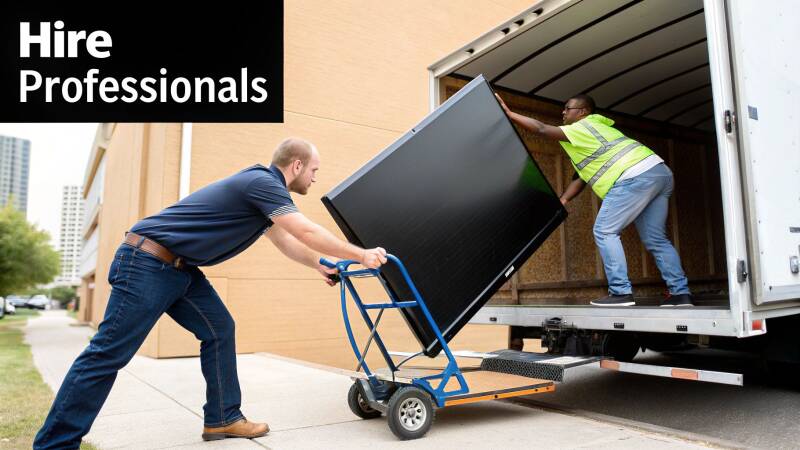
While drop-off events and retail take-back programs are fantastic options, they aren't always practical. Let’s be honest, trying to wrestle a 65-inch TV into the back of a small SUV is more than just a hassle—it's a recipe for a scratched bumper, a pulled muscle, or a cracked screen.
This is where calling in a professional junk removal service becomes the smartest and safest move. Think of it as the ultimate convenience. Instead of you puzzling over the logistics, a team shows up, does all the heavy lifting, and guarantees your old TV is recycled according to every last NY and CT regulation. It's the "set it and forget it" solution to e-waste.
Signs You Should Call a Pro
The decision to DIY or hire out really boils down to a few key factors. If you find yourself nodding along to any of these scenarios, a professional service is probably your best bet.
- Your TV is too big or heavy. Modern flat screens are deceptively awkward. If you can't safely lift and carry the TV with a partner, don't risk it. The pros come with the right gear—dollies, straps, and experience—to move it without damaging your walls, your back, or themselves.
- You don't have the right vehicle. A big TV just won't fit in a sedan. If you don't have a truck or a large SUV at your disposal, getting it to a recycling center becomes a complicated and time-consuming headache.
- You have more than just a TV. Often, that old television is just the tip of the iceberg. If you’re also staring at an old computer monitor, a busted printer, and a box of miscellaneous electronics, a junk removal service can take it all in one trip. Companies like D&B Complete Home Services INC. handle a wide range of junk removal and cleanout projects, making it a one-call solution.
- Your time is too valuable. Between work, family, and everything else, spending your Saturday driving to the county transfer station might not be how you want to spend your free time. The sheer convenience of scheduling a quick pickup is often well worth the cost.
The real value of a professional service isn't just getting rid of an old TV. It's about buying back your weekend, ensuring your safety, and getting peace of mind that the job was done right—and legally.
Checklist: Is a Junk Removal Service Right for You?
Still on the fence? Run through this quick checklist. If you answer "yes" to two or more of these questions, it's probably time to pick up the phone.
- Is the TV larger than 50 inches?
- Do you live alone or lack a second person to help you lift?
- Do you need to haul the TV up or down a flight of stairs?
- Do you lack a truck, van, or large SUV for transport?
- Do you have other e-waste or junk items that need to go at the same time?
- Is your schedule too packed to coordinate a drop-off during specific facility hours?
What to Say When You Call for a Quote
Making the call is simple and only takes a few minutes. You don't need a complicated script—just have the key details ready so the company can give you an accurate price estimate.
Here’s a simple, no-fuss example of what to say:
"Hi, I'm calling to get a quote for TV disposal. I have a 60-inch flat-screen TV that needs to be removed from my home in Poughkeepsie. It's on the main floor and easy to get to. Can you give me an idea of the cost and your availability?"
Just be sure to mention the TV's size, your town, and where it is in your home (e.g., basement, second floor). This helps the company provide a clear and accurate quote, ensuring there are no surprises on pickup day.
Got Questions About TV Disposal? We've Got Answers
Even with the best plan, a few questions always seem to pop up right when you're ready to get that old TV out the door. Let's clear up some of the most common ones I hear from homeowners so you can handle this last step with confidence.
Can I Just Leave My Old TV on the Curb?
I get this one all the time, and the answer is a hard no. In our neck of the woods—New York and Connecticut—leaving a TV on the curb for the trash collectors is illegal. It’s considered fly-dumping, and you could get hit with a fine from your town.
But more than that, it's a huge environmental problem. When a TV gets crunched in a garbage truck, all the nasty stuff inside like lead and mercury can leak out. You absolutely have to use an approved channel, whether that's a town recycling event, a store take-back program, or a professional junk hauler.
How Much Does It Really Cost to Get Rid of a TV?
The price can swing from zero to over a hundred bucks. It all comes down to how much of the work you want to do yourself.
- Totally Free: Your town's e-waste drop-off days or some manufacturer mail-in programs won't cost you a dime. The catch? You have to wrestle the TV into your car and get it there yourself.
- A Small Fee: Retailers like Best Buy have a great program, but they usually charge a small recycling fee, typically around $30. It's a solid, low-cost choice if you can transport the TV.
- The "Done-For-You" Price: Bringing in a junk removal service is the easiest path. For a single TV pickup, you're likely looking at a range of $75 to $150. That fee covers the labor, the truck, and the guarantee that your TV is being recycled legally and ethically.
A quick tip: When you're weighing the cost, don't forget to factor in your own time and the hassle—or even risk—of moving a big, awkward TV. Sometimes paying a pro is just the smarter, safer move.
What if My Flat-Screen TV Is Broken?
A cracked or busted TV changes the game. Donation and resale are off the table, so your only real option is recycling. And you need to be careful—a broken screen has sharp edges and can expose the hazardous materials inside.
Your first call should be to your local county transfer station or recycling center, as most are equipped to handle broken electronics. Honestly, though, for a broken unit, calling a junk removal company is your safest bet. We have the proper gear to move it without anyone getting hurt or making a bigger mess, and we'll make sure it goes to the right facility. If you're stuck and not sure what to do, you can always contact a local expert to get some advice for your situation.
When you want the safest, most straightforward way to dispose of your flat-screen TV, D&B Complete Home Services INC. has you covered. Our team takes care of the heavy lifting and guarantees your e-waste is recycled in full compliance with all New York and Connecticut laws. Visit us at https://www.dbcompletehomeservices.com to schedule your pickup.
Add comment
Comments